

Add, Subtract, Divide, Multiply: MHSAA Not Alone
July 25, 2017
By Rob Kaminski
MHSAA benchmarks editor
This is the third part in a series on MHSAA tournament classification, past and present, that will be published over the next two weeks. This series originally ran in this spring's edition of MHSAA benchmarks.
As the MHSAA faces its most recent classification task with 8-Player Football, and opinions continue to swirl about as to the method, timeframe, location and other procedures, a look around the country provides plenty of company among state association brethren factoring variables into their own equations.
In the Pacific Northwest, the Oregon School Activities Association Football Playoffs are under public scrutiny as leadership ponders a five or six classification format beginning with the 2018-19 school year.
The OSAA has crowned six champions on the gridiron since 2006-07. Many of the state’s smaller schools would like to keep it that way, while larger schools lean toward a five-classification system, citing larger leagues, ease of travel and credibility to state championships as the advantages.
Still others would prefer more than six classes, pointing to safety issues and the opportunity to increase participation numbers as positives.
Moving southeast of Oregon, the Nevada Interscholastic Activities Association recently voted to hold serve on a classification proposal that was volleyed to the membership.
However, changes still could be forthcoming by as early as the 2018-19 season which would add a fifth classification in more populated southern Nevada while allowing northern schools to participate in four classifications. Such divisions could mean no state championship for the fifth class in southern Nevada.
Because of that, the NIAA wants equal numbers of schools in each classification on both ends of the state. Complicating the issue is the fact that the 24 largest schools in the state, by enrollment, are all in Clark County in Southern Nevada.
Across Nevada’s border into Arizona, charter schools are asking the Arizona Interscholastic Association to reconsider classification that was voted upon and approved in September 2015. That agreement called for the largest 33 percent of charter schools by enrollment to be placed in the state’s largest school classification, 3A, the middle 33 percent into 2A, and the smallest 33 percent into 1A.
Less than two years later the charter schools have had a change of heart and have asked to be considered the same as other Arizona public schools and be placed appropriately by enrollment beginning with the 2018-19 school year.
The situation in Arizona further illustrates how the public/private debate that all state associations have faced throughout existence now has the added dynamic of rapidly growing charter schools in today’s educational system, along with virtual school enrollment.
In the nation’s heartland, Nebraska has retooled its football classifications by using enrollment of boys students only in its schools rather than total enrollment. The Nebraska School Activities Association football-playing schools will kick off the 2018 season using this alignment.
Nebraska has three classes of 11-player football, with the smallest class divided in two, Class C-1 and C-2. The state also will have 8-player football for boys enrollments under 47, and the NSAA will sponsor a new 6-player tournament in 2018 for schools with 27 or fewer boys.
“This is a good proposal because some schools have a sizable imbalance between the number of boys and girls, and there’s a large gap (in enrollment) between the largest and smallest schools in Classes A and B,” NSAA executive director Jim Tenopir said. “I think this addresses both of those concerns.”
Swimmers in Georgia, meanwhile, will feel like they are moving with the current, rather than upstream in 2017-18, as the Georgia High School Association recently doubled the number of team championship events from two to four.
Swim enthusiasts can also count on longer days at the finals, as the top 30 finishers from the prelims will advance to the finals instead of 20, and all championship events will have three heats versus two.
Leland's Glass Childress Inducted into National High School Hall of Fame
By
Geoff Kimmerly
MHSAA.com senior editor
August 3, 2026
Alisha Glass Childress’ excellence on the volleyball court led to national championships at the college level, an Olympic medal and both playing and currently a coaching career in the professional ranks.
But even after achieving all of that greatness over the last two decades following her career at Leland High School, her experiences starring for the Comets in multiple sports continue to carry significant weight.
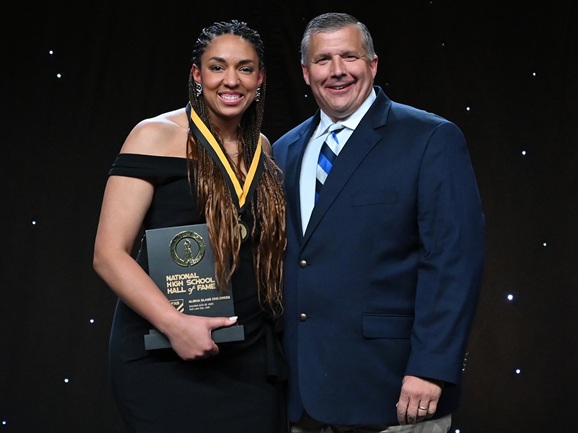
On June 29 in Salt Lake City, Childress became Michigan’s 11th inductee into the National High School Hall of Fame by the National Federation of State High School Associations (NFHS). The video above was shown as an introduction before Childress was awarded her Hall of Fame plaque and medal during the induction ceremony.
 She graduated from Leland in 2006 with national high school career records of 3,584 kills, 680 blocks and 937 aces, and 296 aces for one season as a junior. Her aces records still stand, her career kills record stood until broken in 2024 by Shelby’s Navea Gauthier, and she remains third on the career blocks list. Glass continues to hold MHSAA records for single-season and career aces and also for her 48 kills in Leland’s 2005-06 Class D Final win over Battle Creek St. Philip. Childress also led Leland to a Class D runner-up finish in 2004-05 and the Semifinals in 2003-04. (All three tournament runs took place while girls volleyball was still played during the winter season before moving to the fall to begin the 2007-08 school year).
Childress earned the Miss Volleyball Award and Gatorade Player of the Year Award for Michigan as a senior, and her name is listed 19 times throughout the MHSAA girls volleyball record book. She also made Michigan's Class D all-state first team on the basketball court as both a junior and senior, averaging 18 points and 11 rebounds per game as a junior and 16 points, 10 rebounds and 3.7 blocked shots per game as a senior while leading her basketball team to Class D Quarterfinals both of those seasons.
After high school, she started all four seasons at national power Penn State and set the Nittany Lions to three straight NCAA championships, being named to the American Volleyball Coaches Association (AVCA) All-America first team twice and second team once.
Childress continued her career professionally and internationally, playing professionally in the United States and Puerto Rico, Italy, Turkey, Poland and Brazil and being named USA Volleyball Indoor Female Athlete of the Year for both 2013 and 2014. She led the U.S. national team to bronze at 2016 Olympics and was named Best Setter of the tournament, after being selected as an alternate for the 2012 Olympic team.
Childress currently is serving as head coach of the San Diego Mojo of Major League Volleyball after previously playing for the Pro Volleyball Federation's Vegas Thrill in 2024 and 2025 and in that league's first All-Star Match.
She previously served as a coach with Athletes Unlimited, as an assistant coach with the Stanford University women’s volleyball program from 2019-21 – including during the team’s run to the Division I national title in 2019 – and as an assistant for the gold medal-winning U.S. national team during the 2018 Pan American Cup.
Previous Michigan inductees to the National High School Hall of Fame
2024: Tyrone Wheatley, Dearborn Heights Robichaud - Watch
2022: John E. "Jack" Roberts, MHSAA - Watch
2016: Ken Beardslee, Vermontville Maple Valley - Watch
2011: Brad Van Pelt, Owosso
2007: Jim Johnson, Bloomfield Hills Cranbrook
2005: Bob Wood, Grosse Pointe Woods University Liggett
2001: Richie Jordan, Fennville
2000: Diane Laffey, Warren Regina
1986: Lofton Greene, River Rouge
1983: Charles E. Forsythe, MHSAA
PHOTO Alisha Glass Childress stands for a photo with MHSAA Executive Director Mark Uyl during her NFHS Hall of Fame induction June 29. (Photo courtesy of the NFHS.)