

Add, Subtract, Divide, Multiply: MHSAA Not Alone
July 25, 2017
By Rob Kaminski
MHSAA benchmarks editor
This is the third part in a series on MHSAA tournament classification, past and present, that will be published over the next two weeks. This series originally ran in this spring's edition of MHSAA benchmarks.
As the MHSAA faces its most recent classification task with 8-Player Football, and opinions continue to swirl about as to the method, timeframe, location and other procedures, a look around the country provides plenty of company among state association brethren factoring variables into their own equations.
In the Pacific Northwest, the Oregon School Activities Association Football Playoffs are under public scrutiny as leadership ponders a five or six classification format beginning with the 2018-19 school year.
The OSAA has crowned six champions on the gridiron since 2006-07. Many of the state’s smaller schools would like to keep it that way, while larger schools lean toward a five-classification system, citing larger leagues, ease of travel and credibility to state championships as the advantages.
Still others would prefer more than six classes, pointing to safety issues and the opportunity to increase participation numbers as positives.
Moving southeast of Oregon, the Nevada Interscholastic Activities Association recently voted to hold serve on a classification proposal that was volleyed to the membership.
However, changes still could be forthcoming by as early as the 2018-19 season which would add a fifth classification in more populated southern Nevada while allowing northern schools to participate in four classifications. Such divisions could mean no state championship for the fifth class in southern Nevada.
Because of that, the NIAA wants equal numbers of schools in each classification on both ends of the state. Complicating the issue is the fact that the 24 largest schools in the state, by enrollment, are all in Clark County in Southern Nevada.
Across Nevada’s border into Arizona, charter schools are asking the Arizona Interscholastic Association to reconsider classification that was voted upon and approved in September 2015. That agreement called for the largest 33 percent of charter schools by enrollment to be placed in the state’s largest school classification, 3A, the middle 33 percent into 2A, and the smallest 33 percent into 1A.
Less than two years later the charter schools have had a change of heart and have asked to be considered the same as other Arizona public schools and be placed appropriately by enrollment beginning with the 2018-19 school year.
The situation in Arizona further illustrates how the public/private debate that all state associations have faced throughout existence now has the added dynamic of rapidly growing charter schools in today’s educational system, along with virtual school enrollment.
In the nation’s heartland, Nebraska has retooled its football classifications by using enrollment of boys students only in its schools rather than total enrollment. The Nebraska School Activities Association football-playing schools will kick off the 2018 season using this alignment.
Nebraska has three classes of 11-player football, with the smallest class divided in two, Class C-1 and C-2. The state also will have 8-player football for boys enrollments under 47, and the NSAA will sponsor a new 6-player tournament in 2018 for schools with 27 or fewer boys.
“This is a good proposal because some schools have a sizable imbalance between the number of boys and girls, and there’s a large gap (in enrollment) between the largest and smallest schools in Classes A and B,” NSAA executive director Jim Tenopir said. “I think this addresses both of those concerns.”
Swimmers in Georgia, meanwhile, will feel like they are moving with the current, rather than upstream in 2017-18, as the Georgia High School Association recently doubled the number of team championship events from two to four.
Swim enthusiasts can also count on longer days at the finals, as the top 30 finishers from the prelims will advance to the finals instead of 20, and all championship events will have three heats versus two.
Olivet Girls Continue Reign as Peters Closes Championship-Filled Career
By
Todd VanSickle
Special for MHSAA.com
May 30, 2026
KENT CITY – After winning its first Finals championship in girls track & field a year ago by just five points, Olivet extended its title reign with another close finish Saturday at Kent City.
The Eagles scored 82 points at the Lower Peninsula Division 3 championship meet to outpace Lansing Catholic (76), with Pewamo-Westphalia (61.5) third.
“I am an alumni of the school, so to come back and do this is, is awesome,” Olivet head coach Brian Lincoln said. “We knew going in that it is was going to be a battle with Lansing Catholic. Our girls stepped up, like they have all season and for the past four seasons.”
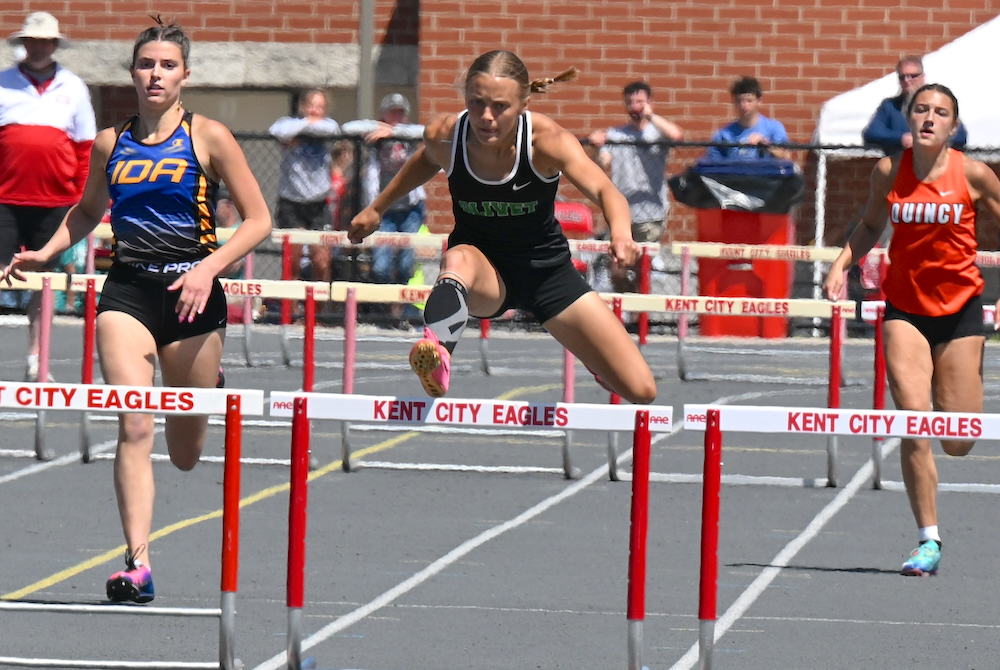
Olivet senior Emily Peters claimed her fourth 300-meter hurdles title in 44 seconds. She qualified for this meet in seven events.
“It is pretty crazy,” said Peters said, who plans to run track for Northwood University next season. “Going into my freshman year, I knew I was pretty fast, but I never expected to have this kind of success.
“This is a perfect ending. It is the culmination of all my hard work. I am so grateful for this.”
Peters also took second in the 100-meter hurdles with a personal best of 14.83 seconds as the Eagles had success in several events.
Celina Sinclair won the 200 meters with a personal best of 24.91 seconds after finishing second in the prelims. The Eagles’ 400 relay team of Bailey Powell, Lola Miars, Peters and Sinclair took first place (49.51) over Kingsley (49.53) and Traverse City St. Francis (49.77). Olivet’s 800 relay team (Peters, Sinclair, Miars and Kendall Eggerstedt) also found the top spot on the podium (1:44.67).
Pewamo-Westphalia won the 3,200 relay (9:40.94) with Julia Paxton, Katherine Schafer, Adelyn Thelen and Calista George. Lansing Catholic was second and Saugatuck finished third.
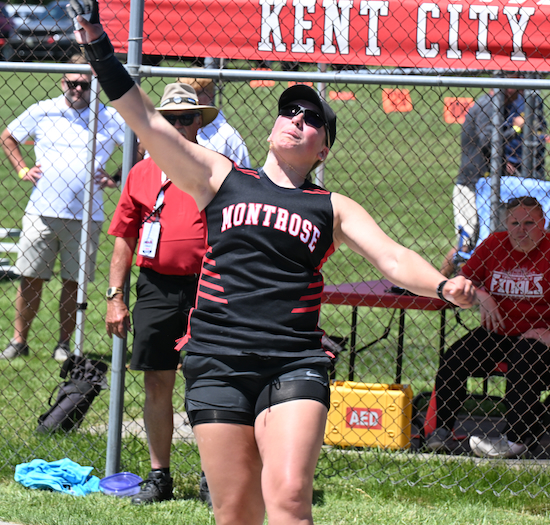 Montrose’s Addyson Stiverson won the shot put with an all-Finals record of 55 feet, 6½ inches. The previous record (50-9½) was set in 2021 by Bryon’s Sarah Marvin.
Second place went to Pewamo-Westphalia’s Jenna Spitzley with a toss of 38-1¾. “If you would have asked me a week ago, I didn’t think I would have been in the 38 range,” Spitzley said.
The Pirates senior also won the discus with a throw of 136-7. She credited her family for her success.
“I had my brother there,” Spitzley said. “He has been coaching me a lot and helping me.”
She will attend Hillsdale College in the fall and plans to throw the shot put, discus and the hammer at the collegiate level.
Olivia Beaudrie, of Monroe St. Mary Catholic Central, won the high jump with a leap of 5-4. Julia Sergeant, of Houghton Lake, took first place in the pole vault clearing 11 feet after finishing sixth in the event last spring.
“I am really happy with my progress this year,” Sergeant said.
Despite being the top seed, she was a little nervous coming into meet.
“There were a few girls I was a little intimidated by,” Sergeant said. “There were two girls I have never seen vault before, but I knew what I was capable of and I did it.”
Novella DeGraff, of Saugatuck, had a personal best of 10-9 in the pole vault to finish second. She also finished third in the long jump with a personal best of 17-2. Smantha Hopkins, of Harrison, was first with a leap of 17-4¾.
Both of DeGraff’s marks in the field events set school records. It was the second year DeGraff had competed at the Finals, although she missed last season’s meet due to a torn knee ligament. She also ran a personal best in the 100-meter hurdles for third place (14.83).
“Today has been pretty chaotic,” DeGraff said. “I planned to try my best, but I didn’t expect I would do as good as I am. My mentality was to have a good time.”
Lansing Catholic’s Grace Wonch (4:58.84) and Josie Bishop (4:58.89) took first and second, respectively, with personal bests in the 1,600 meters. Bishop won the 800 meters (2:16.07), while Wonch took the bronze. Wonch also claimed the 3,200 meters (10:53.12) and Tiya Feldpausch, of Olivet, was second. (10:58.84).
The reigning 100 hurdles champion Julia Hughes repeated with a run of 14.55 seconds. She took third in the 300 hurdles.
Erie Mason senior Giuliana Nastale repeated as the 100 champion in 12.11 seconds. Sinclair, of Olivet, was second. Ella Clause, of Clinton, ran a personal best (57.99) to claim the 400. Centreville's Diannah Schwartz finished first in the 100, 200, 400 and shot put adaptive events.
PHOTOS (Top) Olivet's Emily Peters, center, clears a hurdle on the way to a runner-up finish in the 100 hurdles race Saturday. (Middle) Montrose's Addyson Stiverson launches the shot; she set the all-Finals record in the event. (Click for more from Mary Wilson and John Willoughby/RunMichigan.com.)