


Add, Subtract, Divide, Multiply: MHSAA Not Alone
July 25, 2017
By Rob Kaminski
MHSAA benchmarks editor
This is the third part in a series on MHSAA tournament classification, past and present, that will be published over the next two weeks. This series originally ran in this spring's edition of MHSAA benchmarks.
As the MHSAA faces its most recent classification task with 8-Player Football, and opinions continue to swirl about as to the method, timeframe, location and other procedures, a look around the country provides plenty of company among state association brethren factoring variables into their own equations.
In the Pacific Northwest, the Oregon School Activities Association Football Playoffs are under public scrutiny as leadership ponders a five or six classification format beginning with the 2018-19 school year.
The OSAA has crowned six champions on the gridiron since 2006-07. Many of the state’s smaller schools would like to keep it that way, while larger schools lean toward a five-classification system, citing larger leagues, ease of travel and credibility to state championships as the advantages.
Still others would prefer more than six classes, pointing to safety issues and the opportunity to increase participation numbers as positives.
Moving southeast of Oregon, the Nevada Interscholastic Activities Association recently voted to hold serve on a classification proposal that was volleyed to the membership.
However, changes still could be forthcoming by as early as the 2018-19 season which would add a fifth classification in more populated southern Nevada while allowing northern schools to participate in four classifications. Such divisions could mean no state championship for the fifth class in southern Nevada.
Because of that, the NIAA wants equal numbers of schools in each classification on both ends of the state. Complicating the issue is the fact that the 24 largest schools in the state, by enrollment, are all in Clark County in Southern Nevada.
Across Nevada’s border into Arizona, charter schools are asking the Arizona Interscholastic Association to reconsider classification that was voted upon and approved in September 2015. That agreement called for the largest 33 percent of charter schools by enrollment to be placed in the state’s largest school classification, 3A, the middle 33 percent into 2A, and the smallest 33 percent into 1A.
Less than two years later the charter schools have had a change of heart and have asked to be considered the same as other Arizona public schools and be placed appropriately by enrollment beginning with the 2018-19 school year.
The situation in Arizona further illustrates how the public/private debate that all state associations have faced throughout existence now has the added dynamic of rapidly growing charter schools in today’s educational system, along with virtual school enrollment.
In the nation’s heartland, Nebraska has retooled its football classifications by using enrollment of boys students only in its schools rather than total enrollment. The Nebraska School Activities Association football-playing schools will kick off the 2018 season using this alignment.
Nebraska has three classes of 11-player football, with the smallest class divided in two, Class C-1 and C-2. The state also will have 8-player football for boys enrollments under 47, and the NSAA will sponsor a new 6-player tournament in 2018 for schools with 27 or fewer boys.
“This is a good proposal because some schools have a sizable imbalance between the number of boys and girls, and there’s a large gap (in enrollment) between the largest and smallest schools in Classes A and B,” NSAA executive director Jim Tenopir said. “I think this addresses both of those concerns.”
Swimmers in Georgia, meanwhile, will feel like they are moving with the current, rather than upstream in 2017-18, as the Georgia High School Association recently doubled the number of team championship events from two to four.
Swim enthusiasts can also count on longer days at the finals, as the top 30 finishers from the prelims will advance to the finals instead of 20, and all championship events will have three heats versus two.

Vicksburg's Wright, Corunna Right On in Claiming LPD2 Championships
By
Steve Vedder
Special for MHSAA.com
June 3, 2023
ADA – If Michael Wright was a baseball player, he probably would've been called out on strikes a year ago.
Instead, the Vicksburg senior can celebrate after winning the 200 at Saturday's Lower Peninsula Division 2 Track & Field Finals at Forest Hills Eastern.
The road to the championship in the 200, via a time of 21.72, was anything but a straight line for Wright. An aspiring baseball player, he was cut from the Vicksburg squad as a freshman. His football career, by Wright's own admission, was "on and off." And then a year ago in his first track meet, Wright suffered a leg injury that virtually ended his season. He did return to finish fifth in the 200 at Finals while helping the 400 relay team to a 16th place.
So there is nothing to realistically explain how Wright found himself in the position Saturday at sweltering Forest Hills Eastern to win a championship. Except for returning this season to break the school record in the 200 four times in two months. Well, that and willpower and simple desire.
 "I knew I could finish high, maybe in the top five. But this is better," said Wright, who credits drinking large quantities of milk for his resurgence. "I looked to football because I didn't think I could bounce back for track. But I overcame the bumps, the obstacles."
While Wright was jump-starting his track career, Corunna won the team title with 41 points. Mason and Forest Hills Eastern tied for second with 35. Whitehall was fourth with 33 points, and Frankenmuth fifth with 29 points.
Corunna coach Jeff Sawyer, who had never won a Finals title in 37 years coaching at Owosso and three more at Corunna, said the championship came after little fanfare during the season. Virtually right up until the time Corunna hauled off its first-place trophy, Sawyer said it was never really on his team's mind. The title came after the team managed only a runner-up finish at the Regional.
"We kind of low-keyed it," he said. "We knew scoring 40 points was possible. We lost to Frankenmuth by one point at the Regional. … We were a little disappointed we didn't win, but we had some good times today. We knew it was possible.
"Every day we just come and do what we do. We talk about getting better every day with PRs (personal records). And we're still getting better because we have some tough guys. Just competitive, tough kids. But we were the underdogs."
Corunna had only two firsts on Saturday, in the 400 relay (42.63) and Wyatt Bower in the long jump (22-8½).
Among the individual highlights was Frankenmuth senior Dalton DeBeau, who successfully defended his Finals title in the discus (171-6). He was fifth in that event as a sophomore and after winning a year ago, was considered a good bet to repeat.
"I kind of expected it," said DeBeau, who will compete at Michigan State next spring. "There wasn't a lot of pressure. I knew what had to be done. I threw 160 feet on my first throw to get in the finals, and that helped right away. I knew I could go all out."
 Berrien Springs' Jake Machiniak won the 100 (10.54) while the team also captured the 800 relay (1:28.18). Machiniak said his season hasn't been without its share of difficulties. There was a time when he couldn't seem to come out of the starting blocks smoothly. But beginning with the conference meet where he ran school record 10:73, Machiniak felt himself back on course.
"There were ups and downs. I struggled in the middle of the season," he said. "But my teammates helped me through some difficulties. I came here to finish the job; I knew I could do something here."
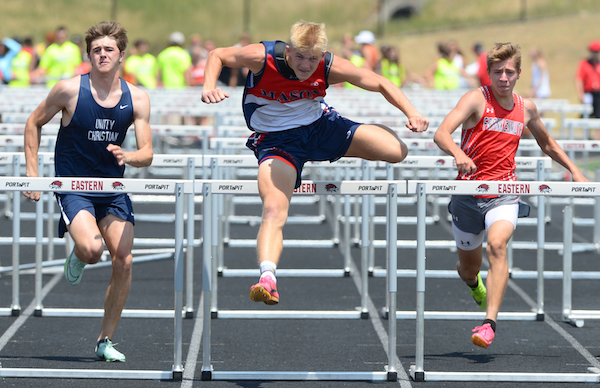
Mason's Tyler Baker won the 100 hurdles (14.63) to complete a long journey that included finishing just ninth in last year's prelims. The success was as simple as putting in loads of offseason work.
"I practiced and did stuff about every day," he said. "I might not be the fastest, but I make up for that in form. It's a fine-tuning thing. Everyone wants to be faster."
Mason also got a championship from A.J. Mantel, who captured the 300 hurdles (38.90).
Among other highlights was Forest Hills Eastern senior Aiden Sullivan successfully defending a 2022 title on his own home turf. He won Saturday's 800 (1:53.92).
Adrian won the 3,200 relay (7:39.77), while Grand Rapids Christian took the 1,600 (3:24.49).
Alma had two individual winners in Michael Howey in the shot (55-08) and Jacob Dunlap in the high jump (6-7).
The other champs were Kyle Eberhard of Linden in the 1,600 (4:14.79), Whitehall's Trannon Ayler in the 400 (48.83), Freeland's T.J. Hansen in the 3,200 (9:11.56) and Sam Vesperman of Grosse Ile in the pole vault (15.01). Chelsea senior Jacob Nelson competed in the adaptive 100 (27.28), 200 (57.71) and shot put (6-6).
PHOTOS (Top) Vicksburg's Michael Wright celebrates after winning the 200 on Saturday. (Middle) Corunna's Tarick Bower enjoys a moment after anchoring the winning 400 relay. (Below) Mason's Tyler Baker, center, works to stay ahead in the 110 hurdles. (Photos by Dave McCauley/RunMichigan.com.)