


Add, Subtract, Divide, Multiply: MHSAA Not Alone
July 25, 2017
By Rob Kaminski
MHSAA benchmarks editor
This is the third part in a series on MHSAA tournament classification, past and present, that will be published over the next two weeks. This series originally ran in this spring's edition of MHSAA benchmarks.
As the MHSAA faces its most recent classification task with 8-Player Football, and opinions continue to swirl about as to the method, timeframe, location and other procedures, a look around the country provides plenty of company among state association brethren factoring variables into their own equations.
In the Pacific Northwest, the Oregon School Activities Association Football Playoffs are under public scrutiny as leadership ponders a five or six classification format beginning with the 2018-19 school year.
The OSAA has crowned six champions on the gridiron since 2006-07. Many of the state’s smaller schools would like to keep it that way, while larger schools lean toward a five-classification system, citing larger leagues, ease of travel and credibility to state championships as the advantages.
Still others would prefer more than six classes, pointing to safety issues and the opportunity to increase participation numbers as positives.
Moving southeast of Oregon, the Nevada Interscholastic Activities Association recently voted to hold serve on a classification proposal that was volleyed to the membership.
However, changes still could be forthcoming by as early as the 2018-19 season which would add a fifth classification in more populated southern Nevada while allowing northern schools to participate in four classifications. Such divisions could mean no state championship for the fifth class in southern Nevada.
Because of that, the NIAA wants equal numbers of schools in each classification on both ends of the state. Complicating the issue is the fact that the 24 largest schools in the state, by enrollment, are all in Clark County in Southern Nevada.
Across Nevada’s border into Arizona, charter schools are asking the Arizona Interscholastic Association to reconsider classification that was voted upon and approved in September 2015. That agreement called for the largest 33 percent of charter schools by enrollment to be placed in the state’s largest school classification, 3A, the middle 33 percent into 2A, and the smallest 33 percent into 1A.
Less than two years later the charter schools have had a change of heart and have asked to be considered the same as other Arizona public schools and be placed appropriately by enrollment beginning with the 2018-19 school year.
The situation in Arizona further illustrates how the public/private debate that all state associations have faced throughout existence now has the added dynamic of rapidly growing charter schools in today’s educational system, along with virtual school enrollment.
In the nation’s heartland, Nebraska has retooled its football classifications by using enrollment of boys students only in its schools rather than total enrollment. The Nebraska School Activities Association football-playing schools will kick off the 2018 season using this alignment.
Nebraska has three classes of 11-player football, with the smallest class divided in two, Class C-1 and C-2. The state also will have 8-player football for boys enrollments under 47, and the NSAA will sponsor a new 6-player tournament in 2018 for schools with 27 or fewer boys.
“This is a good proposal because some schools have a sizable imbalance between the number of boys and girls, and there’s a large gap (in enrollment) between the largest and smallest schools in Classes A and B,” NSAA executive director Jim Tenopir said. “I think this addresses both of those concerns.”
Swimmers in Georgia, meanwhile, will feel like they are moving with the current, rather than upstream in 2017-18, as the Georgia High School Association recently doubled the number of team championship events from two to four.
Swim enthusiasts can also count on longer days at the finals, as the top 30 finishers from the prelims will advance to the finals instead of 20, and all championship events will have three heats versus two.
Grosse Ile's Molnar Wins Title in 2nd Sport, EGR Top Team for 2nd-Straight Year
By
Steve Vedder
Special for MHSAA.com
June 3, 2023
ADA – The only common denominator that Kaitlyn Molnar can think of between her two sports is that brief feeling of pure freedom as she soars through the air.
The big difference, of course, is that one comes in a swimming pool and the other while hurling herself along a long jump pit.
The Grosse Ile junior added a state long jump title to a state diving championship at Saturday's Lower Peninsula Division 2 Track & Field Finals at Forest Hills Eastern. The long jump win came after Molnar won a Division 3 diving title in the fall and followed a fifth-place finish in the long jump as a sophomore.
While the necessary talents for both sports may seem incompatible, Molnar sees one significant similarity.
"I just love that feeling of being in the air," she said after a jump of 18-feet, 5 inches. "You just take off and go as high as possible. It takes a lot of focus, but I love the long jump.
"It was kind of a surprise, but it was nice to pull it off. (Jumping and diving) are about foot placement and keeping your head up."
While Molnar's individual exploits were impressive, East Grand Rapids successfully defended its team title with 50 points, 16 better than runner-up Sturgis. Mason, New Boston Huron and Otsego tied for third with 26 points. Tecumseh was sixth with 24.
 EGR coach Mike Dykstra said the loss of four major point scorers from last season was overcome by depth and young talent stepping up to fill in gaps. But if you had asked the 19-year coach two months ago if the Pioneers had a realistic shot a back-to-back titles, he would have hedged.
"Maybe," he said. "We had some good competitors back and a lot of talented young kids trying to fill in spots. Today, I think the (90-plus degree) weather was helpful in a way because it made us focus on the weather as the enemy. It helped us focus on ourselves. It was kind of a blessing in a way."
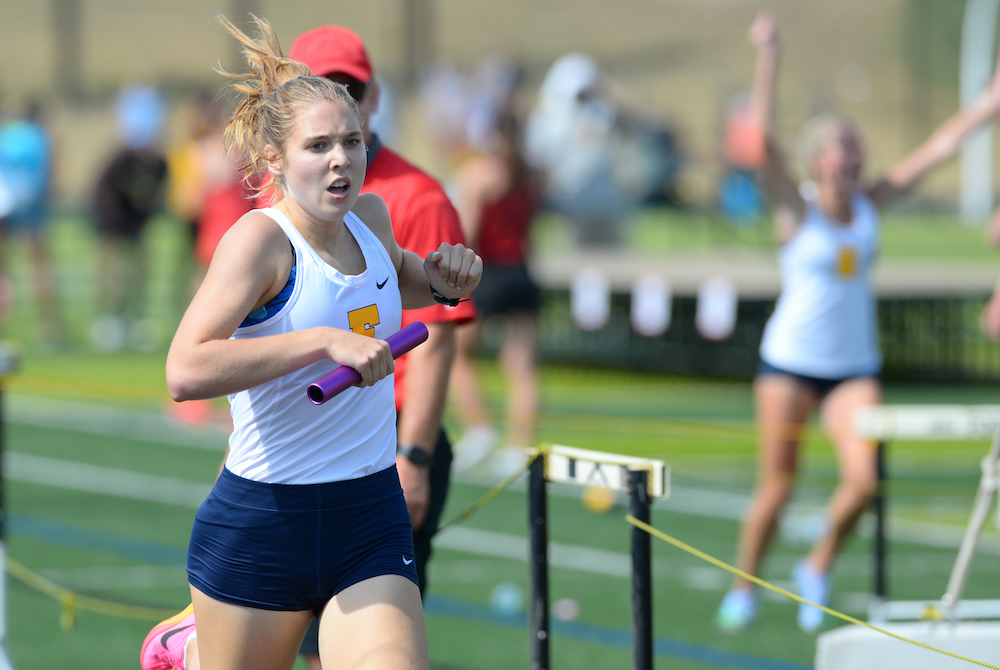
Among the Pioneers champions was the 3,200 relay team (9:28.17) and the 1,600 relay (3:58.18), while junior Drew Muller repeated in the 1,600 (4:56.01) and senior Camryn Bodine won the 800 (2:11.53).
"There definitely was more pressure this year," she said. "People look out for me just as I look for them. There was awesome competition both years, but I'm happy because I had better times this year. It took a lot of work behind the scenes."
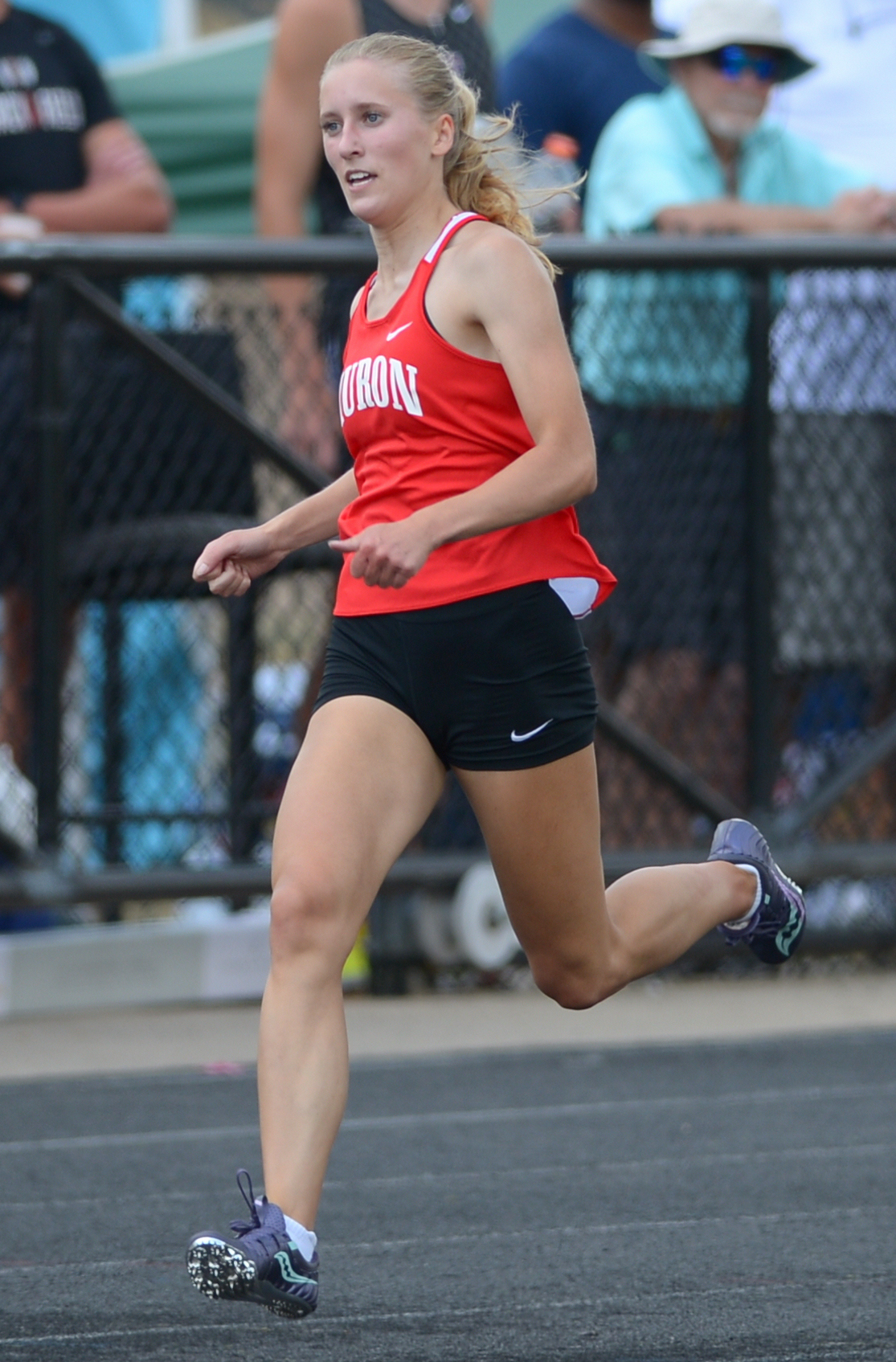
New Boston Huron senior Elizabeth Anderson had a big day that included winning the 400 (55.38). She also was second in both the 100 and 200 and part of the 1,600 relay team. Anderson followed last season's championships in the 200 and 400 and runner-up in the 100. But by at least one measurement, this season was an improvement, she said.
"It was better this year because my times were better," said Anderson, who will run track at Michigan State next season. "I just felt heathier and wanted to finish my season strong. I really wanted to win the 400 because it's my favorite event. That was my goal the whole year. I trained all year to do it."
Other LPD2 champs included Keyanna O'Tey of Sturgis, who won the 100 (11.84). O'Tey said winning the Regional made her realize she could become a Finals champ.
"It's a mindset; I have confidence in myself," she said. There's a lot going on with me right now, but the right people said they have confidence in me and that gave me a positive mindset."
Saginaw Swan Valley's Lyberty Brandt won the high jump in 5 feet, 5 inches. Brandt was second as a junior with a leap of 5-3.
 "This was a chance to redeem myself," said Brandt, who swept every high jump event she entered this season. "My dad said this was going to be the year and I just said, 'whatever.' When I went 5-4 in my first event this year ,I thought maybe I could do this. I just trusted myself, the confidence just came."
Marysville junior Janae Hudson won the shot put with a toss of 42 feet, 7 inches. That followed a 10th in the shot and a third in the discus a year ago. Hudson said the improvement was a matter of fine-tuning technique. She compares throwing the shot to golf in that even the smallest changes can result in a large reward.
"There were very few days when I wasn't working on that," she said. "It was a lot of little things in technique. You fix one little thing and you're better. You have to have the determination to have a good season."
Other champs were the Cadillac 800 relay (1:44.76) and the 400 relay of Berrien Springs (49.32).
Ella Jenkins of Warren Regina won the 100 hurdles (14.64), and Annabelle Densmore of Charlotte the 300 hurdles (45.06). Natalie VanOtteren of Grand Rapids Christian won the 3,200 (10:57.20), Allison Shelton of Ortonville Brandon the pole vault (12 feet) and Haley Guerrant of Otsego the discus (136-11). Sturgis' Jillian Romanyk competed in the adaptive 100 (30.53) and shot put (13-7).
PHOTOS (Top) East Grand Rapids closes in on the 1,600 relay championship Saturday. (Middle) New Boston Huron's Elizabeth Anderson leads the field in the 400. (Below) The Pioneers celebrate their championship. (Photos by Dave McCauley/RunMichigan.com.)