


Add, Subtract, Divide, Multiply: MHSAA Not Alone
July 25, 2017
By Rob Kaminski
MHSAA benchmarks editor
This is the third part in a series on MHSAA tournament classification, past and present, that will be published over the next two weeks. This series originally ran in this spring's edition of MHSAA benchmarks.
As the MHSAA faces its most recent classification task with 8-Player Football, and opinions continue to swirl about as to the method, timeframe, location and other procedures, a look around the country provides plenty of company among state association brethren factoring variables into their own equations.
In the Pacific Northwest, the Oregon School Activities Association Football Playoffs are under public scrutiny as leadership ponders a five or six classification format beginning with the 2018-19 school year.
The OSAA has crowned six champions on the gridiron since 2006-07. Many of the state’s smaller schools would like to keep it that way, while larger schools lean toward a five-classification system, citing larger leagues, ease of travel and credibility to state championships as the advantages.
Still others would prefer more than six classes, pointing to safety issues and the opportunity to increase participation numbers as positives.
Moving southeast of Oregon, the Nevada Interscholastic Activities Association recently voted to hold serve on a classification proposal that was volleyed to the membership.
However, changes still could be forthcoming by as early as the 2018-19 season which would add a fifth classification in more populated southern Nevada while allowing northern schools to participate in four classifications. Such divisions could mean no state championship for the fifth class in southern Nevada.
Because of that, the NIAA wants equal numbers of schools in each classification on both ends of the state. Complicating the issue is the fact that the 24 largest schools in the state, by enrollment, are all in Clark County in Southern Nevada.
Across Nevada’s border into Arizona, charter schools are asking the Arizona Interscholastic Association to reconsider classification that was voted upon and approved in September 2015. That agreement called for the largest 33 percent of charter schools by enrollment to be placed in the state’s largest school classification, 3A, the middle 33 percent into 2A, and the smallest 33 percent into 1A.
Less than two years later the charter schools have had a change of heart and have asked to be considered the same as other Arizona public schools and be placed appropriately by enrollment beginning with the 2018-19 school year.
The situation in Arizona further illustrates how the public/private debate that all state associations have faced throughout existence now has the added dynamic of rapidly growing charter schools in today’s educational system, along with virtual school enrollment.
In the nation’s heartland, Nebraska has retooled its football classifications by using enrollment of boys students only in its schools rather than total enrollment. The Nebraska School Activities Association football-playing schools will kick off the 2018 season using this alignment.
Nebraska has three classes of 11-player football, with the smallest class divided in two, Class C-1 and C-2. The state also will have 8-player football for boys enrollments under 47, and the NSAA will sponsor a new 6-player tournament in 2018 for schools with 27 or fewer boys.
“This is a good proposal because some schools have a sizable imbalance between the number of boys and girls, and there’s a large gap (in enrollment) between the largest and smallest schools in Classes A and B,” NSAA executive director Jim Tenopir said. “I think this addresses both of those concerns.”
Swimmers in Georgia, meanwhile, will feel like they are moving with the current, rather than upstream in 2017-18, as the Georgia High School Association recently doubled the number of team championship events from two to four.
Swim enthusiasts can also count on longer days at the finals, as the top 30 finishers from the prelims will advance to the finals instead of 20, and all championship events will have three heats versus two.
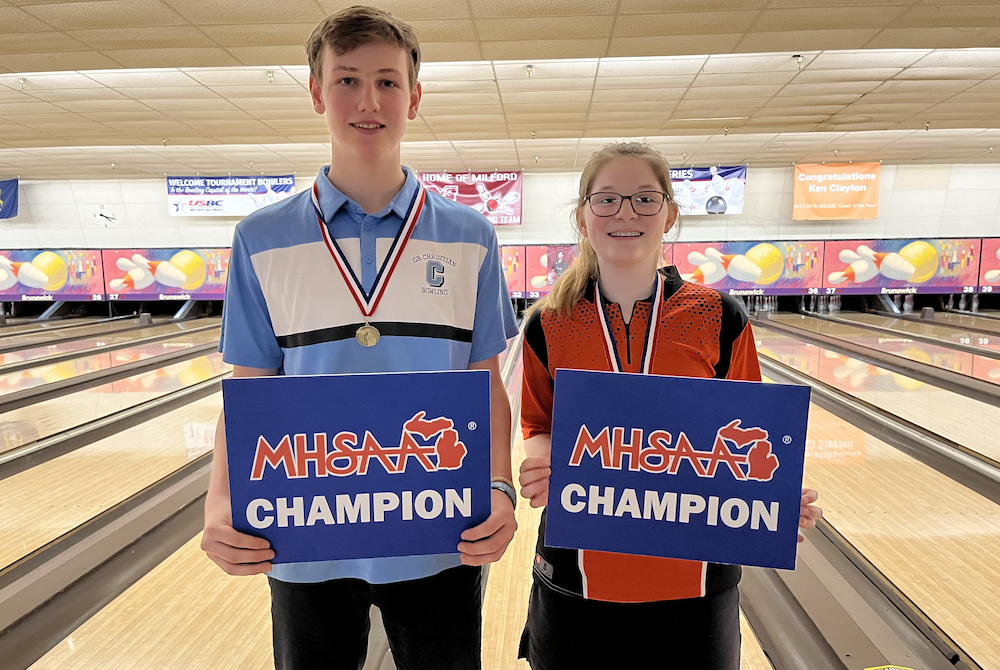
Grand Rapids Christian's Heerema, Charlotte's Portillo Arrive with 1st Finals Wins
By
Keith Dunlap
Special for MHSAA.com
March 4, 2023
WATERFORD – Sometimes, being young and oblivious to surroundings has its advantages.
Such was certainly the case for Charlotte’s Savannah Portillo at the Division 2 Singles Bowling Finals on Saturday.
Just a freshman, it was Portillo’s first time competing at an MHSAA Finals tournament. But the thought of going up against more experienced upperclassmen didn’t deter her when she walked into Century Bowl.
“The seniors and the juniors, they have so much pressure,” she said. “I didn’t have any. If I didn’t win, I had next year.”
If Portillo is back at the tournament next year, she’ll return trying to repeat after winning the individual title with a 413-384 victory over Fruitport senior Brynna Hanson in the final.
Winning as a freshman brought about some facetious comments – that Portillo should just retire from high school bowling now that she has already reached the pinnacle – but she had a good response for those jokes.
“I can just come back and win next year,” she said.
Portillo finished sixth out of the qualifying block, and then started her run with a 450-359 win over Flint Kearsley senior Sara Ritchie in the round of 16.
Portillo then defeated Dearborn Divine Child senior Amber Ligenza in the quarterfinals (405-263) and Cedar Springs senior Chloe Fisk in the semifinals (437-296) to set up the championship match with Hanson.
Portillo bowled a 242 in the first game to take a healthy 48-pin lead into the second, and did enough in the second game to hold on.
Four matches against seniors, four wins for the freshman.
Portillo said her family owns a bowling alley in her hometown, so she has been around the sport since she was a toddler.
Charlotte head coach Pat Landry said he saw Portillo’s development during her years before high school and was anxiously awaiting her arrival in the program.
The entire state now knows why.
“We’ve seen her coming up through the stages,” Landry said. “She bowls a lot of youth tournaments in the state and out of the state.”
On the boys side, Grand Rapids Christian junior Zeke Heerema won a close championship match over Tecumseh junior Owen Williams, prevailing by six pins, 388-382.
Heerema held a five-pin lead after the first game, and entered the final frame of the second game needing at least a mark to preserve his lead.
Admittedly nervous for the shot, Heerema let go of the ball and essentially said “uh-oh.”
“I threw it pretty bad, and I thought I was going to get a split because I threw it pretty high,” Heerema said.
But the No. 9 pin fell forward in between the No. 6 and No. 7 pins, knocking them both down and giving him an unorthodox strike.
Heerema then knocked down nine pins on his next ball to clinch the title.
“We’ve been working toward this all year,” Grand Rapids Christian head coach Dan VanderPloeg said. “He’s just got nerves of steel and is so focused.”
Heerema finished second out of the qualifying block, and started his run in the round of 16 with a 435-369 win over Gibraltar Carlson sophomore Jordon Bryson.
Heerema then defeated Waterford Kettering senior Cole Peters in the quarterfinals (503-484) and Howie Hammond of Flint Kearsley in the semifinals by a score of 483-457.
Heerema advanced out of the qualifying block at last year’s tournament, but lost in the round of 16 because he wasn’t as familiar with match play.
He was more ready for it this time around.
“I learned how to deal with the pressure, shut everything else out and make the shots,” he said.