

Add, Subtract, Divide, Multiply: MHSAA Not Alone
July 25, 2017
By Rob Kaminski
MHSAA benchmarks editor
This is the third part in a series on MHSAA tournament classification, past and present, that will be published over the next two weeks. This series originally ran in this spring's edition of MHSAA benchmarks.
As the MHSAA faces its most recent classification task with 8-Player Football, and opinions continue to swirl about as to the method, timeframe, location and other procedures, a look around the country provides plenty of company among state association brethren factoring variables into their own equations.
In the Pacific Northwest, the Oregon School Activities Association Football Playoffs are under public scrutiny as leadership ponders a five or six classification format beginning with the 2018-19 school year.
The OSAA has crowned six champions on the gridiron since 2006-07. Many of the state’s smaller schools would like to keep it that way, while larger schools lean toward a five-classification system, citing larger leagues, ease of travel and credibility to state championships as the advantages.
Still others would prefer more than six classes, pointing to safety issues and the opportunity to increase participation numbers as positives.
Moving southeast of Oregon, the Nevada Interscholastic Activities Association recently voted to hold serve on a classification proposal that was volleyed to the membership.
However, changes still could be forthcoming by as early as the 2018-19 season which would add a fifth classification in more populated southern Nevada while allowing northern schools to participate in four classifications. Such divisions could mean no state championship for the fifth class in southern Nevada.
Because of that, the NIAA wants equal numbers of schools in each classification on both ends of the state. Complicating the issue is the fact that the 24 largest schools in the state, by enrollment, are all in Clark County in Southern Nevada.
Across Nevada’s border into Arizona, charter schools are asking the Arizona Interscholastic Association to reconsider classification that was voted upon and approved in September 2015. That agreement called for the largest 33 percent of charter schools by enrollment to be placed in the state’s largest school classification, 3A, the middle 33 percent into 2A, and the smallest 33 percent into 1A.
Less than two years later the charter schools have had a change of heart and have asked to be considered the same as other Arizona public schools and be placed appropriately by enrollment beginning with the 2018-19 school year.
The situation in Arizona further illustrates how the public/private debate that all state associations have faced throughout existence now has the added dynamic of rapidly growing charter schools in today’s educational system, along with virtual school enrollment.
In the nation’s heartland, Nebraska has retooled its football classifications by using enrollment of boys students only in its schools rather than total enrollment. The Nebraska School Activities Association football-playing schools will kick off the 2018 season using this alignment.
Nebraska has three classes of 11-player football, with the smallest class divided in two, Class C-1 and C-2. The state also will have 8-player football for boys enrollments under 47, and the NSAA will sponsor a new 6-player tournament in 2018 for schools with 27 or fewer boys.
“This is a good proposal because some schools have a sizable imbalance between the number of boys and girls, and there’s a large gap (in enrollment) between the largest and smallest schools in Classes A and B,” NSAA executive director Jim Tenopir said. “I think this addresses both of those concerns.”
Swimmers in Georgia, meanwhile, will feel like they are moving with the current, rather than upstream in 2017-18, as the Georgia High School Association recently doubled the number of team championship events from two to four.
Swim enthusiasts can also count on longer days at the finals, as the top 30 finishers from the prelims will advance to the finals instead of 20, and all championship events will have three heats versus two.
Columbia Central Overcomes December Stumble to Claim Long-Anticipated Title
By
Doug Donnelly
Special for MHSAA.com
February 17, 2026
In early December, the Brooklyn Columbia Central boys basketball team dropped two games in three nights and was staring at a 3-2 record that – more importantly – included two conference losses.
 So, winning the Cascades Conference championship Saturday – the first in 43 years for the Golden Eagles – was something of a minor miracle.
“It was a long chase,” Columbia Central coach Jacob Crawford said. “I feel we started to peak at the right time.”
The Golden Eagles certainly were trending upward. After losing by two points to Jonesville right after the Christmas break, Columbia Central won nine consecutive games to win the Cascades Conference West division and set up an overall league championship tilt against Michigan Center.
Michigan Center had beaten was one of those teams that beat Columbia Central in December.
“We knew that was going to be a tough one,” Crawford said. “My guys have been matched up against (Hayden) Hinkle and those guys from Michigan Center for years. We did a good job of weathering the storm.”
The conference championship game was originally scheduled to be played at Spring Arbor University, but due to a scheduling snafu, Columbia Central got to host the game. It made for an incredible environment, Crawford said.
“Don’t get me wrong, I love playing at Spring Arbor, but being able to host the championship game was an awesome experience,” Crawford said. “I had guys coming into the gym who I played with. The whole community came together.”
Columbia Central led by seven with only a few minutes remaining, but Michigan Center fought back to within one possession of the lead during the final seconds, missing a couple of game-tying attempts.
The Golden Eagles held on for a 59-56 victory.
Columbia Central is a balanced team by nature. David Munro leads with a 13.9-points per game average with Nolan Schiel a point behind him. Munro shoots a healthy 35 percent from 3-point range, making 48 shots on the season from behind the arc. Trent Troyer fills the stat sheet night after night, averaging 6.5 rebounds, 6.3 points, 2.6 steals and 2.1 assists a game.
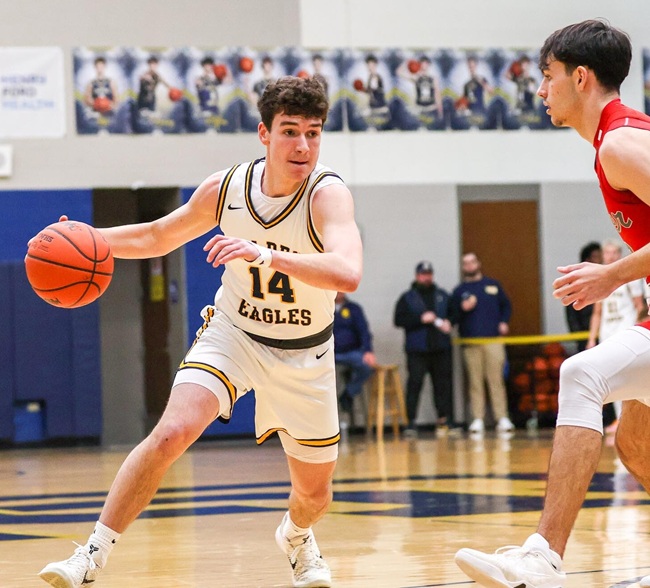 Schiel is the point guard.
“I’m probably talking to him during a game more than anyone else,” Crawford said. “He has the ball in his hand most of the game. What’s really unique about him is his rebounding ability despite being a point guard. He really gets to the glass.”
The Golden Eagles are 17-4 heading into Thursday’s final regular-season game. The losses, however, were by a combined 12 points. They are the third seed in a tough District at Tecumseh next week. One of the teams in the District is Michigan Center, 18-2 and the top seed.
Columbia Central was a Cascades Conference member from 1968 to 1995 before joining the Lenawee County Athletic Association. In 2023-24, the Golden Eagles rejoined the Cascades Conference. Prior to the league title in 1982-83, the others all came during the 1970s.
Columbia Central not only won its first conference boys basketball championship since 1983, it also became the fifth different league team to win the title in six years. In a league that was once dominated by Hanover-Horton, seven schools have celebrated league championships since 2012.
“There is a lot of parity in the league,” Crawford said. “It’s a tough league. You play a lot of games, and then you get to the finals and have to win another.”
Last year Columbia Central reached the conference championship game against undefeated Grass Lake and lost 31-30.
Crawford said that experience played into the Golden Eagles getting back to the final this season.
“We talk about trailblazers, and last year the seniors that helped us get there were just that,” Crawford said. “They kind of showed everyone else the path, what it takes to get to that game. The experience for our guys as underclassmen was immeasurable.”
Crawford started as the freshman coach at Columbia Central, moved up to the JV coach and now is in his second season as the varsity coach at his alma mater. He graduated in 2014, having played for Jason Rychener, who is now the head coach at nearby Dexter.
“I’ve always looked up to him,” Crawford said. “It’s been really cool having him as a mentor.”
Crawford had ideas of a future in coaching, but an internship in Kalamazoo while going to school at Western Michigan University helped him decide.
“I was with Next Level Sports and I started working with schools in that area,” he said. “I had a blast, and it led me to go back to school and get my teaching degree because I knew I wanted to coach.”
 Doug Donnelly has served as a news and sports reporter at the Adrian Daily Telegram and the Monroe News for 30 years, including 10 years as city editor in Monroe. He's written a book on high school basketball in Monroe County and compiles record books for various schools in southeast Michigan. He is now publisher and editor of The Blissfield Advance, a weekly newspaper. E-mail him at [email protected] with story ideas for Jackson, Washtenaw, Hillsdale, Lenawee and Monroe counties.
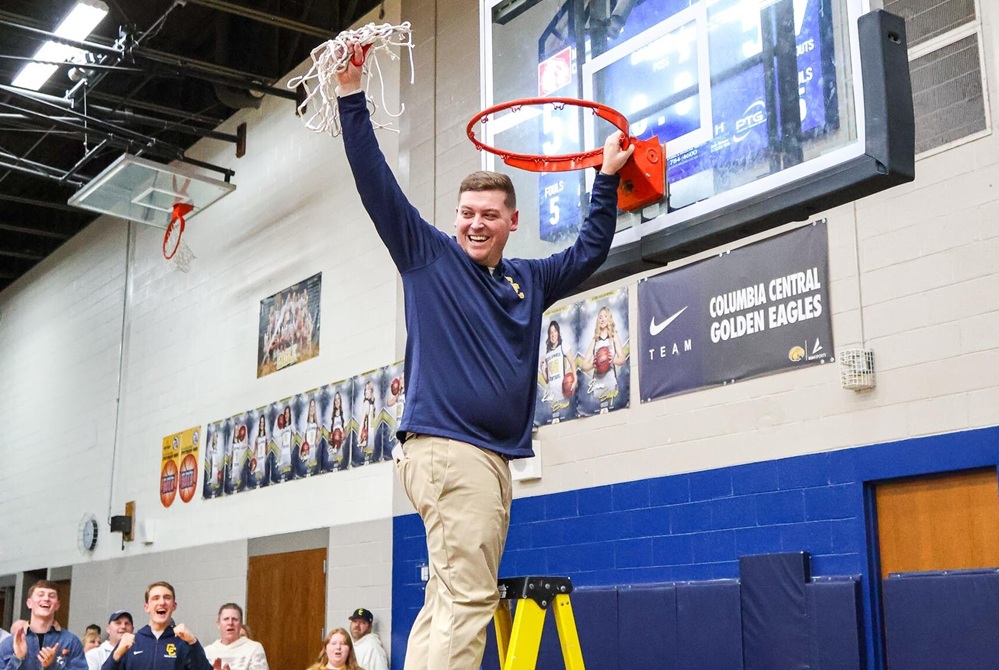
PHOTOS (Top) Brooklyn Columbia Central boys basketball coach Jacob Crawford finishes cutting the net after his team clinched the Cascades Conference title Saturday. (Middle) BCC’s Nolan Schiel (14) works to get to the basket. (Photos by Hannah Tacy/JTV.)