

Add, Subtract, Divide, Multiply: MHSAA Not Alone
July 25, 2017
By Rob Kaminski
MHSAA benchmarks editor
This is the third part in a series on MHSAA tournament classification, past and present, that will be published over the next two weeks. This series originally ran in this spring's edition of MHSAA benchmarks.
As the MHSAA faces its most recent classification task with 8-Player Football, and opinions continue to swirl about as to the method, timeframe, location and other procedures, a look around the country provides plenty of company among state association brethren factoring variables into their own equations.
In the Pacific Northwest, the Oregon School Activities Association Football Playoffs are under public scrutiny as leadership ponders a five or six classification format beginning with the 2018-19 school year.
The OSAA has crowned six champions on the gridiron since 2006-07. Many of the state’s smaller schools would like to keep it that way, while larger schools lean toward a five-classification system, citing larger leagues, ease of travel and credibility to state championships as the advantages.
Still others would prefer more than six classes, pointing to safety issues and the opportunity to increase participation numbers as positives.
Moving southeast of Oregon, the Nevada Interscholastic Activities Association recently voted to hold serve on a classification proposal that was volleyed to the membership.
However, changes still could be forthcoming by as early as the 2018-19 season which would add a fifth classification in more populated southern Nevada while allowing northern schools to participate in four classifications. Such divisions could mean no state championship for the fifth class in southern Nevada.
Because of that, the NIAA wants equal numbers of schools in each classification on both ends of the state. Complicating the issue is the fact that the 24 largest schools in the state, by enrollment, are all in Clark County in Southern Nevada.
Across Nevada’s border into Arizona, charter schools are asking the Arizona Interscholastic Association to reconsider classification that was voted upon and approved in September 2015. That agreement called for the largest 33 percent of charter schools by enrollment to be placed in the state’s largest school classification, 3A, the middle 33 percent into 2A, and the smallest 33 percent into 1A.
Less than two years later the charter schools have had a change of heart and have asked to be considered the same as other Arizona public schools and be placed appropriately by enrollment beginning with the 2018-19 school year.
The situation in Arizona further illustrates how the public/private debate that all state associations have faced throughout existence now has the added dynamic of rapidly growing charter schools in today’s educational system, along with virtual school enrollment.
In the nation’s heartland, Nebraska has retooled its football classifications by using enrollment of boys students only in its schools rather than total enrollment. The Nebraska School Activities Association football-playing schools will kick off the 2018 season using this alignment.
Nebraska has three classes of 11-player football, with the smallest class divided in two, Class C-1 and C-2. The state also will have 8-player football for boys enrollments under 47, and the NSAA will sponsor a new 6-player tournament in 2018 for schools with 27 or fewer boys.
“This is a good proposal because some schools have a sizable imbalance between the number of boys and girls, and there’s a large gap (in enrollment) between the largest and smallest schools in Classes A and B,” NSAA executive director Jim Tenopir said. “I think this addresses both of those concerns.”
Swimmers in Georgia, meanwhile, will feel like they are moving with the current, rather than upstream in 2017-18, as the Georgia High School Association recently doubled the number of team championship events from two to four.
Swim enthusiasts can also count on longer days at the finals, as the top 30 finishers from the prelims will advance to the finals instead of 20, and all championship events will have three heats versus two.
Breslin Bound: 2025-26 Girls Report Week 7
By
Geoff Kimmerly
MHSAA.com senior editor
January 26, 2026
The frostiest winter in recent memory disrupted about half of last week’s girls basketball schedule across Michigan.

But there are still plenty of highlights to pass on – and we can look forward to a busy February for many teams as snowed-out games are worked into the open dates remaining. Stay tuned.
“Breslin Bound” is powered by MI Student Aid and based on results and schedules posted for each school at MHSAA.com.
Week in Review
The countdown of last week’s five most intriguing results:
1. Holt 40, DeWitt 37 The Rams (9-2) avenged an 11-point loss to the Panthers (10-2) from Dec. 16 and reset the Capital Area Activities Conference Blue race with DeWitt and Holt now with one loss in league play.
2. Gaylord St. Mary 58, Indian River Inland Lakes 35 The Snowbirds (10-1) stand alone atop the Ski Valley Conference standings after Inland Lakes (9-2) also entered this matchup tied for first.
3. Orchard Lake St. Mary’s 54, Farmington Hills Mercy 22 OLSM (11-2) solidified its place atop the Catholic High School League Central after also defeating second-place Mercy (9-2) by 12 points on Jan. 2.
4. Goodrich 53, Saginaw Heritage 37 The Martians (13-0) won a matchup of league leaders and handed Heritage (10-3) its only double-digit defeat this winter.
5. Midland 65, Detroit Edison 46 The Chemics (9-3) loaded their nonleague schedule with several annual statewide contenders and earned a notable win in downing the Pioneers (4-4).
Watch List
With an eye toward March, here are two teams in each division making sparks:
DIVISION 1
Grand Haven (10-0) The Buccaneers are looking good to push for a first Ottawa-Kent Conference Red title since 2012-13 as they continue to build off last season’s 22-4 overall finish. They’ve started 3-0 in league play but with a tough week ahead hosting Muskegon (9-1) on Tuesday, and then Rockford (8-1) on Friday with first place on the line. Only O-K Black contender Spring Lake has gotten within single digits of catching Grand Haven, with the Bucs winning that Dec. 19 matchup 35-28.
South Lyon East (12-0) Last week’s win over Walled Lake Western gave South Lyon East as many victories as all of last season and kept the Cougars atop the Lakes Valley Conference standings after they finished third a year ago. Only second-place Milford and 10-win Plymouth have gotten within single digits, and East also has a notable 58-44 win over Southeastern Conference Red contender Saline. A closing run including games with Rochester Hills Stoney Creek, Farmington Hills Mercy and Ann Arbor Father Gabriel Richard will be great tournament prep.
DIVISION 2
Holland Christian (7-3) The Maroons are undefeated in O-K Black play, in part thanks to a 38-34 win over Spring Lake and 55-51 overtime victory over Hudsonville Unity Christian. They are playing for a second-straight league title but also have climbed the statewide Division 2 MPR list in part because of losses to strong opponents Grand Rapids South Christian, Wayland and Grand Rapids Catholic Central – which are a combined 30-3. Holland Christian has another notable nonleague matchup coming up Feb. 3 against undefeated Grand Rapids Covenant Christian.
Wayland (8-1) The Wildcats have strung together seven straight winning seasons and have an opportunity to shake up the O-K Gold this winter. Wayland fell two weeks in its first matchup against still-undefeated Grand Rapids South Christian, but can look forward to a rematch Feb. 10 and games as well against Grand Rapids West Catholic on Feb. 3 and 17. A 51-44 victory over Holland Christian on Dec. 19 avenged last year’s District loss, and a 15-point win over Wyoming to start January also was among the most notable.
DIVISION 3
Beaverton (9-0) After finishing second and four games back of Sanford Meridian in the Jack Pine Conference Division 2 last season, Beaverton quickly has a 2.5-game lead thanks in part to a 67-27 win over Meridian on Jan. 15. Meridian had swept Beaverton last season, and the Beavers also have a victory over St. Louis after splitting with the Sharks in 2024-25. Beaverton has several big nonleague games coming up, including against undefeated McBain, Evart, Standish-Sterling and Jackson Lumen Christi.
Grass Lake (10-1) The Warriors have won seven straight league championships and lead the Cascades Conference East thanks to handing Michigan Center its only league loss, 61-55 on Jan. 15. Grass Lake also has wins over league leaders Hanover-Horton and Ann Arbor Father Gabriel Richard, with the only loss to Division 1 contender Rockford. The Michigan Center rematch on Feb. 13 and home game against Parma Western on Feb. 24 will be intriguing as the postseason approaches.
DIVISION 4
Kingston (11-0) The Cardinals are perfect through the first half of this regular season and have celebrated a new all-time leading scorer in Molly Walker. A 53-34 win over second-place Deckerville last week sent Kingston into first place alone in the Big Thumb Conference Blue, and the Cardinals are also the only team to defeat BTC Black co-leader Brown City. The closest an opponent has come is 19 points, and only one has reached 40 points.
Mendon (9-2) The Hornets have won 18 or more games five times since their last league championship season in 2015-16 – including going 23-4 and making the Division 4 Quarterfinals two years ago. But this could be the season they complete the title climb again as they lead the Southern Central Athletic Association West by a game over Climax-Scotts, which they defeated 30-24 last week. Mendon has allowed only two opponents to reach 40 points, in losses to Division 3 Union City (43-27) and Division 1 Sturgis (46-40).
Can’t-Miss Contests
Be on the lookout for results of these games coming up:
Tuesday – Gladstone (10-2) at Negaunee (12-0) – Both were league champions last year and could be again, but what makes this matchup especially intriguing is it’s the first since Gladstone defeated the Miners in last year’s District Final.
Tuesday – Brown City (9-1) at Sandusky (10-1) – These two are tied for first in the BTC Black and will meet again Feb. 19.
Wednesday – Morenci (8-1) at Adrian Lenawee Christian (9-1) – The Friday matchup between these two at Morenci was postponed, but they’re set to play this time at Lenawee Christian for first place in the Tri-County Conference.
Friday – Rockford (8-1) at Grand Haven (10-0) – The Rams have won three straight O-K Red titles, and this matchup could go a long way toward helping them secure a fourth in a row.
Friday – Shelby (9-0) at Ravenna (10-2) – They are the only teams still undefeated in West Michigan Conference Rivers play after finishing second and third, respectively, in the league last season.
MHSAA.com's weekly “Breslin Bound” reports are powered by MI Student Aid, a division within the Department of Lifelong Education, Advancement, and Potential (MiLEAP). MI Student Aid encourages students to pursue postsecondary education by providing access to student financial resources and information. MI Student Aid administers the state’s scholarship and grant programs that help make college Accessible, Affordable and Attainable for you. Click to connect with MI Student Aid and find more information on Facebook and X @mistudentaid.
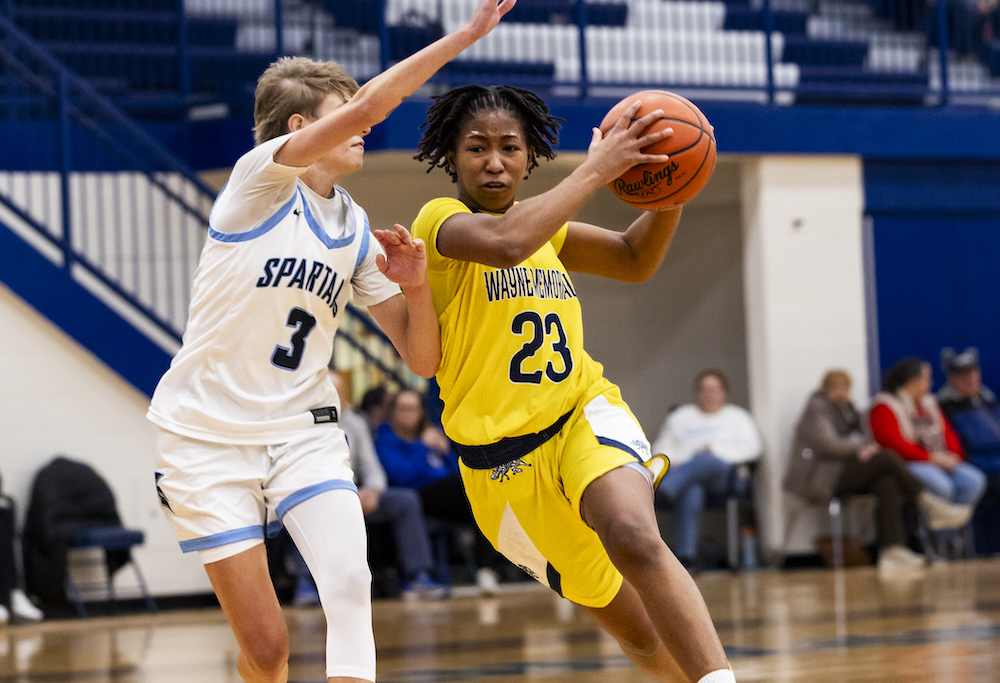
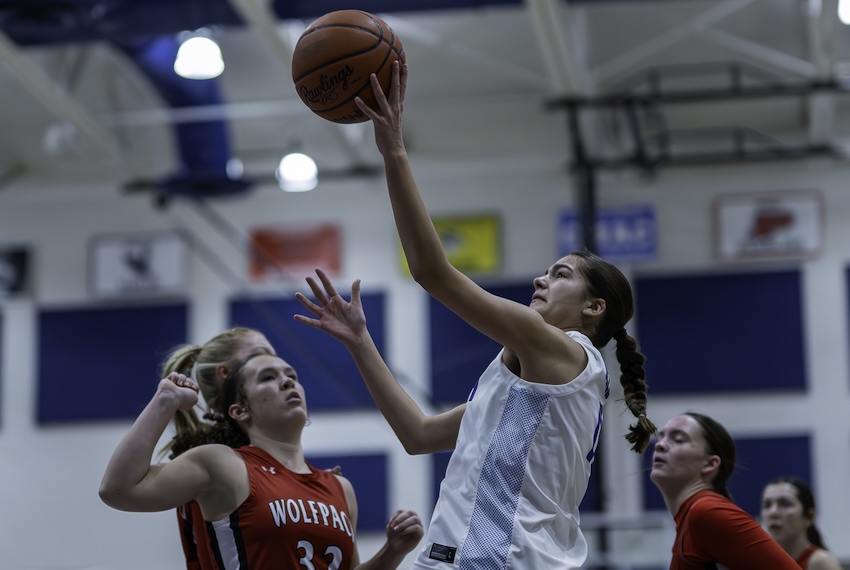
PHOTOS (Top) Wayne Memorial’s Micah Darling (23) drives into the lane during her team’s 55-40 win over Livonia Stevenson last week. (Middle) A Bath player puts up a shot as the Bees held on for a 35-33 win over Laingsburg on Wednesday. (Wayne/Stevenson photo by KMS Photography. Bath/Laingsburg photo by Team Arreguin Photos.)