

Add, Subtract, Divide, Multiply: MHSAA Not Alone
July 25, 2017
By Rob Kaminski
MHSAA benchmarks editor
This is the third part in a series on MHSAA tournament classification, past and present, that will be published over the next two weeks. This series originally ran in this spring's edition of MHSAA benchmarks.
As the MHSAA faces its most recent classification task with 8-Player Football, and opinions continue to swirl about as to the method, timeframe, location and other procedures, a look around the country provides plenty of company among state association brethren factoring variables into their own equations.
In the Pacific Northwest, the Oregon School Activities Association Football Playoffs are under public scrutiny as leadership ponders a five or six classification format beginning with the 2018-19 school year.
The OSAA has crowned six champions on the gridiron since 2006-07. Many of the state’s smaller schools would like to keep it that way, while larger schools lean toward a five-classification system, citing larger leagues, ease of travel and credibility to state championships as the advantages.
Still others would prefer more than six classes, pointing to safety issues and the opportunity to increase participation numbers as positives.
Moving southeast of Oregon, the Nevada Interscholastic Activities Association recently voted to hold serve on a classification proposal that was volleyed to the membership.
However, changes still could be forthcoming by as early as the 2018-19 season which would add a fifth classification in more populated southern Nevada while allowing northern schools to participate in four classifications. Such divisions could mean no state championship for the fifth class in southern Nevada.
Because of that, the NIAA wants equal numbers of schools in each classification on both ends of the state. Complicating the issue is the fact that the 24 largest schools in the state, by enrollment, are all in Clark County in Southern Nevada.
Across Nevada’s border into Arizona, charter schools are asking the Arizona Interscholastic Association to reconsider classification that was voted upon and approved in September 2015. That agreement called for the largest 33 percent of charter schools by enrollment to be placed in the state’s largest school classification, 3A, the middle 33 percent into 2A, and the smallest 33 percent into 1A.
Less than two years later the charter schools have had a change of heart and have asked to be considered the same as other Arizona public schools and be placed appropriately by enrollment beginning with the 2018-19 school year.
The situation in Arizona further illustrates how the public/private debate that all state associations have faced throughout existence now has the added dynamic of rapidly growing charter schools in today’s educational system, along with virtual school enrollment.
In the nation’s heartland, Nebraska has retooled its football classifications by using enrollment of boys students only in its schools rather than total enrollment. The Nebraska School Activities Association football-playing schools will kick off the 2018 season using this alignment.
Nebraska has three classes of 11-player football, with the smallest class divided in two, Class C-1 and C-2. The state also will have 8-player football for boys enrollments under 47, and the NSAA will sponsor a new 6-player tournament in 2018 for schools with 27 or fewer boys.
“This is a good proposal because some schools have a sizable imbalance between the number of boys and girls, and there’s a large gap (in enrollment) between the largest and smallest schools in Classes A and B,” NSAA executive director Jim Tenopir said. “I think this addresses both of those concerns.”
Swimmers in Georgia, meanwhile, will feel like they are moving with the current, rather than upstream in 2017-18, as the Georgia High School Association recently doubled the number of team championship events from two to four.
Swim enthusiasts can also count on longer days at the finals, as the top 30 finishers from the prelims will advance to the finals instead of 20, and all championship events will have three heats versus two.
Past Wildcats Bringing Valuable Experiences Home as Three Rivers' New Hoops Coaches
By
Scott Hassinger
Special for MHSAA.com
December 2, 2025
THREE RIVERS – Basketball has always been a passion for rookie Three Rivers coaches Drew Bosma and Michael Morrison.
 The two former Wildcats aim to bring that same level of energy they exhibited during their playing careers as they embark on their first varsity coaching stints.
Both Bosma and Morrison have brought along a few familiar faces as they begin working to rebuild Three Rivers' strong basketball tradition.
Bosma, a 2009 graduate, replaced long-time mentor Brian Burg as the Wildcats' varsity boys coach, while Morrison has taken the reins of the girls program from Carley Shoesmith.
As a student-athlete at Three Rivers, Bosma excelled in football, basketball, baseball and track & field. He continued his playing career at Alma College and Liberty University before returning home and completing his undergraduate studies in psychology through online courses.
"My psychology background has been useful in my coaching career. The kids you work with have so many different issues they encounter than when I was in school," said Bosma, who is employed in the RV Industry at Grand Design in Elkhart, Ind.
Bosma's early shift works out perfectly with his coaching duties. After 11 seasons as Three Rivers’ JV boys coach, he spent the last two as a varsity assistant at Portage Northern. His immediate goal is to renew enthusiasm within the program.
"My experience with Three Rivers basketball as a player was a very good one. I want to build the culture to the point where people want to be here, the effort isn't questioned and (we) have kids who enjoy the game," Bosma said. "I've had a lot of good mentors in this game. Now that I'm a head coach, I want our players to be able to step onto the court and play freely. Yelling after every mistake they make isn't going to teach them anything. They are going to make mistakes in life, and they have to understand it’s ok to mess up and learn from those mistakes.”
Bosma's additional goals this season are simple ones.
"I want our kids to make it known that we have competed hard in every game with a no-quit attitude. It's a coach’s dream to win every game, but I want to make sure these kids are becoming better people as well as basketball players," Bosma said.
Long-range goals include increasing interest among students to try out for the team. He and his staff have organized the Three Rivers NextGen Boys' Basketball Program for students in kindergarten through eighth grade that will begin in January and focus on building skills and nurturing players who may fill the ranks down the road.
Bosma's coaching philosophy includes being tough on his players while showing that he truly cares about their well-being.
 "As a coach I'm going to be hard on you, but these guys know that it’s out of love and concern for them,” he said. “They understand that anything I say to them is meant truthfully, and it comes from the heart. I want them to know they can come and talk to me. I want them to return 10-12 years later and notice the same type of feeling in this program. All of my coaches are either former teammates of mine or guys who played for me.”
Tirrell Hausmanis, a former hoops star at Three Rivers, serves as Bosma's varsity assistant. Brenden Brown is the Wildcats' junior varsity mentor, and alumnus Thomas O'Dell is the freshman coach.
"Having Three Rivers alumni on our coaching staff teaches these kids how important basketball is to our community," Bosma said.
Offensively, Bosma expects the Wildcats to be able to stay in space and use their long wing players and better shooters to their advantage. Among the top returners are junior point guard Brayden Carpenter, 6-foot-6 senior forward Zander Barth (who is committed to Central Michigan for football), and senior forward Carter Langston.
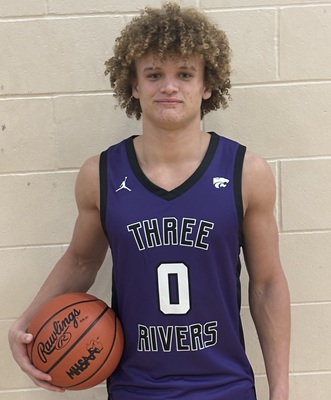
Carpenter averaged 13 points per game as a sophomore, as Three Rivers finished 7-15.
"You can tell there's a different attitude under the new coaching staff. There are lot of guys now who want to put in the extra time and energy to get better,” Carpenter said. “Our communication on the court has improved, and Coach Bosma's system allows us to play freely without worrying about the consequences of making a mistake.”
Three Rivers looks to be more adaptable at the defensive end.
"Defensively I want to change things up all the time. We don't want to just sit back in one zone or play man-to-man, but rather press whenever we can,” Bosma said. “We have a group that has improved its basketball IQ, which allows us to do so much more as coaches. We have good team camaraderie and kids who are going to play for each other. These guys are more excited about getting the win rather than what shows up in the box score.”
Bosma has seven seniors on his roster, but Three Rivers still is a fairly young team in terms of experience.
"We have long and athletic kids and guys who could be pretty good once they build their confidence level. We have great guards and kids who like to defend. Defense has become somewhat of a lost art in high school basketball. We have the tools though to be a successful basketball team," Bosma said.
Morrison, a 2003 Three Rivers graduate who played football, basketball and baseball for the Wildcats, has taken the reins of the girls program. After high school, Morrison attended Ferris State University where he graduated with a psychology degree as well. He is employed as a probation officer for the state.
Morrison has extensive experience coaching basketball. He started out coaching travel basketball in Paw Paw while also coaching high school teams at Kalamazoo Loy Norrix, Vicksburg and Three Rivers, including the last five years as the JV boys coach under Burg. He also served as an assistant men's coach at Glen Oaks Community College under Mike Elliott.
"Working under Mike taught me so much more about basketball and has made me an even better coach. That time was very beneficial," Morrison said.
 Morrison's immediate goal is to provide stability in the girls program.
"These girls have had several coaches in the last few years. I want to provide some stability and help the program grow from the lower levels,” he said. “Obviously you want to win championships, but right now we have to start with attainable goals like finishing over .500, which we haven't done in a while.”
Other goals that Morrison feels are within Three Rivers’ grasp are finishing in the top half of the Wolverine Conference and competing for a District title. The Wildcats were 8-14 last season and tied for sixth in the league.
His philosophy centers around pace and space.
"I want to get up and down the floor and defend. We want to execute an offense in the halfcourt, but also get up and down the floor and get some fastbreaks when we can. We spent the first couple weeks of practice working on executing things the right way," Morrison said.
Senior guard Dani Glass, a second-team all-Wolverine Conference pick last season, returns for her fourth varsity season. Glass, who averaged 12 points per game as a junior, has committed to play at Kalamazoo Valley Community College.
"Dani makes us go and is our catalyst for everything we do offensively. We expect more from her this season as she gets ready for the next level," Morrison said.
Sophomore post player Braylee Burg will be another key component for the Wildcats, along with senior defensive specialist Jersey Roehrs.
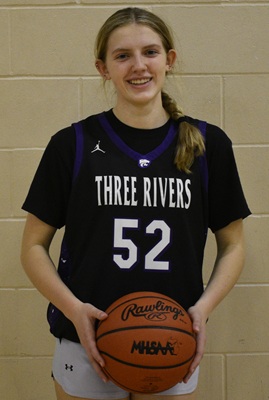
"I feel I help my team most with my ability to box out and create a lane for my guards along with providing rebounding. I want to work on finishing stronger at the rim this year,” Burg said. “Our coaching staff has us doing fun drills that are getting us ready for the season. We want to get the ball down the floor more effectively and set up our offense."
Morrison is most excited about his team's work ethic.
"We are very excited about this team's potential and are really leaning heavily on our seniors to give us a big great burst of energy and bring everyone else along,” Morrison said. “People are going to see a very well-disciplined group that works hard and together as a team. We are working extremely hard on our communication and shooting as well."
Parker Ellifritz, who ranks among Three Rivers’ all-time leading scorers, serves as Morrison's varsity assistant. Olivia Hancock, whose played on the 2016 Class B championship team at Marshall during her prep days, fills the role of junior varsity coach with Payge Ellifritz, Parker's sister, serving as her assistant.
 Scott Hassinger is a contributing sportswriter for Leader Publications and previously served as the sports editor for the Three Rivers Commercial-News from 1994-2022. He can be reached at [email protected] with story ideas for Berrien, Cass, St. Joseph and Branch counties.
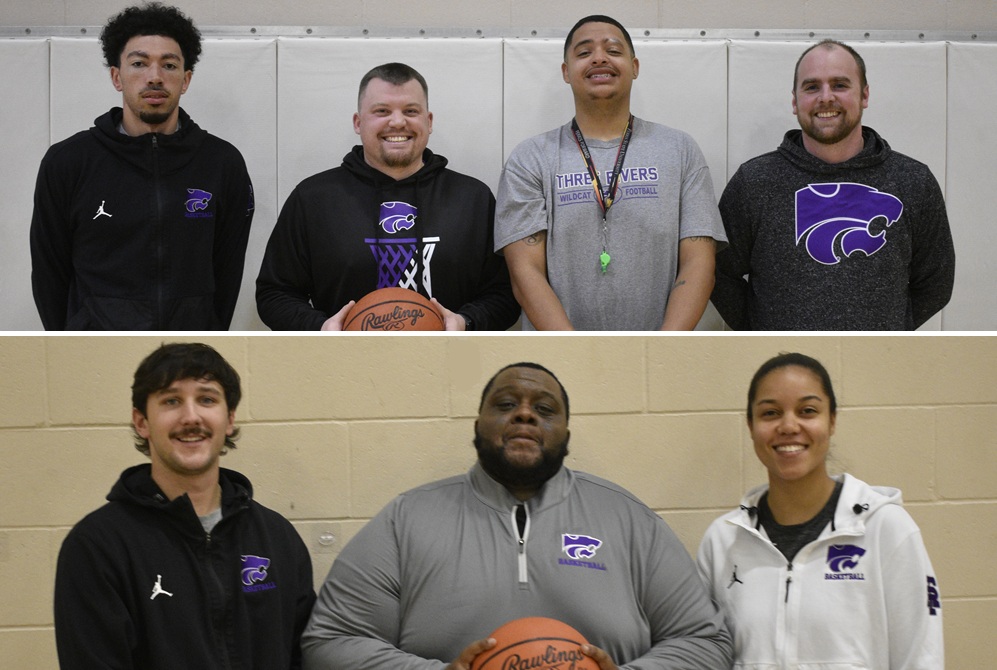
PHOTOS (Top) Above, the Three Rivers boys basketball coaching staff, from left to right: junior varsity coach Brenden Brown, head varsity coach Drew Bosma, varsity assistant Tirrell Hausmanis and freshman coach Thomas O'Dell. Below, the girls basketball coaching staff, also from left to right: varsity assistant Parker Ellifritz, head varsity coach Michael Morrison and junior varsity coach Olivia Hancock. (Middle) Junior point guard Brayden Carpenter (0) returns for his second varsity season at Three Rivers. (Below) Senior Braylee Burg (52) returns for her second varsity season for Three Rivers. (Photos by Scott Hassinger.)