


Add, Subtract, Divide, Multiply: MHSAA Not Alone
July 25, 2017
By Rob Kaminski
MHSAA benchmarks editor
This is the third part in a series on MHSAA tournament classification, past and present, that will be published over the next two weeks. This series originally ran in this spring's edition of MHSAA benchmarks.
As the MHSAA faces its most recent classification task with 8-Player Football, and opinions continue to swirl about as to the method, timeframe, location and other procedures, a look around the country provides plenty of company among state association brethren factoring variables into their own equations.
In the Pacific Northwest, the Oregon School Activities Association Football Playoffs are under public scrutiny as leadership ponders a five or six classification format beginning with the 2018-19 school year.
The OSAA has crowned six champions on the gridiron since 2006-07. Many of the state’s smaller schools would like to keep it that way, while larger schools lean toward a five-classification system, citing larger leagues, ease of travel and credibility to state championships as the advantages.
Still others would prefer more than six classes, pointing to safety issues and the opportunity to increase participation numbers as positives.
Moving southeast of Oregon, the Nevada Interscholastic Activities Association recently voted to hold serve on a classification proposal that was volleyed to the membership.
However, changes still could be forthcoming by as early as the 2018-19 season which would add a fifth classification in more populated southern Nevada while allowing northern schools to participate in four classifications. Such divisions could mean no state championship for the fifth class in southern Nevada.
Because of that, the NIAA wants equal numbers of schools in each classification on both ends of the state. Complicating the issue is the fact that the 24 largest schools in the state, by enrollment, are all in Clark County in Southern Nevada.
Across Nevada’s border into Arizona, charter schools are asking the Arizona Interscholastic Association to reconsider classification that was voted upon and approved in September 2015. That agreement called for the largest 33 percent of charter schools by enrollment to be placed in the state’s largest school classification, 3A, the middle 33 percent into 2A, and the smallest 33 percent into 1A.
Less than two years later the charter schools have had a change of heart and have asked to be considered the same as other Arizona public schools and be placed appropriately by enrollment beginning with the 2018-19 school year.
The situation in Arizona further illustrates how the public/private debate that all state associations have faced throughout existence now has the added dynamic of rapidly growing charter schools in today’s educational system, along with virtual school enrollment.
In the nation’s heartland, Nebraska has retooled its football classifications by using enrollment of boys students only in its schools rather than total enrollment. The Nebraska School Activities Association football-playing schools will kick off the 2018 season using this alignment.
Nebraska has three classes of 11-player football, with the smallest class divided in two, Class C-1 and C-2. The state also will have 8-player football for boys enrollments under 47, and the NSAA will sponsor a new 6-player tournament in 2018 for schools with 27 or fewer boys.
“This is a good proposal because some schools have a sizable imbalance between the number of boys and girls, and there’s a large gap (in enrollment) between the largest and smallest schools in Classes A and B,” NSAA executive director Jim Tenopir said. “I think this addresses both of those concerns.”
Swimmers in Georgia, meanwhile, will feel like they are moving with the current, rather than upstream in 2017-18, as the Georgia High School Association recently doubled the number of team championship events from two to four.
Swim enthusiasts can also count on longer days at the finals, as the top 30 finishers from the prelims will advance to the finals instead of 20, and all championship events will have three heats versus two.
Britton Deerfield, Whiteford Administrators Provide Diamond Leadership As Well
By
Doug Donnelly
Special for MHSAA.com
April 15, 2025
Victoria Fraley has two new softball coaches this spring.
 It’s nothing new to the Britton Deerfield senior. Every year of her high school career, a new coach has welcomed the team come springtime.
But this year’s coaching duo – while two people she’s become very familiar with at the Class D high school of 140 students in Lenawee County – is a bit different.
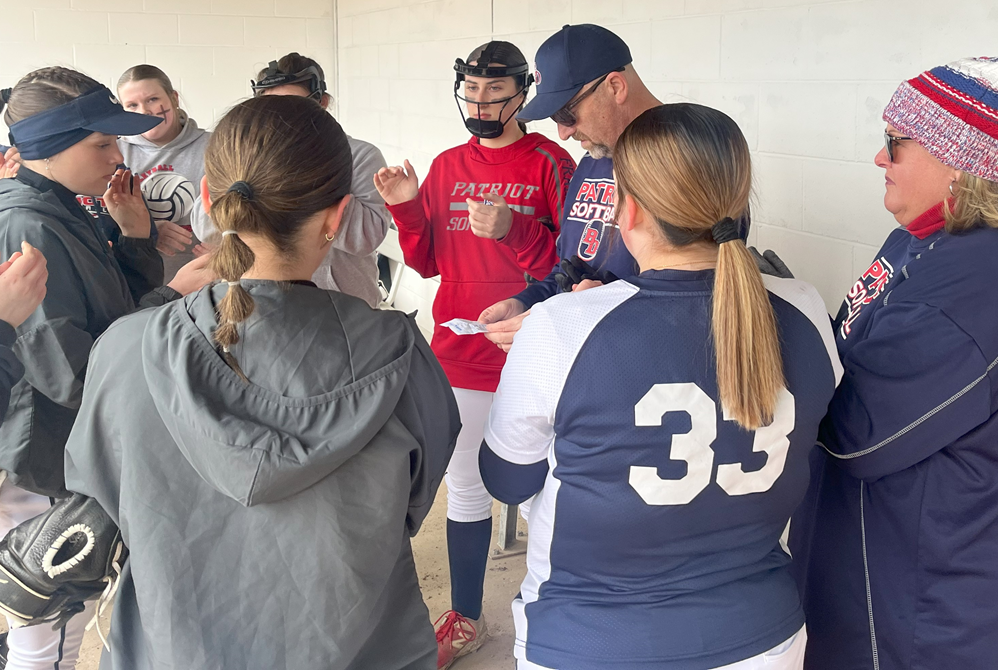
It’s her superintendent, Stacy Johnson, and high school principal, Jeff Scott.
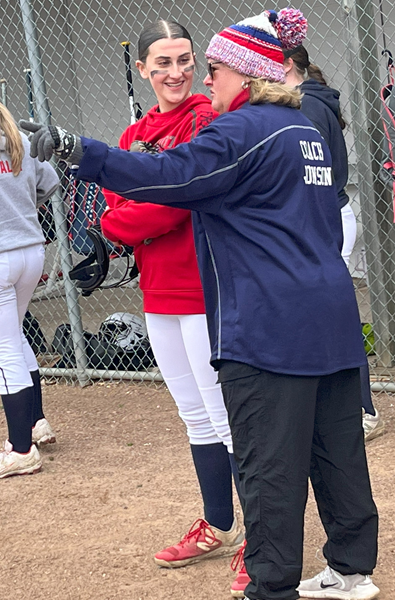
“I was so excited when I found out,” said Fraley, a pitcher for the Patriots. “I knew they had coached previously, and Mr. Scott has coached so many sports before. I was excited for the change because I knew they would hold us to higher standards than other coaches in the past.”
Fraley said the difference became noticeable the first practice of the spring.
“In years past, some people have been okay with losing,” she said. “Now, people are being held accountable.”
Johnson and Scott decided to co-coach this season after a lack of candidates surfaced to replace last year’s coach.
Britton Deerfield athletic director Erik Johnson is the husband of the superintendent and co-softball coach, and he’s already signed on to coach golf this spring. Superintendent Johnson said Erik started hinting about her coaching months ago.
“He plants a seed, right? He kept building upon that,” she said. “He’d say ‘There are no candidates.’”
Finally, Johnson and Scott – who have coached together previously – decided on coaching together again.
“We’re never going to let our kids go without,” Stacy Johnson said. “We’ll never let them go without the same opportunities that some kids in other districts have, so we just step up. That’s what we do.”
Both are at every practice and bring different perspectives.
Scott was the softball coach for BD several years ago. He’s also coached girls basketball and football – with Erik Johnson, also currently the varsity football coach.
“When I left the program, it was in pretty good shape,” Scott said. “The secret to softball is to have a program that develops a pitcher. Pitching comes with a lot of time and dedication and commitment. You can teach the hitting and fielding; you can practice that and get better.
“When I first took over back in the day, there were probably five girls who were travel ball players. With that comes experience – girls play all summer. They get a lot of work in. I don’t think there is anyone in our program now who has played a game of travel ball. Teams who have two, three, four travel ball players will have an advantage on us.”
Scott said the 11 girls on BD’s varsity softball roster are green, but willing to learn.
 “I have some girls who are learning to run bases and some girls who are learning the rules – how to tag up and things,” he said. “I had to back up a little bit, slow down a little. I am going to teach them college-level skills. We do have some young ladies who are willing and dedicated to learn.”
Johnson grew up in Monroe, where she played high school softball for one of the winningest coaches in state history in Vince Rossi.
“They don’t come any better than Coach Rossi,” she said. “I learned from him. I love this. I like being out here. I feel like I still have some knowledge to pass along to the girls.”
BD opened its season last week, being swept by Sand Creek in the Tri-County Conference opener for both schools. The Aggies scored most of their runs without hitting a ball out of the infield, taking advantage of walks and a couple of misplays. Scott, however, was encouraged by the determination he saw in the BD girls.
“We’re going to have bumps and bruises, but I can’t wait to see where we are going from the first game to the last game,” he said. “This is fun. I have 11 players, 22 sets of eyes looking at me every time.”
Another Tri-County Conference school, Ottawa Lake Whiteford, had a similar situation this spring when a lack of candidates for the junior varsity baseball coaching job led to Scott Huard, the superintendent in that district, putting his name into the running. He was hired.
“When I made the decision 18 years ago to move from the classroom to school administration, I also gave up coaching understanding that being a school administrator is demanding of your time,” Huard said. “As a school administrator, you have a greater reach and influence on the number of students, staff, and the families you serve. However, with this greater responsibility, you often lose out on creating those close relationships with your students or athletes as a teacher or coach might do from being with them daily.”
Huard’s return to the diamond has been welcomed.
“What I have found this spring in coaching is that my passion for coaching and teaching baseball has returned after being idle for many years,” he said. “It has also afforded me the opportunity to really get to know 15 of our students in a much different way than being a superintendent.”
Johnson and Huard said getting away from the day-to-day pressures of being a superintendent has been a bonus.
“I love the kids,” Johnson said. “So much of my job is about the district. It relates to kids, but it’s not necessarily dealing with them 1-on-1. This gives me that opportunity. For a couple of hours every day I can catch my breath a little bit and be out here with the girls.”
Huard echoed those sentiments.
“It has been nice to slip away for a couple of hours to practice with the boys, which allows me to rejuvenate my energy, which I believe has made me a better superintendent and avoiding potential burnout,” he said.
As a player, Fraley loves having the school administrators at the softball field.
“They will treat you the same no matter what,” she said. “They are both so encouraging – on the field and in the school. Because we are now their athletes and students, I think they hold us to a higher standard. You can really see the shift. It’s a different atmosphere out here.”
Huard, who coached in Bryan, Ohio, before becoming an administrator, isn’t sure if he will continue coaching in the future, but is having fun with it this spring. Being superintendent of the district is his No. 1 priority.
“I don't feel that the boys treat me any differently since I am the superintendent and their coach,” he said. “(And) I am treating them like any other baseball team that I have coached at the high school level. I am attempting to prepare these boys for future success at the varsity level by ensuring they are fundamentally sound in all aspects of baseball as well as understanding game situations.”
 Doug Donnelly has served as a news and sports reporter at the Adrian Daily Telegram and the Monroe News for 30 years, including 10 years as city editor in Monroe. He's written a book on high school basketball in Monroe County and compiles record books for various schools in southeast Michigan. He is now publisher and editor of The Blissfield Advance, a weekly newspaper. E-mail him at [email protected] with story ideas for Jackson, Washtenaw, Hillsdale, Lenawee and Monroe counties.
PHOTOS (Top) Britton Deerfield varsity softball coaches Stacy Johnson, far right, and Jeff Scott announce their starting lineup to their players before a recent game. (Middle) Johnson points something out to senior Victoria Fraley. (Photos by Doug Donnelly.)