

4 Thrusts: In Motion, On Track in 2013-14
December 20, 2013
By Jack Roberts
MHSAA Executive Director
During the fall of 2012 at Update meetings across Michigan, we described “Four Thrusts for Four Years” – four health and safety emphases that would help us keep student-athletes healthier and also get a seat for Michigan’s policies and procedures for school sports on the train of best practices – an express train that is moving faster than we've ever seen it toward more cautious practice and play policies and more educational requirements for coaches.
At this December’s meeting, the MHSAA Representative Council examined a first quarter report card – what’s been accomplished during the first year.
It has been a remarkably strong start, but it’s only a start.
The first thrust, improving management of heat and humidity, received a boost last March when the Representative Council adopted a “Model Policy for Managing Heat and Humidity.” It has been promoted in print, online and at face-to-face meetings; and the response of schools has been nothing short of outstanding.
This rapid acceptance by school administrators and coaches reflects their appreciation for a clear policy that identifies the precise conditions that call for adjustments in activities, and lists specific actions to be taken when temperature and humidity combine to reach un-safe levels. Gut and guesswork are gone.
The second thrust, raising expectations for coaches’ preparedness, is being advanced in three ways.
In May, the Representative Council adopted the requirement that by the 2014-15 school year, schools must attest that, prior to established deadlines, all assistant and subvarsity coaches at the high school level have completed annually the same MHSAA rules meeting required by all varsity head coaches or, in the alternative, one of the free online sports safety courses posted on or linked to MHSAA.com and designated to fulfill this requirement. This popular change is only the first component of this critically important second thrust.
The second component is this. The Representative Council voted in December to require by 2015-16 that MHSAA member high schools certify that all of their varsity head coaches of high school teams have a valid (current) CPR certification, with AED training as a recommended component.
As this requirement was discussed at constituent meetings, the question was frequently raised: “Why just head coaches?”
“Why indeed,” is our response. If a school has the will and resources, it most certainly should make CPR a requirement of all its coaches, as some school districts have required for many years.
CPR training is conveniently available near almost every MHSAA member school in Michigan. Still, the MHSAA will begin offering CPR certification (with AED training) on an optional basis as an extension of Level 1 of the Coaches Advancement Program (CAP) during 2014-15.
The third component of this thrust is scheduled to go before the Representative Council in March. The proposal is that all individuals hired for the first time as a varsity head coach of a high school team, to begin those coaching duties after July 31, 2016, must have completed the Coaches Advancement Program (CAP) Level 1 or 2.
The MHSAA will track compliance and prohibit varsity head coaches from attending their teams’ MHSAA tournament contests if they fail to complete this requirement, beginning in the 2016-17 school year.
In cases of very late hiring, schools may substitute two online courses of the National Federation of State High School Associations – “Fundamentals of Coaching” and “First Aid, Health and Safety.” However, that coach must complete CAP Level 1 or 2 within six months of the hiring date.
These feel like big steps to some people in MHSAA member schools – “too expensive” or “another obstacle to finding qualified coaches,” some say; but these are baby steps.
This barely keeps pace with national trends. Michigan’s tradition of local control and its distaste for unfunded mandates has kept Michigan schools in neutral while schools in most other states have made multiple levels of coaching education, and even licensing or certification, standard operating procedure.
The three initiatives to upgrade coaches education in this critical area of health and safety over the next three years only nudges Michigan to a passing grade for what most parents and the public expect of our programs. We will still trail most other states, which continue to advance the grading curve.
And for a state association that is among the national leaders by almost every other measure, it is unacceptable to be below average in what is arguably the most important of all: promoting athlete health and safety by improving the preparation of coaches.
The third health and safety thrust is a focus on practice policies to improve acclimatization and to reduce head trauma; and the fourth thrust is a focus on game rules to reduce head trauma and to identify each sport’s most injurious situations and reduce their frequency.
Because of the critical attention to football on all levels, peewee to pros, our first focus has been to football with the appointment of a football task force which has effectively combined promotion of the sport’s safety record at the school level and its value to students, schools and communities with probing for ways to make the sport still safer.
The task force proposals for practice policies are receiving most attention and will receive Council action in March (and will be published on Second Half over the next few weeks). But the task force also has assisted MHSAA staff in developing promotional materials that are already in use, and the task force pointed MHSAA staff to playing rules that need emphasis or revision to keep school-based football as safe as possible.
During 2013-14, all MHSAA sport committees will be giving unprecedented time to the topics of the third and fourth thrusts and, when necessary, a task force will be appointed to supplement those sport committee efforts.
Frequently Asked Questions About CPR Certification
Q. Who is authorized to provide CPR certification?
A. The MHSAA does not dictate which organization must provide the CPR education and certification. However, the Michigan Department of Human Services lists the following organizations that are approved to provide CPR training:
- American CPR Training: www.americancpr.com
- American Heart Association: www.americanheart.org
- American Red Cross: www.redcross.org
- American Safety and Health Institute: www.hsi.com/ashi/about
- American Trauma Event Management: www.atem.us
- Cardio Pulmonary Resource Center: 517-543-9180
- Emergency Care and Safety Institute: www.ecsinstitute.org
- EMS Safety Services: www.emssafety.com
- Medic First Aid: www.medicfirstaid.com
- National Safety Council: www.nsc.org
- Pro CPR: www.procpr.org
Q.
A. $0 to $75.
Q. How long does certification take?
A. Two to five hours.
Q. How long does the certification last?
A. Generally, two years.
Q. Does the MHSAA specify the age level for the CPR training?
A. No. Generally, the course for adults alerts candidates of the necessary modifications for children and infants, and vice versa.
Hackett Mentor's Care Sparked Lifetime in Hoops for BCAM President White
By
Pam Shebest
Special for MHSAA.com
July 24, 2026
KALAMAZOO — When Kevin White counsels an unruly student, he usually understands what’s going on.
 At one time, he was that student.
For the dean of students at Kalamazoo Hackett Catholic Prep, White’s life has come full circle.
He thrived while attending St. Monica Elementary School as a child, but after his father Damon passed away in 1989, the family moved to Portage and he changed schools.
“Eighth and ninth grades there was a change in behavior and grade point average,” White said. “Right about Christmas break, I had three gentlemen in my living room.
“Mike Smith, Shawn Potts and Nib Reisterer were having a conversation with my mom. They were worried about the direction I was headed and I think somehow those three came up with a plan to get me back (to Hackett).
He soon realized he needed the structure, discipline and smaller class sizes available there. But the worst part of transferring to Hackett was that he had to sit out the upcoming basketball season.
“I was not allowed to play right away because they decided my grades weren’t good enough to play, only to practice,” he recalled. “To sit on the bench as a high school kid with a bad GPA, and (bad attitude), it was like when I was little. If I wanted to do things, I had to do them the right way.”
At Hackett, he was reunited with Reisterer, his mentor who put him through some tough workouts.
“They were some of the hardest workouts I ever had because I had to go back to changing some bad habits, which changed pretty quickly,” White said.
He also had to face the players he idolized as a child when they asked why he wasn’t playing.
“That’s when I knew I had to kick it into gear because I didn’t want to let those guys down,” White said. “They said, ‘You wanted to wear that jersey since you were in fifth grade.’ My mom says peer pressure is the best pressure.”
Learning from the best
White first encountered Reisterer, who changed his life, during elementary school.
After losing his father, White would have to remain at school until his mother, Sheila, who was a police officer, picked him up.
“This gym teacher was, ‘Hey, do you want to hang out in the gym?’ Then he said he had basketball practice at 5 and did I want to come with him to practice? And he’s been stuck with me ever since,” White recalled. “It turned into ‘can I come to practice’ to ‘can I go to a couple games?’ Then I got to ride the bus. Then the Reisterer vacations at the lake became ‘Kevin’s coming too.’ There was a time when the Reisterers became my extended family, and within that came a basketball family.”
Reisterer, who was physical education teacher at St. Monica, said he knew White’s situation and wanted to help.
“My son Ryan was only a couple years younger than Kevin,” he said. “Ryan just adored him, and Kevin became my second son.”
 Reisterer, who was also Hackett’s head boys basketball coach, noted, “Kevin became my ball boy. He came to every practice and did all the drills with the kids. He led the team in warmups before the game and became quite a celebrity himself.”
The highlight of his younger years was riding the bus with the Irish players, White said.
“Doing my third-grade homework with them showing me how to do the math problems and arguing about giving me the answers or not giving me the answers,” White laughed.
“The reward was, if you behaved in school you got to go to the games. So it was real easy to behave because I wanted to hang out with the high school guys and be on the bench.”
That sparked his love of basketball.
White graduated from Hackett in 1998 and then played at Glen Oaks Community College. With thoughts of prolonging his career in basketball after college – he went on to graduate from Western Michigan University – White remembered words he heard in passing.
“The guy said, ‘You might be able to play for a long time, but you’ll coach a lot longer than you’ll play if you start coaching right away,’” White said. “As a young guy, you hear it but you don’t think about it.
“Then you get into coaching and start working camps and going to the Final Fours and start networking. I like playing, but I love teaching the game. It’s been fun doing it that way.”
Reisterer said White wasn’t going to “set the world on fire” as a basketball player, but he worked his way through the coaching ranks, from instructing young kids and contributing at summer camps to filling roles at the high school and college levels, learning at each stop.
“He has quite a network of coaches and a lot of experience,” Reisterer added.
Prioritizing family life
As an assistant coach at Kalamazoo College, White met athletic trainer Kathleen O’Farrell and was immediately smitten. He credits her with making him more detailed and organized.
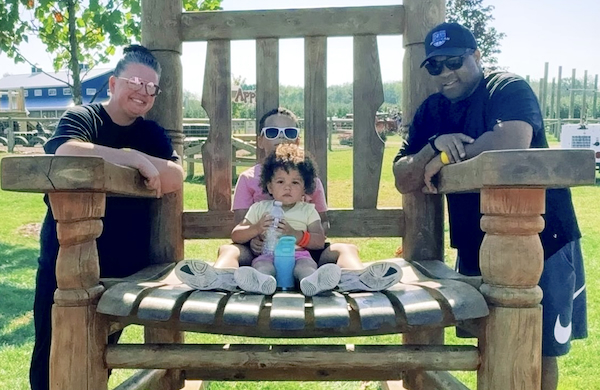
They eventually married and have two children – Vincent, 7, and Riley, 3.
“Vincent is at the age where he wants to come to practice with dad,” White said. “People ask if he’s going to play basketball.
“Right now he loves to swim, loves to play soccer. I love that because I can just sit there and be Dad.”
Vincent not only goes to practice with his dad, but has his own whistle, his own spot in the locker room and his own practice plan.
“He’s in charge of the clock,” White added. “I make him sweep the floor because I had to sweep the floor when I was young. If he decides to coach, I wouldn’t be upset.”
 White called his daughter a “mini-me.”
“She will say hello to anyone,” he said. “She’s got confidence, she will speak up. If she doesn’t like something, she will tell you.”
White honed his coaching skills as an assistant to several college and high school coaches, including at Hackett last season, and discovered that working at the same school where he coaches is special.
“I will tell any young coach, if you can get a high school job in today’s age and work in the school, that’s a win-win,” White noted. “The relationship with players is an advantage of working in the school because you’re with them during the day and after school, a lot of times more than they’re with their parents.”
White is running the summer basketball program at Hackett, but that’s not all the gregarious coach is doing.
As the current president of the Basketball Coaches Association of Michigan (BCAM), “We run an event called Reaching Higher,” he said. “High school teams are selected from all over the state and they come for two days to play at Grand Valley University.
“It’s open to college coaches all over the country to watch the top high school players from the state.”
He was also involved in Midwest Live where 20-40 Michigan teams compete against teams from Ohio, West Virginia and Pennsylvania at Cedar Point.
But next month, White will be back at Hackett, working to keep students on task.
“I see a lot of my classmates and myself in students today,” White said. “Yes, times have changed, but kids still want to be taken care of and want to be treated well and have support. Yes, some discipline comes with my job, but it’s also built on relationship and trust.
“I want (alumni) to come back and tell current kids that yes, Mr. White was hard on me about x, y and z, but when I needed something, he was there for me and if I didn’t follow through, he made sure I did.”
2026 Made In Michigan
July 24: Mackey Leaving Court with 500+ College Hoops Wins, Many More Lessons Shared - Report
July 16: Country Day Two-Time Champ Moore Building Perennial Winner at Harvard - Report
July 9: Multi-Sport Career at TC West Helps Gillis Thrive as Pro in Game She Once Left Behind - Report
July 2: Inspired by Home, Eager to Give Back, Spencer Hosts Hoop City Alumni Games - Report
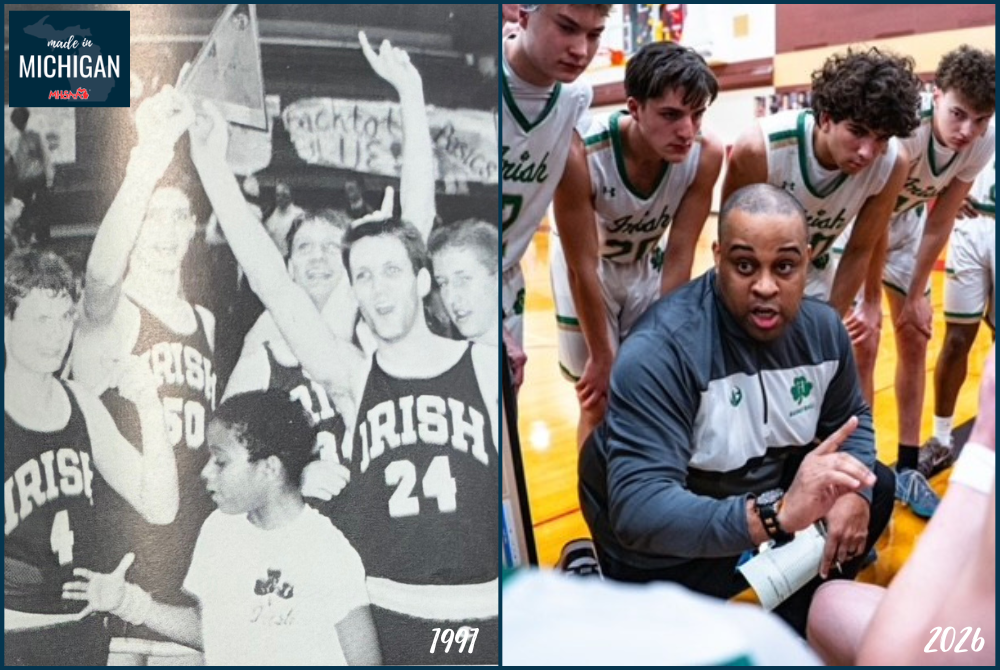
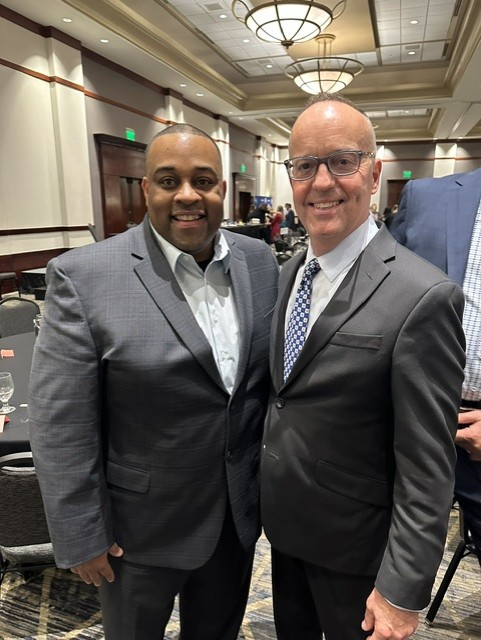
PHOTOS (Top) At left, fifth-grader Kevin White celebrates with the Hackett boys basketball team in 1991. At right, White huddles with his players this past season while serving as an assistant with the Irish varsity. (Middle) White stands for a photo with BCAM Executive Director Dan Young. (Below) White poses with wife Kathleen and children Vincent and Riley. (Photos provided by Kevin White.)