


'Hearts' Focus Includes Action Planning
November 12, 2015
By Geoff Kimmerly
Second Half editor
As most of Michigan’s high school athletes move inside this month for the start of winter sports, many will take part in a program introduced to Michigan High School Athletic Association member schools this fall that assists coaches and students in preparing for the possibility of a health emergency during their after-school practices and events.
Prior to the start of this 2015-16 school year, the MHSAA sent every member school the “Anyone Can Save a Life” emergency action plan authored by the Minnesota State High School League and the Medtronic Foundation. The program instructs schools to assemble teams made up of coaches and their students that will act in the event someone suffers sudden cardiac arrest or another emergency medical situation.
“Anyone Can Save a Life” suggests a game plan that establishes four teams on every level of every sport in a school – a 911 Team, CPR (cardiopulmonary resuscitation) Team, AED (automated external defibrillator) Team and Heat Stroke Team. The groups are made up of coaches and their students who will be in close proximity to all after-school activities.
It’s another valuable tool as the MHSAA begins work on the fourth piece of its eight-year “4 H’s” health and safety emphasis. The next two school years focus on Hearts to go with efforts over the last six years centered on Health Histories, Heads and Heat issues faced by MHSAA athletes. This fall, for the first time, all varsity head coaches at MHSAA member schools were required to have CPR certification – another means by which athletic personnel can work to counter the random, unpredictable nature of sudden cardiac arrest.
“There is something we can do. We can be prepared. We can develop emergency plans, display AEDs and deliver CPR. And, like any good sports teams, we need to practice our preparations,” MHSAA Executive Director John E. “Jack” Roberts said. “’Anyone Can Save a Life’ can help schools revise or revitalize their existing emergency plans in ways that engage team members in planning, practice and execution. This could help save lives now and also convey important lifelong life-saving lessons to students involved on these teams.”
Students are a vital component to having a successful emergency action plan. They will be put in position to call 911, meet the ambulance at a pre-determined access point, locate the nearest AED, make sure immersion tubs are filled for hot-weather practices, and for those who are trained, to assist with CPR. Coaches identify students at the beginning of the season and prior to an emergency taking place, and provide them with the details of the job they are assigned so they will be ready to assist in the event of an emergency.
The “Anyone Can Save a Life” plan was sent to schools nationwide with assistance from the National Federation of State High School Associations and the NFHS Foundation. Click for information on "Anyone Can Save a Life."
“The ‘Anyone Can Save a Life’ initiative promotes the need to have and to practice planning for different kinds of emergencies,” Roberts said. “The result can be a fresh, comprehensive emphasis on preparing for emergencies well before they occur and then responding with more confidence when those emergencies inevitably happen. It is the perfect link between the last two years when we focused on heat illness and the next two years when we focus on sudden cardiac arrest.”
This fall’s focus on “Hearts” began in the wake of 122 Michigan schools receiving recognition this spring as HEARTSafe by the Michigan Department of Health and Human Services, Michigan Department of Education, American Heart Association, Michigan Alliance for Prevention of Sudden Cardiac Death of the Young and the MHSAA.
Public Act 12 of 2014 requires all schools (grades kindergarten to 12) to have a cardiac emergency response plan in place. This MI HEARTSafe School designation recognizes 122 schools that have taken steps above and beyond to prepare to respond in the event of a cardiac emergency, and is awarded for a period of three years.
In order for a school to receive MI HEARTSafe designation, it must perform at least one cardiac emergency response drill per year, have a written medical emergency response plan and team, have current CPR/AED certification of at least 10 percent of staff, have accessible, properly maintained and inspected AEDs with signs identifying their location, and ensure pre-participation sports screening of all student-athletes using the current physical and history form endorsed by the MHSAA.
Schools that meet all requirements are able to apply for the MI HEARTSafe School designation each year. Click for information and for a list of designated schools.
MHSAA Vault: Shooks a Legend as Freshman Coach
By
Geoff Kimmerly
MHSAA.com senior editor
September 4, 2026
The following originally appeared in the Lansing State Journal on Oct. 28, 2004, and was reprinted by the MHSAA that winter.
Wayne Shooks retired from coaching entirely in 2008 and died Tuesday at the age of 84.
Wayne Shooks tried the varsity football thing once. Some time during the late 1980s, longtime DeWitt coach Gail Thornton asked Shooks to be his offensive coordinator.
“I didn't sleep a night. My wife, after three weeks, said, ‘You're going back to freshmen,’” Shooks remembered.
And those three weeks were in the month of June.
But Shooks' wife must have been on to something. Because few, if any, freshman football coaches have accomplished what Shooks finished with one last win last fall.
He ended his 16th and final season as freshman coach with a 135-2-1 record.
Amazing.
“You can't lose a game for him, or you'll feel bad,” DeWitt senior Mat Brynick recalled from his days as a freshman. “Coach never says it, but it's what everyone expects.
“He taught us how to win.”
 Guys like Shooks, 62, usually go unappreciated.
They get the kids fresh to high school, fresh to high school sports, and still learning things like not spiking the ball after a touchdown.
But few freshman football coaches are as legendary as Shooks is in DeWitt. They are so unappreciated that it's impossible to find out if anyone has accomplished what he's done.
Shook is not big on numbers. Never has been during his 41 years teaching in the district, or more than 20 coaching everything from football to basketball to wrestling to tennis. Oh, and track since 1980.
He also coached 8th-grade football for a few years, junior varsity for one season and was a varsity assistant. But he'll be remembered for what he did with the freshmen.
The losses came in 1993 to Mason during a terrible wind storm, and in 2002 to Greenville. That same year, the Panthers tied Haslett, meaning it was the only year during his tenure that DeWitt wasn't sure if it finished first in its league, since league titles aren't handed out at the freshmen level.
“The kids felt bad. They did their best,” Shooks remembered.
But the losses, however few, were more of a relief for Shooks than a letdown.
Don't take that to mean Shooks doesn't like to win.
Sure, he embraced the role of teacher as much as any freshman coach. But as DeWitt varsity coach Rob Zimmerman said, “If he was a 5th-grade coach, he'd be the most competitive 5th-grade coach you've ever seen.”
“I never pointed (our record) out, it was not our goal,” Shooks said. “Our goal was to win the next week. Although the kids knew it. They just assumed we were going to go 9-0, I guess.”
Guess so.
Shooks had more easily-attainable goals:
- Have fun
- Learn fundamentals
- Emphasize the logical stuff, like the importance of bringing equipment to school every day
“He does a really good job teaching expectations about being young men and being great students,” Zimmerman said. “It's gigantic.”
And it kept kids coming back to junior varsity and varsity. You could hear the fun coming out in Brynick's voice.
He was remembering his freshman football experience, remembering his time with perhaps Michigan's most successful coach at that level.
“I remember a few games, we'd find one play that works, and we ran it to death, pounding it and pounding it,” Brynick recalled. “He loves running the same play over and over. If you can do that, march 80 yards down the field, you're doing something right. No one could stop us.”
That was not all Brynick remembered, or didn't.
Shooks almost never yelled. If he did, it meant a kid messed something up over and over and over again.
He has a doctorate in zoology. Education is obviously a big deal. He loves to win, but he loves to teach. And he's hesitant to go looking for any attention for what he's done.
All made him a perfect freshmen football coach.
“Sometimes I don't think people understand about coaches. You think college level, they are coaches first, that's their job, but not at the high school level,” Shooks said.
“It's not what I've done, it's what they've done. I've always believed the focus should be on the kids. My job is a teacher. I coach because I love to coach.”
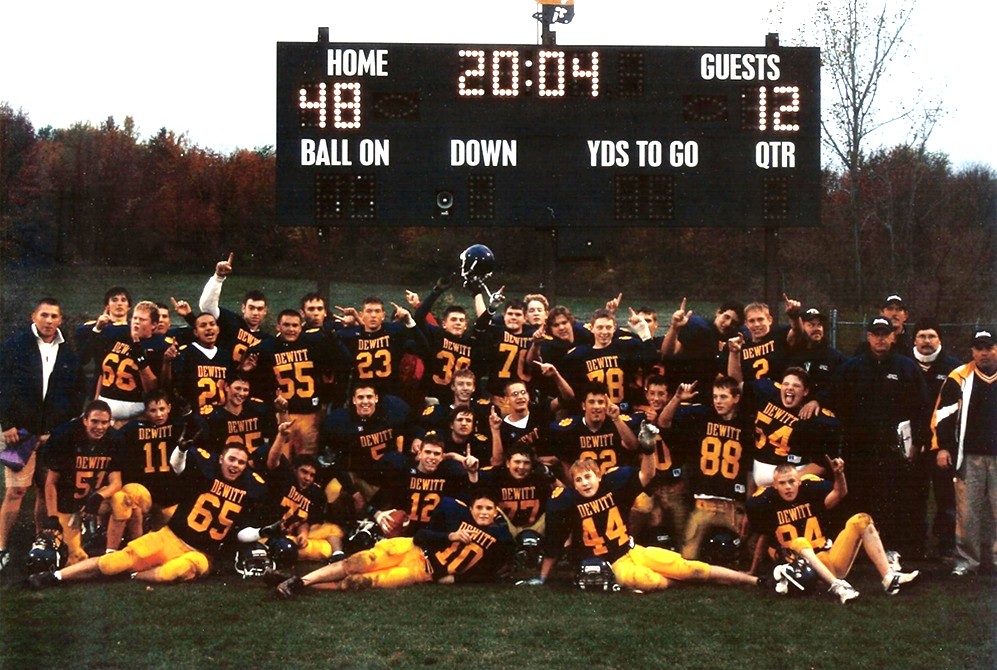
PHOTO DeWitt freshman coach Wayne Shooks, fourth from right, stands for a photo with this final football team in 2004. (Photos courtesy of the DeWitt football program.)