

High School a Time for Plays of All Kinds
April 2, 2015
By Jack Roberts
MHSAA executive director
At end of season or school year banquets attended by student-athletes and their parents, I often tell this short story about my mother that never fails to get a good laugh, especially from mothers:
“At the end of my junior year of high school I attended the graduation ceremony for the senior class on a hot and humid early June evening in our stuffy high school gymnasium. The bleachers on each side were filled to capacity, as were several hundred folding chairs placed on the gymnasium floor.
“The public address system, which was wonderful for announcing at basketball games or wrestling meets, was awful for graduation speeches. Person after person spoke, and the huge audience wondered what they had to say.
“I was present because I was the junior class president; and as part of the ceremony, the senior class president handed me a small shovel. It had something to do with accepting responsibility or carrying on tradition.
“In any event, the senior class president spoke briefly; and then it was my turn. I stepped to the podium, pushed the microphone to the side, and spoke in a voice that was heard and understood in every corner of the gymnasium.
“Whereupon my mother, sitting in one of the folding chairs, positioned right in front of my basketball coach – who had benched me for staying out too late on the night before a game, because I had to attend a required school play rehearsal – my mother turned around, pointed her finger at the coach and said, ‘See there? That’s what he learned at play practice!’
“And she was heard in every corner of the gymnasium too.
“But my mother knew – she just knew – that for me, play practice was as important as basketball practice. And she was absolutely correct.”
This old but true story about in-season demands of school sports actually raises two of the key issues of the debate about out-of-season coaching rules.
One is that we are not talking only about sports. School policies should not only protect and promote opportunities for students to participate in more than one sport; they should also allow for opportunities for students to participate in the non-athletic activities that comprehensive, full-service schools provide.
This is because surveys consistently link student achievement in school as well as success in later life with participation in both the athletic and non-athletic activities of schools. Proper policies permit students time to study, time to practice and play sports and time to be engaged in other school activities that provide opportunities to learn and grow as human beings.
A second issue the story presents is that parents have opinions about what is best for their children. In fact, they feel even more entitled to express those opinions today than my mother did almost 50 years ago. In fact, today, parents believe they are uniquely entitled to make the decisions that affect their children. And often they take the attitude that everyone else should butt out of their business!
The MHSAA knows from direct experience that while school administrators want tighter controls on what coaches and students do out of season, and that most student-athletes and coaches will at least tolerate the imposed limits, parents will be highly and emotionally critical of rules that interfere with how they raise their children.
No matter the cost in time or money to join elite teams, take private lessons, travel to far-away practices and further-away tournaments, no matter how unlikely any of this provides the college athletic scholarship return on investment that parents foolishly pursue, those parents believe they have every right to raise their own children their own way and that it’s not the MHSAA’s business to interfere.
It is for this very reason that MHSAA rules have little to say about what students can and can’t do out of season. Instead, the rules advise member schools and their employees what schools themselves have agreed should be the limits. The rules do this to promote competitive balance. They do this in order to avoid never-ending escalating expense of time and money to keep up on the competitive playing field, court, pool, etc.
Every example we have of organized competitive sports is that, in the absence of limits, some people push the boundaries as far as they can for their advantage, which forces other people to go beyond what they believe is right in order to keep up.
If, during the discussions on out-of-season rules, someone suggests that certain policies be eliminated, thinking people will pause to ask what life would be like without those rules.
Our outcome cannot be mere elimination of regulation, which invites chaos; the objective must be shaping a different future.
A good start would be simpler, more understandable and enforceable rules. A bad ending would be if it forces more student-athletes and school coaches to focus on a single sport year-round.
Former Sportswriter Knows a Good Story
July 22, 2013
By Rob Kaminski
MHSAA benchmarks editor
It’s not exactly “Man Bites Dog,” the old newspaper standard by which headline stories were determined.
But the role reversal that Rick Jakacki and Kevin Miller have experienced certainly makes for interesting reading.
And Jakacki, who spent 20 years as a sportswriter/editor with the Port Huron Times Herald, knows a good story.
After Miller, a former radio personality with the Tampa Bay Buccaneers, moved to Michigan’s thumb to pursue a career in education, he yearned to keep his hand in athletics – so he began to work as a stringer on Friday nights covering prep football for the Times Herald.
It was a neat “hobby” for Miller. But for Jakacki, whose career was in print journalism, the steady hum of immediate, electronic mediums became increasingly difficult to ignore. Figuratively, the writing was on the wall.
“It’s always been said that you never treat anyone badly because you never know when it’ll bite you, or when someone can help you in the future,” Jakacki said.
“I saw the way the newspaper trend was going, and it was scary going to work. We were cutting back all the time, not covering as many events, not traveling as much, not filling people’s jobs, implementing furloughs. I always wanted to go out on my own terms, not have the paper tell me when to leave.”
Following the 2009-10 school year, the athletic director at one of the schools in the Times Herald coverage area announced he was leaving. John Knuth, the AD at Croswell-Lexington, was headed back to Marysville, where he’d built a prep volleyball power.
By then, Miller had become the superintendent at Cros-Lex, and had been submitting stories to Jakacki for years. Now, it was Miller’s turn to lend his newspaper “boss” a hand, one that Jakacki certainly had never bitten.
And so it was that Jakacki became an employee working for his former part-time employee.
He couldn’t be happier.
“I’ve never heard of a person going from sportswriter to athletic director, but talk about a smooth transition,” Jakacki said. “I’m working with all the same people I used to write about: ADs, students, coaches, officials. And now I’m at a school that plays the same teams I covered.”
The athletic office desk suits him just fine, and he’s easily shifted from story writer to storyteller. Coupled with his administrative duties, he’s become the Pioneers’ No. 1 cheerleader, lauding the exploits of the school’s 700-plus students, nearly 70 percent of whom participate in at least one extracurricular activity.
“We got a new gym and locker rooms in the fall of 2011, and a new training room and weight room this fall” Jakacki said, putting on his tour guide hat prior to a show-and-tell session. The new digs allow for increased MHSAA Tournament opportunities, and thus increased exposure for the school.
“The best atmosphere we’ve enjoyed since I began here was this fall’s MHSAA Volleyball Regional between Marysville and North Branch. It was electric; this place was packed,” he recalled.
It’s more than athletic events drawing people to Croswell-Lexington these days. Jakacki proclaims with equal enthusiasm that the school district recently ranked 20th among 560 in Michigan for academic achievement.
Extracurricular activity, including the Pioneer Activities Leadership Council, plays a vital role in the makeup of the student population.
“There are about 40 or 50 kids who meet with the principal and me on the second Friday of each month during the school year,” Jakacki said of the Council. “It’s after school, and they don’t get credit. But they show up to talk about various leadership ideas.”
If Jakacki sounds like a proud parent while extolling the virtues of his new workplace, well, that’s fine with him. The Pioneers’ student-athletes have become like family, adding to his own children: Liam (18), Cameron (14) and Zoe (10).
“It’s funny. Having three kids of my own, I got to watch them play a lot of sports,” Jakacki said. “After getting to know all these kids, it’s like watching my kids play. People sometimes ask, ‘How can you just go to a random baseball game?’ Well it’s like watching nine of my own kids. That’s something I didn’t expect when I took this job.”
So it is fitting that his office is across from the cafetorium, where traffic flow and student interaction is steady. And, now, so is the work.
“I was looking for job security, and I love dealing with kids and sports,” Jakacki said. “It was a perfect transition for me. Now I deal with them every day.
“What’s the old saying, as you get older don’t get a job, get something you love to do? That’s what I’ve done. If I work 12-hour days, I don’t mind because I love what I do.”
It’s a story the former sportswriter never tires of telling.
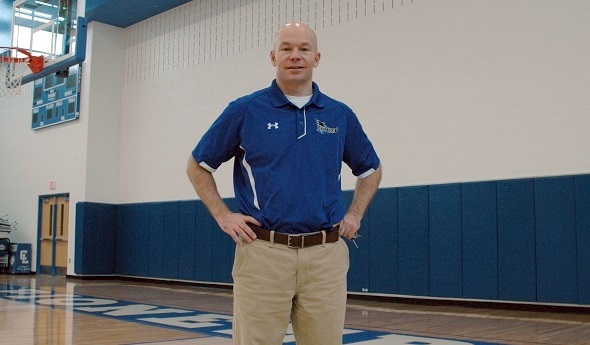
PHOTO: Croswell-Lexington athletic director Rick Jakacki stands in his school's gymnasium. He formerly covered the school as a reporter for the Port Huron Times Herald.
This is the final installment of a series, "Career Paths," focusing on the unsung contributions of athletic directors. See below for earlier installments.