

Nurturing Our Lower Level Programs
May 15, 2014
By John E. “Jack” Roberts
MHSAA Executive Director
When I’ve been faced with the most difficult choices as to different courses of action for the MHSAA, I’ve tried to face up to this reframing of the issue: “If we were creating the MHSAA for the first time today, would we do this, or would we do that?”
For example, would we or would we not limit coaches’ contact with athletes out of season? Would we have a 90-day period of ineligibility for transfer students or would it be 180 days?
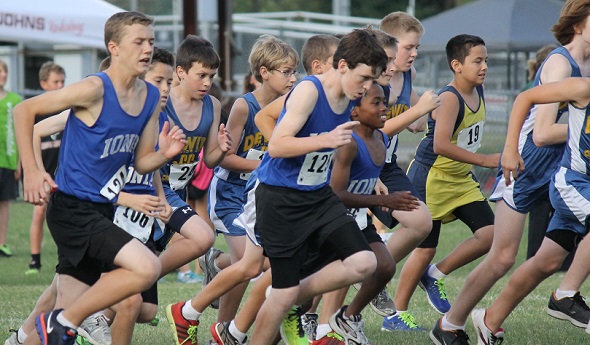
There are other examples of such “either, or” questions I could provide, but none is as difficult or defining as this: Should school sports under the MHSAA’s auspices provide more opportunities for 7th- and 8th-graders and new opportunities for even younger students?
I won’t be coy about what I think our answer should be. I haven’t always felt this way, and I recognize it is a different opinion than some who are quoted in this publication; but today it’s my belief that if we were creating the MHSAA for the first time in 2014, the MHSAA would allow more contests and longer contests for 7th- and 8th-graders, and the MHSAA would have competition policies and programs for younger middle schoolers too.
I believe this is what parents want for their children and what students want for themselves; and I believe, within reason, that the better we serve these students in their junior high/middle school years, the stronger high school sports will be and the better these programs will support the educational missions of schools.
I believe we must begin to serve middle school students more comprehensively, and that our doing so today is the best hope we have for retaining comprehensive programs for high school students tomorrow. Not only does the lower profile and pressure of lower level programs nurture the highest ideals of educational athletics, they provide our highest hope for preserving those ideals at the high school level.
The Lasting Impact of First Impressions
The over-arching question before us is how to maintain policies that encourage multiple sport experiences for students at the junior high/middle school level while at the same time adjusting those policies in terms of grade level served and the numbers and lengths of contests allowed in order to be more attractive to junior high/middle school parents and to school districts which desire additional competition opportunities in the school setting for students prior to high school.
There is a good healthy discussion in our midst about the scope of junior high/middle school athletics – how much should occur and how young it should commence; and the result of these discussions may have long-lasting effect on students, schools and the MHSAA.
Here are two central issues:
1. Contest Limits
Many people over many years have contributed to developing the current season limitations for the number of contests permitted by MHSAA member junior high/middle schools. These good people have believed in a philosophy of sports at this level that encourages students to try multiple sports.
“Kids haven’t fully matured yet,” they say. “Kids haven’t been exposed to some sports yet. They don’t know what they might like or be good at. So let’s have policies and programs that encourage new opportunities and experiences at this level.”
The season limits that have been put in place allow some junior high/middle schools, or their entire leagues, to fit four distinct seasons in a nine-month school year, consistent with this over-arching philosophy to encourage these students to try new things and learn.
There is another educationally grounded and equally astute group of administrators and coaches who are concerned that the current limits are too severe in comparison to non-school youth sports programs. For example, community/club basketball or soccer programs may schedule 15 or 18 or more games per season versus the MHSAA limit of 12 at the junior high/middle school level.
These folks think these restrictive limitations create a disincentive for kids to play school sports, and that many of those who have no place in junior high/middle school sports have no interest later in high school sports.
2. 6th-Graders
Historically, the popular opinion among educators has held that 7th and 8th grade is early enough for schools to provide competitive athletics, early enough to put youth into the competitive sports arena, and early enough to pit one school against another in sports.
Today, however, many educators and parents point out that such protective philosophies and policies were adopted about the same time “play days” were considered to be the maximum exertion females should experience in school sports. Some administrators and coaches argue that both our severe limits on contest limits at the junior high/middle school level, and our refusal to serve 6th-graders, are as out of date and inappropriate as play days for females.
Today, in nearly four of five school districts with MHSAA member schools, 6th-graders go to school in the same building with 7th- and 8th-graders. But MHSAA rules don’t allow 6th-graders to participate with and against 7th- and 8th-graders. In fact, the MHSAA Constitution doesn’t even acknowledge that 6th-graders exist.
Today, in many places, 6th-graders have aged-out of non-school, community sports, but they are not permitted to play on MHSAA junior high/middle school teams.
Last school year, 50 different school districts requested this rule be waived for them, and the MHSAA Executive Committee approved 46 of 50 waivers, allowing 6th-graders to compete on 7th- and 8th-grade teams. During 2011-12, 37 of 40 requests for waiver were approved, in all cases for small junior high/middle schools. Many of these schools want, and some of them desperately need, these 6th-graders to fill out junior high/middle school teams.
Young people are starting sports much younger today than 100 years ago when the MHSAA was created. Younger than even 50 years ago when the MHSAA was incorporated. If the MHSAA were created today to serve any students before 9th grade, I’m certain it would not leave out 6th-graders who are walking the same halls with 7th- and 8th-graders, and who have been playing competitive sports almost since the first day they started walking at all.
Eyes on the future
The most important thing we can do to enhance high school sports is to grow junior high/middle school sports programs. The earlier we disconnect young people from non-school sports and engage them in school-sponsored sports, the better our chances are of keeping high school athletic programs healthy, and the better our prospects are of keeping both participation rates and conduct standards high.
School sports are in competition for hearts and minds of young people. Our competition includes movies, jobs, cars, video games, boyfriends and girlfriends and club sports ... especially club sports. School sports needs to market itself better, and part of better is to be available earlier – much sooner in the lives of youth. More contests at the junior high/middle school level and more opportunities for 6th-graders should be parts of our marketing strategies on behalf of educational athletics generally.
For at least 50 years there have been predictions by people outside of our member schools that the system of school-sponsored sports that is almost unique to the United States would someday give way to the system of most countries where youth sports is provided by non-school community groups and private athletic clubs. Some people challenge school-sponsored sports on a program basis – for example, that competitive athletics creates a distraction to the core educational mission of schools. Others may challenge school-sponsored sports on a financial basis – that interscholastic athletics compete for the limited resources communities have to support their schools.
Today there also exists among our member schools a small percentage of administrators who have come to their leadership roles without involvement in school sports and who either desire and believe that interscholastic sports will be moved from schools to communities or who do not want but predict that such will occur as resources for schools continue to shrink.
I believe this is more likely to happen, or to happen sooner, if we do not change our approach to junior high/middle school sports. If we continue to restrict 7th- and 8th-graders to so few contests of such limited length compared to what those students have in non-school sports, and if we continue to offer nothing for younger students, we essentially and effectively force these students to non-school sports.
It is an often cited statistic that between 80 and 90 percent of all young people who ever begin playing competitive athletics stop playing before they reach the age of 13, meaning the vast majority of young people never, ever are involved in school programs. Thus, it is no mystery why people question the future of school sports. We’re doing nothing to make programs available to them. They have no experience in them.
Our restrictive and possibly outdated policies and procedures regarding contest limits and lengths and the age at which we begin to serve junior high/middle school students may assure that the dire predictions about school sports’ future will be accurate. We are doing too little, too late. It is marketing at its worst.
In my mind there is little doubt that we are doing too little too late with junior high/middle school students. Now the challenge before us is to think beyond “we can’t afford it” and make some necessary changes, while still avoiding a system that allows or even encourages schools doing too much too soon.
Bush Legacy: Culture of Opportunity
By
Doug Donnelly
Special for MHSAA.com
April 6, 2018
By Doug Donnelly
Special for Second Half
CHELSEA – For the first time as Chelsea High School athletic director, Brad Bush has to hire a football coach.
 What’s more, he has the unenviable task of replacing himself.
“I would say that nobody cares more about Chelsea football than I do,” Bush said. “It’s important to me that we find the very best person we can.”
Bush has coached the Bulldogs for 21 seasons. But, his coaching background goes much deeper than that.
He played at Ypsilanti High School for Hall of Fame coach Bill Giarmo, graduating in 1988. After playing quarterback at Cornell University in the Ivy League, he returned to Michigan, graduating from Eastern Michigan University, and started coaching for Bill Kohn, another inductee to the Michigan High School Football Coaches Association Hall of Fame. Bush then went to East Kentwood to coach with Giarmo.
Through his own playing days, coaching with those legends of the game and absorbing everything he could from afar, Bush has developed an impressive culture at Chelsea.
“Friday nights in Chelsea are a big deal,” he said. “We want to keep that tradition.”
Bush became the varsity head coach at Chelsea in 1997. At the time, Chelsea had only two playoff appearances. Bush’s Bulldogs went 3-6 that first season. After that, Chelsea didn’t have a sub-.500 finish for 15 years. The Bulldogs have been kept out of the playoffs only once since 1998.
Chelsea has had only three head coaches since 1965.
“I’m fortunate,” Bush said. “I went for a few more years than the other guys. It’s a great place to coach.”
Temperance Bedford head coach Jeff Wood was an assistant with Bush at Ypsilanti during the 1990s and said he thought then that Bush was going to develop into a great head coach.
“We knew he was going to accomplish greatness, not only as a football coach, but as a father, husband and professional in education,” Wood said. “Brad has always won and lost with great class and dignity. He’s a true Hall of Famer.”
If Bush never coaches at Chelsea again, his lasting legacy might be that culture surrounding the Bulldogs program. It’s known for its large number of football players, from middle school through the varsity, and a system that ensures every student athlete on every team leading to the varsity will play in every game. Teams at the middle school, freshman and junior varsity levels all start 22 players each game – with no two-way starters. For a Class B/Division 3 school, that isn’t the norm.
“We’ve had the same philosophy for 20 years,” he said. “Everybody plays in every middle school, freshman and junior varsity game. That’s how we do it. We start 22 kids on every level. Our kids know they will have the opportunity to play.
“Every kid on every level is going to play in every game. On most nights, we play more kids than the other team has players.”
While every school loses some athletes, or potential athletes, along the way, Bush said this system helps maintain a student’s interest in the sport. Often, he said, a player who may not necessarily be a starter as a freshman will learn the game, develop and turn into a starter by senior year.
“We feel that, over time, with repetition and practice, a kid will become an expert at his position,” he said. “For us, this is a big piece. … That was my thing here. I didn’t invent it. I absorbed it, watched it at other places.”
It’s tough to argue with the results. Chelsea won or shared Southeastern Conference championships in 1999, 2000, 2001, 2003, 2004, 2006, 2007, 2008, 2011, 2012, 2015, 2016 and 2017. The Bulldogs won seven District championships during the Bush era and played in the 2015 Division 3 championship game, falling to Orchard Lake St. Mary’s at Ford Field
He said he learned how to build a program from Giarmo and how to coach a football team under Kohn. Bush was quick to credit his assistant coaches who have remained with the program for years and helped build the culture. He said the program has sacrificed win-at-all-cost at the lower levels with the goal of developing varsity football players.
“You have to manage it,” he said. “That’s why you need a great staff. We have been lucky here with a great, dedicated group of guys. They always have the ultimate goal in mind.”
Bush said he won’t hamstring the next coach into running his system, but anticipates whoever is hired will buy into the culture after seeing what it’s about.
“The next coach has to run it the way he wants to run it, but I do believe we have created a culture here and we’d like to maintain that. You want to hire the right person who is going to handle the kids the right way.”
In addition to coaching at Chelsea and leading the entire athletic program, Bush also is heavily involved in the Michigan High School Football Coaches Association as a past president, serves on the Michigan High School Athletic Association football committee and has served on the National Federation football rules committee. He’s coached in all-star games and is a true believer in high school sports.
His record at Chelsea is 169-60.
“I have great energy,” Bush said. “I love coaching. I have a great passion for it, but I also know when you need to do certain things. I felt this was just the right time for the athletic department and the football team. It wasn’t one thing that led me to this.
“I love the game. I’m going to be very much involved.”
 Doug Donnelly has served as a sports and news reporter and city editor over 25 years, writing for the Daily Chief-Union in Upper Sandusky, Ohio from 1992-1995, the Monroe Evening News from 1995-2012 and the Adrian Daily Telegram since 2013. He's also written a book on high school basketball in Monroe County and compiles record books for various schools in southeast Michigan. E-mail him at [email protected] with story ideas for Jackson, Washtenaw, Hillsdale, Lenawee and Monroe counties.
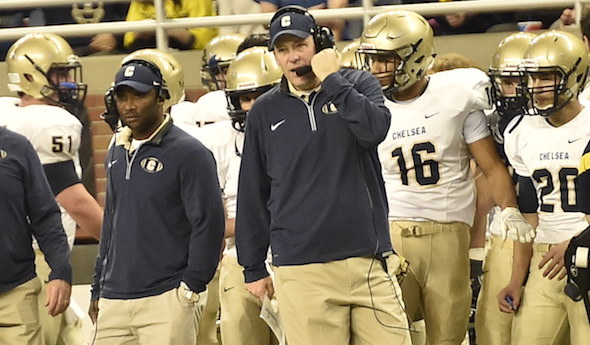
PHOTO: Chelsea's Brad Bush coaches his team during the 2015 Division 3 Final at Ford Field.