


Regulation with Roots
December 3, 2015
By Jack Roberts
MHSAA Executive Director
The following is an excerpt from “History, Rationale and Application of the Essential Regulations of High School Athletics in Michigan.”
Throughout the years, schools of this and every other state have identified problems relating to school transfers.
There is recruitment of athletes and undue influence. There is school shopping by families for athletic reasons. There is jumping by students from one school to another for athletic reasons because they couldn't get along with a coach or saw a greater opportunity to play at another school or to win a championship there. There is the bumping of students off a team or out of a starting lineup by incoming transfers, which often outrages local residents. There is the concentration of talent on one team by athletic-motivated transfers. There is friction between schools as one becomes the traditional choice for students who specialize in a particular sport. There is imbalance in competition as a result. And there is always the concern that the athletic-motivated transfer simply puts athletics above academics, which is inappropriate in educational athletics.
All states have developed rules to address the problems related to school transfers. In some states it is called a transfer rule and in other states a residency rule, because linking school attendance to residence is one of the most effective tools for controlling eligibility of transfers. None of the state high school association rules is identical, but all have the intention of preventing recruiting, school shopping and jumping, student bumping, friction, imbalance and overemphasis, as well as the intention of promoting fairness in athletic competition and the perspective that students must go to school first for an education and only secondarily to participate in interscholastic athletics.
The transfer/residency rule is a legally and historically tested but still imperfect tool to control athletic-motivated transfers and other abuses. It is a net which catches some students it should not, and misses some students that should not be eligible. This is why all state high school associations have procedures to review individual cases and grant exceptions; and why all state high school associations have procedures to investigate allegations and to penalize violations where they are confirmed.
Over the years, state high school associations have considered four options to handle transfers. The first two options are the easiest courses: either (1) let schools decide themselves about transfers, as Michigan once did, but this leads to inconsistent applications and few states now subscribe to such an approach; or (2) make no exceptions at all, rendering all transfer students ineligible for a period of time, but this becomes patently unfair for some students and no state high school association subscribes to that extreme, although it would be easy to administer.
The third option – the ideal approach perhaps – would be to investigate the motivation of every transfer and allow quicker eligibility or subvarsity eligibility to those which are not motivated by athletics, but this is very time consuming if not impossible to administer. No state high school association has sufficient staff and money to consider every detail of every transfer.
This is why a fourth option has been most popular with most state high school associations. This is a middle ground which stipulates a basic rule, some exceptions (15 exceptions in Michigan), and procedures to consider and grant waivers (a primary role of the MHSAA Executive Committee).
It is certain that the MHSAA transfer rule is imperfect. However, whatever few imperfections exist are remedied through a process by which member school administrators may make application to the MHSAA Executive Committee to waive the rule if, in the committee's opinion, the rule fails to serve any purpose for which it is intended or in its application creates an undue hardship on the student. In a typical year, the Executive Committee will receive approximately 250 requests to waive the transfer regulation, approving approximately 60 percent of those requests.
The committee brings to its considerations the following rationale, most recently reviewed and reaffirmed on Aug. 5, 2015:
- The rule tends to insure equality of competition in that each school plays students who have been in that school and established their eligibility in that school.
- The rule tends to prevent students from “jumping” from one school to another.
- The rule prevents the “bumping” of students who have previously gained eligibility in a school system by persons coming from outside the school system.
- The rule tends to prevent interscholastic athletic recruiting.
- The rule tends to prevent or discourage dominance of one sport at one school with a successful program, i.e., the concentration of excellent baseball players at one school to the detriment of surrounding schools through transfers and to the detriment of the natural school population and ability mix.
- The rule tends to create and maintain stability in that age group, i.e., it promotes team stability and team work expectation fulfillment.
- The rule is designed to discourage parents from “school-shopping” for athletic purposes.
- The rule is consistent with educational philosophy of going to school for academics first and athletics second.
- It eliminates family financial status from becoming a factor on eligibility, thus making a uniform rule for all students across the state of Michigan (i.e., tuition and millage considerations).
- It tends to encourage competition between nonpublic and public schools, rather than discourage that competition.
- It tends to reduce friction or threat of students changing schools because of problems they may have created or because of their misconduct, etc.
Following the adoption of a more standardized statewide transfer rule in 1982, there were multiple legal challenges. However, in 1986, the Michigan Court of Appeals determined that a rational basis exists for the transfer regulation and that the rule, with its exceptions, is not overbroad and is neither arbitrary nor capricious, noting that neither a fundamental right nor suspect classification is involved. Berschback v. Grosse Pointe Schools 154 Mich App 102 (1986). That decision is also noteworthy for this statement which has halted or decided subsequent legal challenges: “This Court is not the proper forum for making or reviewing decisions concerning the eligibility of transferring students in interscholastic athletics.”
There were two major changes in the MHSAA transfer regulation during the 1980s. The first, the athletic-motivated transfer rule, led to the busiest period of litigation in the MHSAA’s history. The other major change, arguably of equal impact, was implemented without any controversy.
This second subtle but substantial change occurred in 1987 when language was adopted to limit eligibility after a transfer to the non-public school closest to the student’s residence, as opposed to any non-public school in whose service area the student lived. “Service area” did not have a consistent definition and created unnecessary concern that non-public schools had the advantage of huge, undefined attendance areas, compared to public school districts at that time.
Some high school associations prescribe geographic boundaries or mileage limitations for students transferring to non-public schools. Michigan simply says it’s only the non-public school closest to the student’s residence, where eligibility may be immediate.
PHOTO: The MHSAA Transfer Regulation dates back to the early 1980s when the Association building stood on Trowbridge Road in East Lansing.
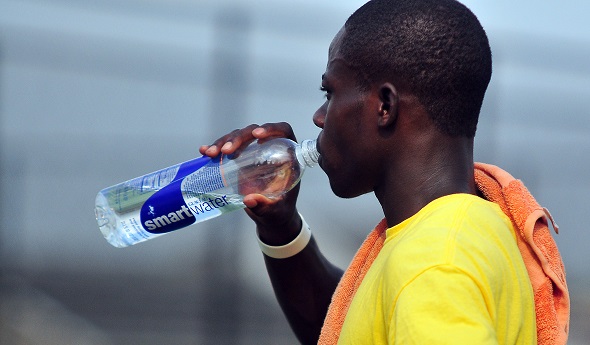
Schools Continue to Manage the Heat
July 16, 2015
By Rob Kaminski
MHSAA benchmarks editor
It certainly was not the MHSAA’s intent to spur the most historically frigid back-to-back winters the state has seen. Nor did the Association wish for one of the mildest summers in recent memory during 2014.
Seemingly, it’s just Mother Nature’s way of reading into MHSAA efforts for managing heat and humidity and acclimatizing student-athletes for warm-weather activities.
Since guidelines were put in place (recommended for regular-season sessions and required for postseason tournaments) before the 2013-14 school year, there have been relatively few days during which psychrometers have had to be implemented.
“The key is, we’ve got plans in place for when the climate returns to normal trends for return-to-school practices and contests in August and September, as well as early June events,” said MHSAA Executive Director Jack Roberts. “It is a bit ironic that there have been relatively few days since the guidelines were established that they’ve actually come into play.”
In a nutshell, the guidelines provide instruction for four ranges of heat index: below 95 degrees; 95-99 degrees; 99-104 degrees, and heat indexes above 104 degrees, with increasing precautions in place as heat indexes rise. An index above 104 calls for all activity to cease.
Certified athletic trainers Gretchen Mohney and James Lioy agree that recent requirements in heat and hydration guidelines are a step in the right direction and encourage that – when possible – an athletic trainer oversee the implementation. Simply taking a reading from just outside the AD’s office or at home does not simulate on-site conditions.
“This doesn’t take into account the radiant heat at the site, which can drastically affect the conditions that athlete plays in. It is essential that all parties involved in making decisions to play collaborate with one another,” Mohney said.
Heat-related deaths in athletics rank only behind cardiac disorders and head and neck injuries, but such fatalities might lead the way in frustration for families and communities of the victims. The reason? Heat-related illness is totally preventable.
Another source of mild frustration is the lack of recording within the state for those practice and game situations which warrant heat protocols.
When the Representative Council was formulating the Heat and Humidity Policy, it was also mindful of ways in which the MHSAA could assist schools in putting the plan into practice. Coaches, athletic directors and trainers needed a method to record information for athletic directors to view and for the MHSAA to track. The MHSAA developed interactive web pages on MHSAA.com which allow registered personnel to record weather conditions as practices and contests are taking place, using psychrometers.
Additionally, discounted Heat and Humidity Monitors and Precision Heat Index Instruments are offered to schools through a partnership between the MHSAA and School Health.
Yet, since the availability of such tools came to fruition two years back, fewer than 1,000 entries have been recorded, and many are multiple entries from the same schools.
Of the 772 entries, only 15 took place when the heat index was in excess of 104, while just 21 indicated an index of greater than 100. Cooler temperatures could be playing a factor in the overall number of participation, particularly in the northern areas of the state.
Nearly all of the responses came during fall practices, with a few isolated cases coming during the spring.
As Mohney pointed out, all resources must be properly used in concert with one another to achieve desired results.
Reminders of the tools available to schools are disseminated throughout the state each summer.