


Big Lessons for Little Leaguers
March 13, 2015
The only thing worse than adults corrupting kids for their own glory and gratification is politicians trying to excuse those adults so the kids learn nothing positive and much that’s negative from the situation.
So, things went from bad to worse when the mayor of Chicago tried to pressure Little League Baseball to restore the victories and championships that the Jackie Robinson West All-Stars baseball team claimed during the 2014 Little League World Series while some of its players were in violation of the organization’s residency rules.
So far, the kids have learned that it’s not right to cheat. The mayor would have them learn that you can avoid the consequences of cheating if you know people in the right places.
Little League is a victim of its own success. The more hype it has brought to what once was a healthy local game for 9-12 year olds of modest skills – the more it has become a spectacle for all-stars who, really, are merely those children who have matured the most – the more it has raised the stakes, the more Little League Baseball has invited excesses and even corruption.
This trend will only get worse; and it will get worse much faster if the politicians try to overpower those Little League officials who are still trying to hold things in check. Those so-called “stubborn” leaders offer Little League its biggest and best legacy.
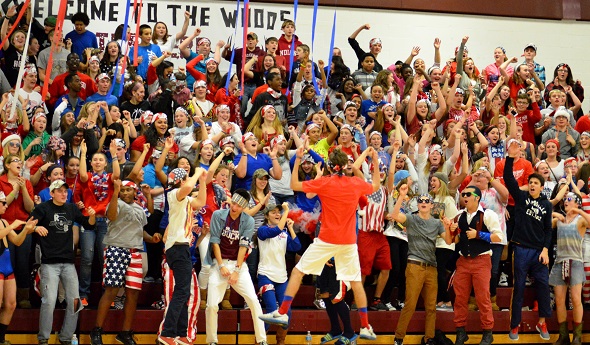
Welcome Back to 'The Woods'
January 17, 2014
By Geoff Kimmerly
Second Half editor
Buchanan, here we come.
The MHSAA and its Student Advisory Council will kick off "Battle of the Fans III" tonight with a return trip to Buchanan, last season's BOTF champion.
Buchanan, tucked into the southwest corner of the Lower Peninsula, is a Class B school of 465 students hailing from a community of roughly 4,400. The Bucks earned voters' hearts in 2013 as most of that student body and community filled the home gym – fittingly referred to as "The Woods" – for the MHSAA's BOTF visit.
 The MHSAA will visit finalists Beaverton, Bridgman, Frankfort and Traverse City West later this month and during the first two weeks of February before crowning a champion on Feb. 21 and inviting representatives from the winning section to a banner presentation during the Boys Basketball Semifinals on March 21 at Michigan State's Breslin Center.
Remember, follow the Battle of the Fans on the MHSAA's Facebook, Twitter and Instagram social media sites by clicking hashtag #BOTF. The MHSAA-produced story and video from tonight's trip will be published Tuesday on Second Half.
Here's Buchanan's application video for this winter's contest.
PHOTO is courtesy of Buchanan High School. Battle of the Fans III is sponsored in part by the United Dairy Industry of Michigan.