


Official Treatment
March 7, 2014
A book I quoted in this space three times last November – How: Why HOW We Do Anything Means Everything by Dov Seidman – has me thinking about sports officiating.
One premise of the book is that the Internet era has made the world so transparent and connected that there is no such thing anymore as “private” behavior or a “minor” mistake. Everything can become a public matter – instantly. Anything can become a major problem – overnight. Worldwide.
So, when our local real estate agent, who officiates junior varsity basketball, misses a call that an invested spectator captures with his or her smart phone camera, and sends to his or her relatives and a local media outlet that night, there is no limit to where that video could appear by the next morning.
And while major college and professional officials may now receive four-figure fees to work under those conditions, officials at the junior high/middle school and high school levels – sometimes working for little more than gas money - wonder if it’s worth the hassle.
There are many obstacles to recruiting and retaining officials for school sports, including poor business practices by assigners and bad sportsmanship by coaches and spectators; but a significant factor not to be overlooked is the adverse potential of immediate worldwide criticism for a call that had to be made in the blink of an eye.
The human factor of sports is now subject to inhuman expectations. In an enterprise that strives for fairness, it appears that it’s the official who is being treated least fairly.
The Official View: Multiplying Legacies
By
Brent Rice
MHSAA Assistant Director
September 17, 2018
By Brent Rice
MHSAA Assistant Director
In this week’s edition, check out the latest news on the MHSAA’s Officials Review Committee and Officials Guidebook, rules scenarios to consider in football and swimming and a quick story of multiple generations learning through the Legacy Program.
It’s Official!
Officials Review Committee Meeting: The Officials Review Committee will meet next week, and the agenda will include a number of important topics such as officials’ tournament fees, registration options and benefits, and the current system of selecting tournament officials.
The Officials Guidebook will be released in the upcoming week. Whether you’re an official, assigner, or association leader, please take some time to review its policies, requirements, and restrictions. It should have much of the information you need regarding the administrative duties of MHSAA officiating.
Rule of the Week
FOOTBALL Late in a tight contest, A1 receives the snap and attempts to throw a bubble screen to a stacked receiver behind A1’s position. As A1’s arm motion begins forward in his attempt to make the backward pass, it is contacted by rushing B1 and is knocked loose. Team B falls on top of the ball.
Ruling: This is a turnover and Team B’s ball. Even though the arm motion is coming forward, this is not a legal forward pass because it is not in the direction of the line of scrimmage. As a result, this is a fumble and live ball until it is recovered by Team B.
It’s Your Call
SWIMMING This week’s clip involves determining the legality of a turn in swim. The swimmer is participating in a 100-yard backstroke race. This clip begins at the point where he is beginning his turn. Is this a legal turn in this backstroke event? Why or why not? Check back next week for the correct ruling. (Video courtesy of USA Swimming.)
Official View
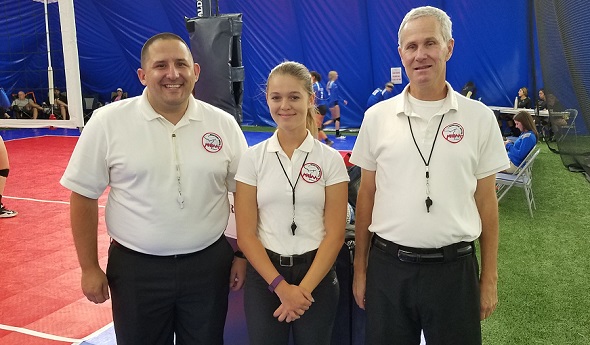
In 1996, Dana Fuller (far left in top photo) was a Legacy official under the tutelage of mentor official Jerry Sosnowski (far right). Things came full circle at a recent volleyball contest while working with his new Legacy mentee, Olivia Kostiz, when all three generations of the Legacy program were able to work together.