


See the Whole Play

August 19, 2014

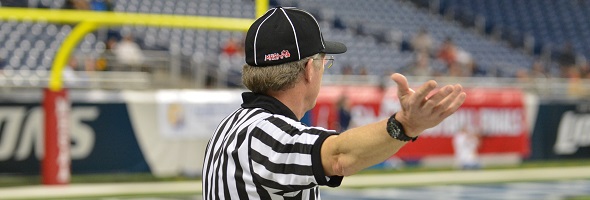
“What I Learned from That Play” was the name given to a session at the National Association of Sports Officials (NASO) Summit in Albuquerque last month. Several prominent officials talked about tough calls they made. One official was telling us of an error made, the other of a correct call; but the message was the same from both: “See the whole play.”

One official described an apparent touchdown reception where the focus of the officials was intent upon whether or not the receiver had a foot inbounds and maintained possession of the ball. Both occurred, but all the officials missed the fact that the receiver’s foot had brushed the pylon at the goal line, which made the pass incomplete regardless of what followed. “In focusing so intently on two key aspects of the play, we missed a detail that overruled the other two.”

“To make the right call we have to avoid narrow focus and be aware of all details,” this college official opined.

The other official described a play in which the quarterback rolled to his left to throw a pass while linemen provided protection. There was a near chop block by the left guard and running back, near hold by the right tackle, and a center/guard double team that had to be observed closely. But there were no penalties called, correctly according to the video the audience was shown.

The play ended with the quarterback heaving a forward pass just as he was being tackled. The referee called him down by contact, before the pass; and the video showed that call to also be correct.

The referee said: “If the officials had fixated on the double team, or the potential hold or the possible chop block, the crew may have missed that the quarterback was down by contact for a seven-yard loss.”

Each official was speaking of the importance of seeing the whole play – all of the key factors. Staying open to all the details.

Game officials must do this over the span of a few seconds or less, but countless times over the course of a contest. Administrators have the luxury of minutes, days, weeks or longer to get it right.

Here are a few more pearls of wisdom from the nation’s leading gathering of sports officials, these from Barry Mano, NASO president:

  • “Incorrect no-calls are easier to explain than incorrect calls.”
  • “Officials are to enforce, not appease.”
  • “In spite of their criticisms, there is no sensible parent who would want their child to participate without officials.”
Planning Period

June 27, 2017

When I was a teacher, I cherished my planning period – that nearly 60 minutes of quiet time every day when, while most other teachers in our school were in class, I could pause to plan for the classroom duties ahead of me.

In a somewhat similar way, I have come to count on and enjoy three times of the year which serve as the major planning periods for my work at the Michigan High School Athletic Association. These three periods are the several weeks late each fall, winter and spring when other MHSAA staff are consumed with the administration of MHSAA tournaments.

I hate to distract these busy tournament directors as they handle countless communications with coaches, athletic directors, officials and local tournament managers. Instead, I look ahead to what is next for the MHSAA and how to frame subjects to help facilitate some progress.

During the recent planning period (aka, the MHSAA’s spring season tournaments in baseball, softball, golf, lacrosse, soccer, tennis and track & field), I was looking down the road and around the corner regarding these topics especially:

  • Basketball tournament scheduling, Finals sites and District seeding.

  • Alternative approaches to regulating transfers.

  • Tangible outcomes from the Task Force on Multi-Sport Participation.

  • Re-energized efforts to promote good sportsmanship.

  • Strategies to turn around declining football participation.

  • Continued expansion of services for junior high/middle school programs.

  • Next steps needed to improve participant health and safety.

  • Innovations for recruiting and retaining contest officials.

  • Guiding and governing participation by “special” student populations.

  • And always ... how next (and every day) to better define and defend educational athletics.

These are the topics I hope to study, survey and discuss with my MHSAA colleagues and others during the next 10 months.