


Valuable Victories
June 30, 2014
The 95th annual meeting of the National Federation of State High School Associations occurs June 28 to July 2 in Boston. I wonder if any speaker will say anything as profound as this statement by philosopher/psychologist William James during a lecture in Boston in 1906 (just months after the founding of the National Collegiate Athletic Association):
“. . . the aim of a football team is not merely to get the ball to a certain goal (if that were so, they would simply get up on some dark night and place it there), but to get it there by a fixed machinery of conditions – the game’s rules and the opposing players.”
Competitive athletics is nothing without a set of rules that opponents must follow. All opponents. Even those with “helicopter parents” who try to provide a parachute to their child after a mistake. Even those who believe their money or connections should give them a free pass. Even for star players; even for substitutes.
Without rules of eligibility and competition, and opponents playing by the very same rules, there is no validity in moving the ball to the goal. Without rules, there is no value in sinking the putt, making the basket, clearing the bar or crossing the finish line.
Without a regulatory scheme adhered to by all competitors, victory is hollow. Rules are a big part of what gives school sports meaning and value.
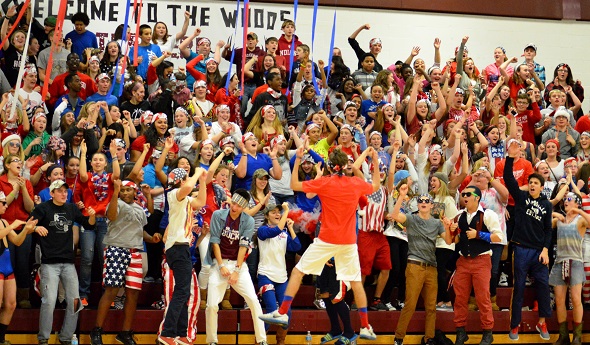
Welcome Back to 'The Woods'
January 17, 2014
By Geoff Kimmerly
Second Half editor
Buchanan, here we come.
The MHSAA and its Student Advisory Council will kick off "Battle of the Fans III" tonight with a return trip to Buchanan, last season's BOTF champion.
Buchanan, tucked into the southwest corner of the Lower Peninsula, is a Class B school of 465 students hailing from a community of roughly 4,400. The Bucks earned voters' hearts in 2013 as most of that student body and community filled the home gym – fittingly referred to as "The Woods" – for the MHSAA's BOTF visit.
 The MHSAA will visit finalists Beaverton, Bridgman, Frankfort and Traverse City West later this month and during the first two weeks of February before crowning a champion on Feb. 21 and inviting representatives from the winning section to a banner presentation during the Boys Basketball Semifinals on March 21 at Michigan State's Breslin Center.
Remember, follow the Battle of the Fans on the MHSAA's Facebook, Twitter and Instagram social media sites by clicking hashtag #BOTF. The MHSAA-produced story and video from tonight's trip will be published Tuesday on Second Half.
Here's Buchanan's application video for this winter's contest.
PHOTO is courtesy of Buchanan High School. Battle of the Fans III is sponsored in part by the United Dairy Industry of Michigan.