

Casting Lines for Future Tournaments
August 12, 2016
By Jack Roberts
MHSAA Executive Director
The MHSAA is best known to the public for the tournaments it conducts to conclude the fall, winter and spring seasons each school year.
These tournaments, the first and largest program of the MHSAA, have survived the Vietnam War, the Korean conflict and two World Wars. They have survived the technology bubble, the housing collapse, the energy crisis and the Great Depression.
MHSAA tournaments existed at the dawn of aviation and at the time of our nation’s lunar landing. Popes, presidents and governors have changed and changed again and again, and MHSAA tournaments roll on year after year.
But the sense of tradition and permanence and inevitability of MHSAA tournaments doesn’t dissuade us from asking questions about our tournaments, even some of the most basic questions. Here are two.
Question #1
I have long been and will always be an advocate for a Ryder Cup format for the MHSAA Golf Finals, and a team tennis approach to the MHSAA Tennis Finals; but 90 years of tradition is hard to overcome. Might this be a more exciting format? Could it be co-ed? Could it reverse the decline in boys tennis participation, and increase girls golf participation? Wouldn’t it be fun to try?
Periodically, the International Olympic Committee requires each of the designated Olympic sports to defend its status, to state its case why the sport should remain a part of the Olympic program. Then, after a series or votes that retain one sport at a time, the IOC drops the sport that makes the weakest case. It does so to make room for one of the previously unlisted sports that makes the best case for inclusion.
This would appear to keep the existing Olympic sports on their toes, and to keep the Olympic movement fresh and reflective of modern trends in sports.
While I would not enjoy the controversy, I can see the potential for some positive results if the MHSAA were to invoke the same policy for determining the 14 tournaments it will provide for girls and the 14 for boys.
This might cause us to consider more deeply what a high school sport should look like, or at least what an MHSAA tournament sport should stand for.
On the one hand, we might be inclined to drop tournaments for those sports that involve mostly non-faculty coaches and non-school venues, or require cooperative programs to generate enough participants to support a team, or resort almost entirely to non-school funding, or cater to individuals more than teams.
Or perhaps this process would cause policymakers to forget traditional thinking and ask: “In this day and age, should we shake off traditional notions of sport and consider more where modern kids are coming from?” That might mean fewer team sports and more individual sports, more “extreme” sports like snowboarding and skateboarding, and more lifetime sports, meaning not just golf and tennis and running sports, but also fishing and even shooting sports.
Currently, MHSAA policy states that the MHSAA will consider sponsorship of a tournament series for any sport which 64 member schools conduct on an interscholastic basis as a result of action by the governing boards of those schools.
Should the only question be how many schools sponsor a sport, or must an activity also have certain qualities and/or avoid certain “defects?” What should an MHSAA tournament sport look like and stand for?
Question #2
Bristling from criticism that his association is a money-grabbing exploiter of children, my counterpart in another state said, “If we were running our programs just to make money, we would do very many things very differently.” I knew exactly what he meant.
Because we care about the health and welfare of students, because we mean what we say that the athletic program needs to maximize the ways it enhances the school experience while minimizing academic conflicts, and because we try to model our claim that no sport is a minor sport when it comes to its potential to teach young people life lessons, we operate our programs in ways that make promoters, marketers and business entrepreneurs laugh, cry or cringe.
If money were the only object, we would seed and select sites to assure the teams that attracted the most spectators had the best chance to advance in our tournaments, regardless of the travel for any team or its fan base. If money were the only object, we would never schedule two tournaments to overlap and compete for public attention, much less tolerate three or four overlapping events. If money were the only object, we would allow signage like NASCAR events and promotions like minor league baseball games.
Those approaches to event sponsorship may not be all wrong; they’re just not all right for us. And we will live with the consequences of our belief system.
During a typical school year, more than 20 percent of the MHSAA’s 2,097 District, Regional and Final tournaments lose money. Not a single site in golf, skiing or tennis makes a single penny. In no sport did every District, Regional and Final site have revenue in excess of direct expenses.
In fact, in only three sports – boys and girls basketball and football – is revenue so much greater than direct expenses overall that it helps to pay for all the other tournaments in which the MHSAA invests.
That’s right: invests. When we present our budget to our board, we talk about the MHSAA’s investment in providing tournament opportunities in all those sports and all those places that cannot sustain the cost of those events on their own. How much is this investment worth to students, schools and society?
These two are core questions that require our focus far in advance of talk about scheduling, site selection, seeding and the myriad matters that too often hijack our time and attention.
BOTF X: Dow Aims to Give Teams Advantage with Charger Spirit
By
Geoff Kimmerly
MHSAA.com senior editor
February 1, 2022
MIDLAND – The 10th MHSAA “Battle of the Fans” – and first after a COVID-induced pause for 2021 – appropriately started Friday with a never-seen-before experience.
Midland Dow’s student section mostly makes its presence known at “Herb’s House” – the unofficial name of the Chargers’ gymnasium. But Dow hit the road, traveling four miles southeast to rival Midland High for the first of this year’s three finalists visits – the first time a section has ever hosted the MHSAA staff and Student Advisory Council at an away game.
Challenge? Chargers accepted it.
“We want to show up and be the best student section at their school,” Dow senior Daniel Watkins said. “That’s always the best thing ever.
“We bring the same energy. If nothing else, (the road game) almost feeds it more. Not only is it against our rival, but we’re at their place.”
This year’s BOTF X finalists tour also will include visits to Buchanan and Traverse City West.
Below is our highlight reel and 10 “X Factors” from our first stop with Dow’s student section.
1. Battle Plan
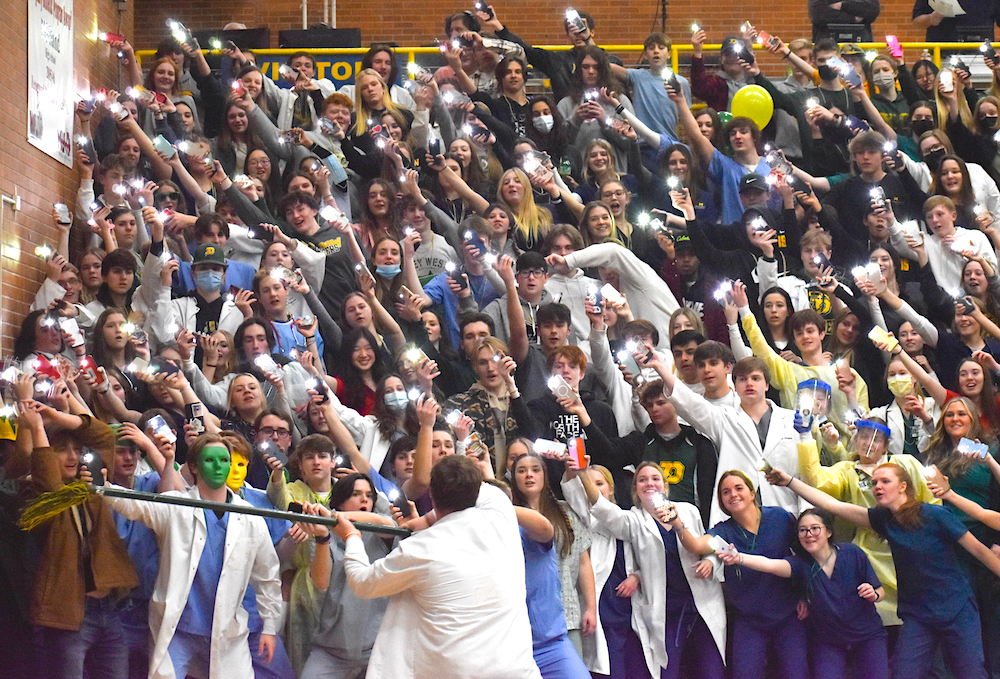
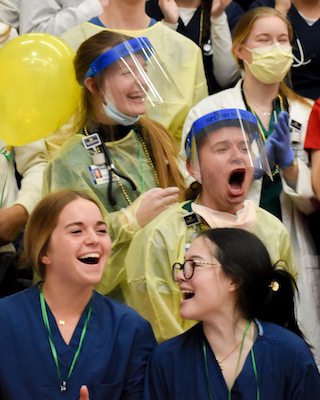
As noted, Dow’s section traveled to rival Midland High, which packed its own student cheering section to match. Dow students dressed in scrubs and lab coats for a “Doctors & Nurses” theme and collected money during halftime to buy snacks for the local hospital emergency room staff.
2. This is the Year of Dow
While a Dow student section has existed for years, a number of factors lined up well for this to be the section’s first applying for Battle of the Fans – and making the championship round. A focused group of leaders was eager to get to work after spectator limits kept crowds small during 2020-21.
3. Follow the Leaders
Every year four seniors – two girls and two boys – take over leadership. Those four leaders then select the next year’s leaders, to be announced at an assembly at the end of the school year. This year’s are Watkins, Kourtney Fischer, Abby Rey and Nolan Sanders. “We know the qualities a section leader needs to have, and we’re picking someone we know can handle the job and go the extra mile,” Rey said. “We make sure they’re driven, because it’s not an easy job – sometimes you just want to go to the game, but you have a bigger responsibility. And obviously someone who can communicate, especially with administrators.”
 4. Believe in the Spirit Stick
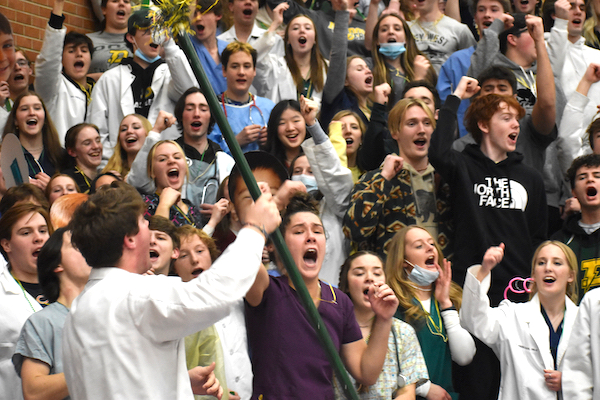
At least since 2014 – when it started appearing in yearbook photos – a Spirit Stick has been the instrument used by leaders to direct the section. The stick is green – and recently repainted – and also recently busted after one end broke off during that hockey game. But section leaders claim it’s still got plenty of magic – when a ball falls out of bounds their way, they make sure the pompom end of the stick sprinkles a little Charger spirit on it before putting it back in play. “It’s powerful, really,” Watkins said. “It changes games.”
5. Strength in Numbers
With an enrollment of nearly 1,300 students, getting a couple hundred to big games is a goal. Section leaders knew there was potential when the section showed in force for the football season opener at University of Michigan – which kicked off at noon on the first Friday of the school year. Despite being on the road this past Friday, nearly 150 students showed for the boys basketball game against the Chemics.
6. Get Social
Without argument, the biggest driver of Dow’s student section strength this year has been the addition of dedicated social media channels. Putting out announcements and themes on Instagram spreads the word, as those posts become part of students’ stories and get passed along quickly. Senior Kimberly Douglas puts together video and the section started a TikTok as well.
7. Making the Difference
Dow’s goal is to affect the game’s outcome – it’s that simple. All four leaders are athletes and know the confidence boost the section can provide. “We just want to be the turning point,” said Sanders, who plays hockey, baseball and runs track. “To allow our sports teams to get the closest to a win as possible … like a sixth man on the court, to help get those extra points. It’s important to understand that we’re not on the court, but we can have a say (in the result).”
8. They’re Everywhere
Dow is part of the Saginaw Valley League, which stretches from Lapeer to Mount Pleasant and makes rallying the section for frequent two-hour road trips difficult. So the section focuses on home events – and not just football and basketball. Watkins would rush from football practice to lead the section during volleyball matches, and the section supported its boys soccer team in the fall and is big at hockey.
 9. Coming Attractions
The section drives attendance by taking sporting events up a level in terms of fan participation. That has included some significant setup for football games; before the game against Midland this fall, Fischer and Rey built enough shakers – two solo cups taped together with corn inside – to fill six garbage bags. “Toga” and “Grandma & Grandpa” have been among popular themes, and they expect a big turnout for tonight’s boys basketball game “Teddy Bear Toss” with stuffed animals to be donated to a children’s hospital.
10. Keep it Classy
Behavior can go south during a rivalry game. Friday’s was a perfect example of how it doesn’t have to do so. While there was plenty of responding to each other’s cheers, it was basically some friendly back and forth and there wasn’t a hint of negativity coming from either side. For Dow’s leaders, cheering is more about giving their teams confidence – they don’t like booing, they don’t do the “who cares” during pregame introductions and they don’t tear opponents down. “That’s the way we do things,” Rey said. “It’s always positive. (Our students) respect that; they know that. They should be cheering out there for our team, and nothing else.”
The Battle of the Fans X finalists tour will resume Friday at Buchanan and conclude Feb. 8 at Traverse City West, with the champion announced Feb. 18.
PHOTOS (Top) Senior Daniel Watkins leads Dow’s cheering section with the Spirit Stick during Friday’s boys basketball game at Midland. (Middle) Students cheer on their classmates during a "Doctors & Nurses" theme night. (Below) Senior Abby Rey, front in purple, helps lead the section after scoring a team-high 16 points in the girls basketball team’s win over the Chemics to begin the evening. (Photos by Kaylee Emrick/Midland Dow Yearbook staff.)