

Casting Lines for Future Tournaments
August 12, 2016
By Jack Roberts
MHSAA Executive Director
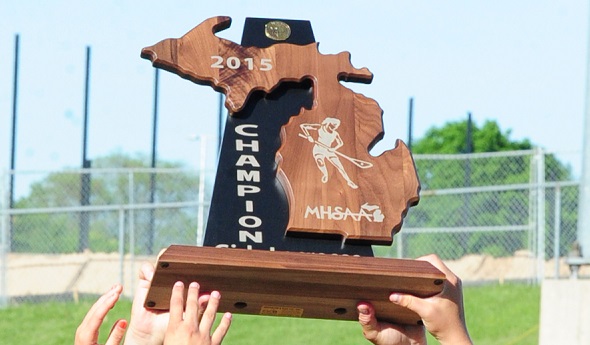
The MHSAA is best known to the public for the tournaments it conducts to conclude the fall, winter and spring seasons each school year.
These tournaments, the first and largest program of the MHSAA, have survived the Vietnam War, the Korean conflict and two World Wars. They have survived the technology bubble, the housing collapse, the energy crisis and the Great Depression.
MHSAA tournaments existed at the dawn of aviation and at the time of our nation’s lunar landing. Popes, presidents and governors have changed and changed again and again, and MHSAA tournaments roll on year after year.
But the sense of tradition and permanence and inevitability of MHSAA tournaments doesn’t dissuade us from asking questions about our tournaments, even some of the most basic questions. Here are two.
Question #1
I have long been and will always be an advocate for a Ryder Cup format for the MHSAA Golf Finals, and a team tennis approach to the MHSAA Tennis Finals; but 90 years of tradition is hard to overcome. Might this be a more exciting format? Could it be co-ed? Could it reverse the decline in boys tennis participation, and increase girls golf participation? Wouldn’t it be fun to try?
Periodically, the International Olympic Committee requires each of the designated Olympic sports to defend its status, to state its case why the sport should remain a part of the Olympic program. Then, after a series or votes that retain one sport at a time, the IOC drops the sport that makes the weakest case. It does so to make room for one of the previously unlisted sports that makes the best case for inclusion.
This would appear to keep the existing Olympic sports on their toes, and to keep the Olympic movement fresh and reflective of modern trends in sports.
While I would not enjoy the controversy, I can see the potential for some positive results if the MHSAA were to invoke the same policy for determining the 14 tournaments it will provide for girls and the 14 for boys.
This might cause us to consider more deeply what a high school sport should look like, or at least what an MHSAA tournament sport should stand for.
On the one hand, we might be inclined to drop tournaments for those sports that involve mostly non-faculty coaches and non-school venues, or require cooperative programs to generate enough participants to support a team, or resort almost entirely to non-school funding, or cater to individuals more than teams.
Or perhaps this process would cause policymakers to forget traditional thinking and ask: “In this day and age, should we shake off traditional notions of sport and consider more where modern kids are coming from?” That might mean fewer team sports and more individual sports, more “extreme” sports like snowboarding and skateboarding, and more lifetime sports, meaning not just golf and tennis and running sports, but also fishing and even shooting sports.
Currently, MHSAA policy states that the MHSAA will consider sponsorship of a tournament series for any sport which 64 member schools conduct on an interscholastic basis as a result of action by the governing boards of those schools.
Should the only question be how many schools sponsor a sport, or must an activity also have certain qualities and/or avoid certain “defects?” What should an MHSAA tournament sport look like and stand for?
Question #2
Bristling from criticism that his association is a money-grabbing exploiter of children, my counterpart in another state said, “If we were running our programs just to make money, we would do very many things very differently.” I knew exactly what he meant.
Because we care about the health and welfare of students, because we mean what we say that the athletic program needs to maximize the ways it enhances the school experience while minimizing academic conflicts, and because we try to model our claim that no sport is a minor sport when it comes to its potential to teach young people life lessons, we operate our programs in ways that make promoters, marketers and business entrepreneurs laugh, cry or cringe.
If money were the only object, we would seed and select sites to assure the teams that attracted the most spectators had the best chance to advance in our tournaments, regardless of the travel for any team or its fan base. If money were the only object, we would never schedule two tournaments to overlap and compete for public attention, much less tolerate three or four overlapping events. If money were the only object, we would allow signage like NASCAR events and promotions like minor league baseball games.
Those approaches to event sponsorship may not be all wrong; they’re just not all right for us. And we will live with the consequences of our belief system.
During a typical school year, more than 20 percent of the MHSAA’s 2,097 District, Regional and Final tournaments lose money. Not a single site in golf, skiing or tennis makes a single penny. In no sport did every District, Regional and Final site have revenue in excess of direct expenses.
In fact, in only three sports – boys and girls basketball and football – is revenue so much greater than direct expenses overall that it helps to pay for all the other tournaments in which the MHSAA invests.
That’s right: invests. When we present our budget to our board, we talk about the MHSAA’s investment in providing tournament opportunities in all those sports and all those places that cannot sustain the cost of those events on their own. How much is this investment worth to students, schools and society?
These two are core questions that require our focus far in advance of talk about scheduling, site selection, seeding and the myriad matters that too often hijack our time and attention.
Gorham Twins Setting Scoring Pace as Mendon Climbs Into League, District Contention
By
Scott Hassinger
Special for MHSAA.com
February 10, 2026
MENDON – After another stellar football season, Mendon is making some big waves on the basketball court as well this winter.
 As the 2025-26 regular season winds down, and coming off a run to the 8-Player Football Regional Finals with some of the same players leading the way, the Hornets are enjoying their finest season on the hardwood in many years. Under second-year head coach Matt Gorham, they are 16-1 overall, with a 10-0 record in the Southern Central Athletic Association West following an 84-40 win Monday in a divisional contest at Bellevue.
Mendon, which hosts its Division 4 District later this month, is looking to win its first league title in boys hoops since 2014 and raise its first District trophy in the sport since 2015.
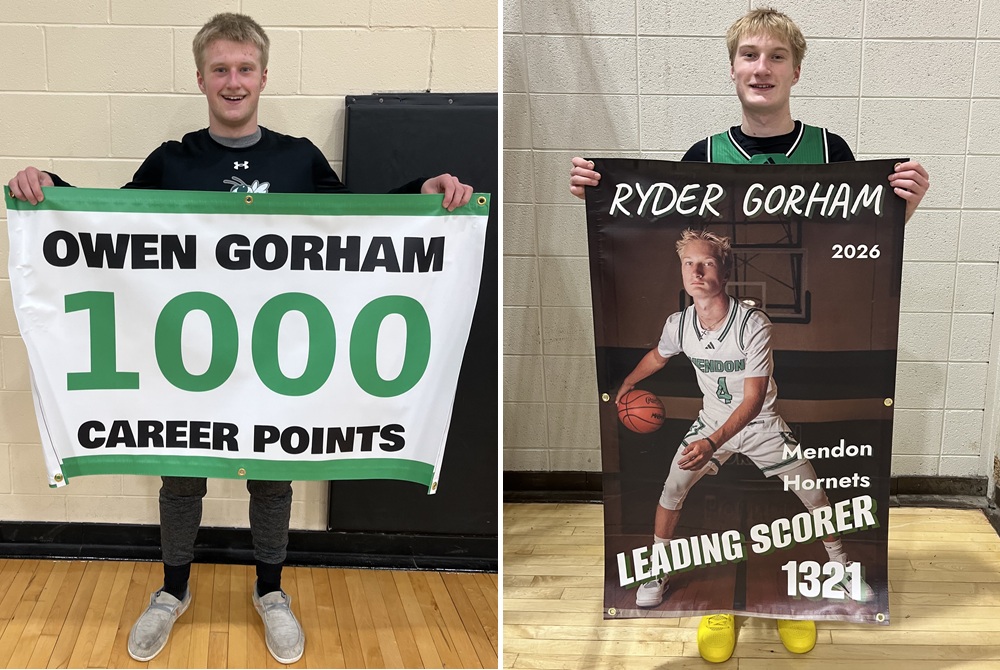
Two of the biggest catalysts in Mendon's pursuit of those two goals are senior guards and twin brothers Ryder Gorham and Owen Gorham. Both four-year varsity letterwinners went over the 1,000-point mark for their respective careers this winter and are the sons of the Hornets' head coach.
Ryder and Owen have experienced both the good and lean times during their careers. During their freshman season, Mendon finished with an 11-14 record before attaining back-to-back winning seasons as sophomores (12-11) and juniors (14-9).
"Mendon has always had good athletes. When I got here, I wanted to bring a professional look to the program in terms of preparing for teams, practicing hard and teaching life skills so that when they get out of here they are better people with a competitive nature," said Matt Gorham, who is employed as an agent for State Farm Insurance in Battle Creek and brought more than 25 years of coaching experience from Vicksburg, Portage Central, Portage Northern, Mattawan, Schoolcraft and Kalamazoo Valley Community College.
Gorham, who previously owned a business training athletes, got involved last spring as an assistant track & field coach at Mendon. That helped him build a better rapport with his current players.
"The kids have gotten to know me, and having two kids myself in the school helps,” he said. “I give last year's seniors that we had on the team a great deal of credit. They helped set the tone for the kids we had coming back. This year it was a matter of rinse and repeat, let's get a bit more focused and prepare better.”
Team speed and unselfishness are two of Mendon's biggest weapons.
Ryder Gorham, the Hornets' point guard, is averaging 24.3 points, 4.1 rebounds, 7.1 assists and 4.6 steals per game.
"Having been on varsity four years really helps. The pace of the game is much faster. I've always played against older and bigger guys, so it just helps the game come to me more naturally,' Ryder Gorham said.
 Mendon is averaging 69.6 points per game and owns a pair of overtime wins over divisional rival Colon (80-75 and 80-73). The Hornets' lone loss came 78-65 in another overtime thriller against Hillsdale Academy. Those two schools could meet again in the Division 4 Quarterfinals.
"Our defense generates most of our offense most of the time. We like to just get out and run,” Ryder Gorham said. “This team can set up plays, but we prefer to score a majority of our points in transition because most of the teams we play are bigger than us."
Ryder Gorham poured in a game-high 36 points in Monday's win at Bellevue. That effort pushed his career total to 1,344 points, surpassing the school record of David Schrock, who previously held the mark with 1,320. Ryder also owns school records for career 3-point field goals made at 141 and steals with 236. Owen Gorham is second in career steals at Mendon with 226.
"It all starts with Ryder. He makes us go and is a special player when the ball is in his hands,” Matt Gorham said. “He's an extremely great passer and establishes the tempo for us. Our biggest trick was to get Ryder's outside shot going so he could get more 3s up. He can drive, finish well and get to the free-throw line too."
Ryder loves the chemistry he and his brother Owen have developed by playing together throughout their high school careers.
"It's awesome being on the same court with my brother. We've been playing together our entire lives. We have that chemistry and know when each of us is hitting their shots. Our dad sometimes jumps on us a little more, but that's the way it's supposed to be," Ryder Gorham said.
Owen Gorham, a shooting guard, is averaging 18 points, 8.4 rebounds, 4.7 assists and 4.2 steals per game.
"My job is just to try and score any way I can. I feel like I've improved my rebounding the most over last season, and outworking people," Owen Gorham said.
"Owen moves very well without the basketball and does a nice job getting rebounds for a 5-10 kid. He almost always averages a double-double," Matt Gorham said.
Also playing a vital role in Mendon's starting lineup is senior forward Carter Huston with norms of 11 points, 2.9 rebounds, 1.3 assists and 1.8 steals per game.
 "I'm usually a forward but they put me everywhere. I can reach around other people and get a lot of boards and get to my spots quickly," said Hutson, who hopes to continue his golf or baseball career in college and major in sports entertainment and marketing.
"We have more leadership, and the guys are more focused in practice this season. This group really works together well. That's why whenever we come out of a huddle we say, 'As a team.’ My position challenges me. I'm average size, but yet I'm tall enough that I can jump and get more rebounds. I'm trying to be more of a leader and communicate better on the floor. We have better team chemistry this season too."
Hustle points, rebounding and getting tip passes are Huston's forte.
"Carter has developed into a pretty good third scoring threat for us. He takes the ball to the bucket and is a pretty good free-throw shooter," Matt Gorham said.
Other key players for Mendon are junior forward Tristan Wood (4.1 points, 5.3 rebounds) and 6-foot-5 junior center Dante Goto (7.6 points, 6.6 rebounds, 1.3 assists and 4.6 blocks).
"Dante is just a sponge. He soaks stuff in and has real good timing on rebounds and blocked shots. He's working on his mid-range shooting," Matt Gorham said. "Tristan is just an insane hard worker who does a lot of the dirty work for us by playing defense, getting loose balls, steals, rebounds and boxing out well. His hustle translates to points for us. You need those kind of guys."
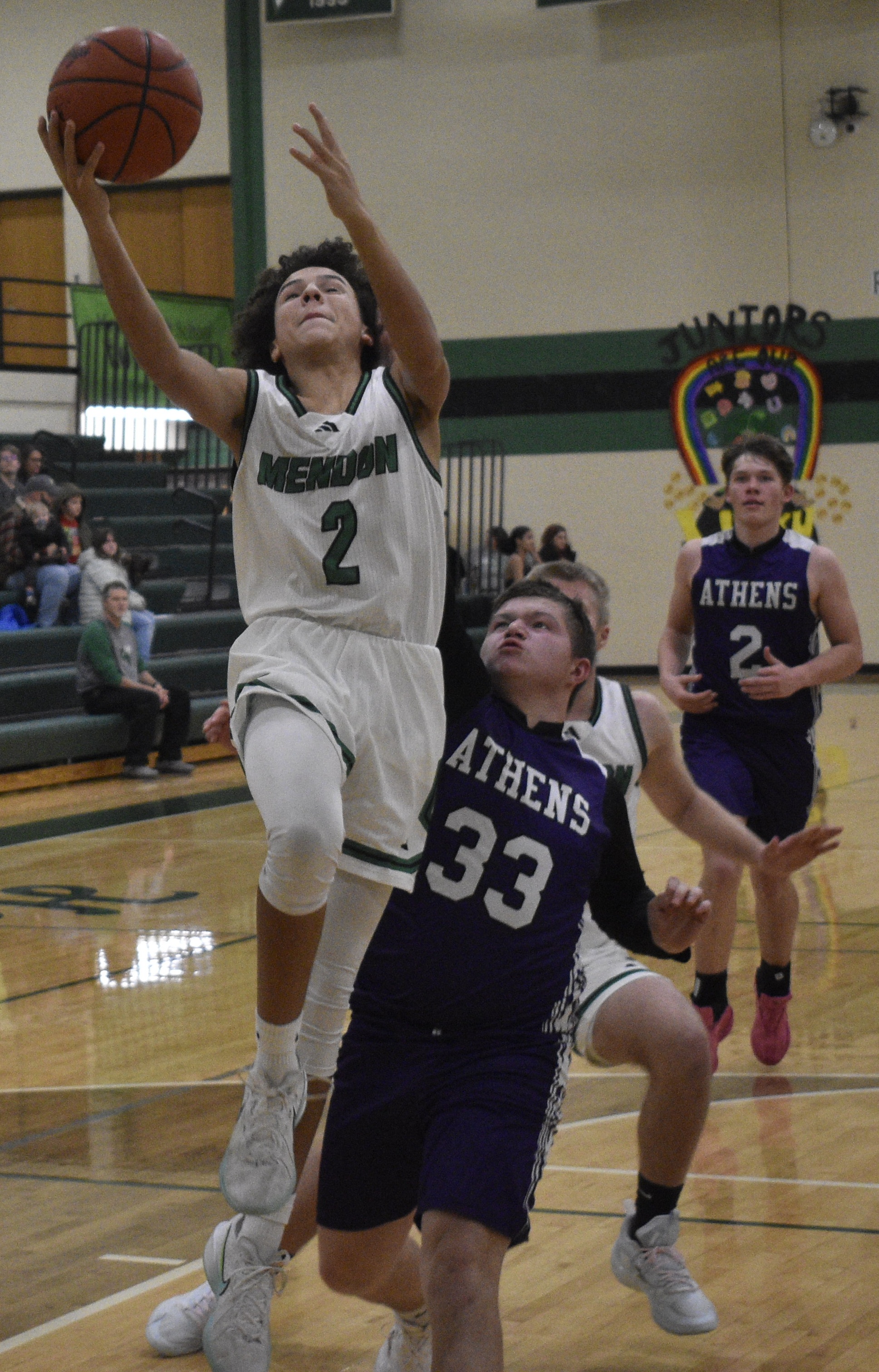
Junior Kyron Truckey has been a sparkplug off the bench at a guard spot averaging 3.3 points, 2.3 rebounds and one steal per game.
"From last year to this season Ky might be our most improved player as far as not just his play, but his basketball mind and maturity. He works extremely hard, plays good defense, takes good care of the basketball and knows his role," Matt Gorham said.
Senior post player Jayden Haigh is a two-year varsity contributor making an impact.
"Jayden is a very physical player and a real good passer. He gets pumped up when he makes a great pass, and that just shows the unselfishness of this team," Matt Gorham said.
Mendon's loss to Hillsdale Academy also should make the Hornets stronger in the postseason.
"We watched film for over two hours straight after that loss. I know we are going to learn a great deal from the mistakes we made in that game,” Owen Gorham said. “We are hoping we see (Hillsdale Academy) again somewhere down the line after Districts.
“It’s great to see us building a legacy here that no has seen before. We just want to help put basketball on the map at Mendon.”
 Scott Hassinger is a contributing sportswriter for Leader Publications and previously served as the sports editor for the Three Rivers Commercial-News from 1994-2022. He can be reached at [email protected] with story ideas for Berrien, Cass, St. Joseph and Branch counties.
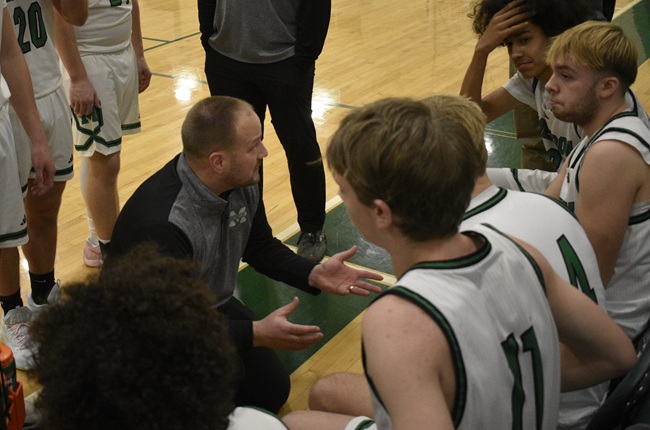
PHOTOS (Top) At left, Owen Gorham shows off a banner earlier this season identifying him as a 1,000-point scorer. At right, Ryder Gorham holds up a banner commemorating him as Mendon's all-time leading scorer with 1,344 points following Monday's 84-40 win at Bellevue. (Middle) Second-year Mendon varsity boys basketball coach Matt Gorham addresses his team during a recent home game against Athens. (Below) Mendon junior guard Kyron Truckey (2) drives inside for a layup and scores against Athens. (Top photos provided by Matt Gorham. Game photos by Scott Hassinger.)