

Casting Lines for Future Tournaments
August 12, 2016
By Jack Roberts
MHSAA Executive Director
The MHSAA is best known to the public for the tournaments it conducts to conclude the fall, winter and spring seasons each school year.
These tournaments, the first and largest program of the MHSAA, have survived the Vietnam War, the Korean conflict and two World Wars. They have survived the technology bubble, the housing collapse, the energy crisis and the Great Depression.
MHSAA tournaments existed at the dawn of aviation and at the time of our nation’s lunar landing. Popes, presidents and governors have changed and changed again and again, and MHSAA tournaments roll on year after year.
But the sense of tradition and permanence and inevitability of MHSAA tournaments doesn’t dissuade us from asking questions about our tournaments, even some of the most basic questions. Here are two.
Question #1
I have long been and will always be an advocate for a Ryder Cup format for the MHSAA Golf Finals, and a team tennis approach to the MHSAA Tennis Finals; but 90 years of tradition is hard to overcome. Might this be a more exciting format? Could it be co-ed? Could it reverse the decline in boys tennis participation, and increase girls golf participation? Wouldn’t it be fun to try?
Periodically, the International Olympic Committee requires each of the designated Olympic sports to defend its status, to state its case why the sport should remain a part of the Olympic program. Then, after a series or votes that retain one sport at a time, the IOC drops the sport that makes the weakest case. It does so to make room for one of the previously unlisted sports that makes the best case for inclusion.
This would appear to keep the existing Olympic sports on their toes, and to keep the Olympic movement fresh and reflective of modern trends in sports.
While I would not enjoy the controversy, I can see the potential for some positive results if the MHSAA were to invoke the same policy for determining the 14 tournaments it will provide for girls and the 14 for boys.
This might cause us to consider more deeply what a high school sport should look like, or at least what an MHSAA tournament sport should stand for.
On the one hand, we might be inclined to drop tournaments for those sports that involve mostly non-faculty coaches and non-school venues, or require cooperative programs to generate enough participants to support a team, or resort almost entirely to non-school funding, or cater to individuals more than teams.
Or perhaps this process would cause policymakers to forget traditional thinking and ask: “In this day and age, should we shake off traditional notions of sport and consider more where modern kids are coming from?” That might mean fewer team sports and more individual sports, more “extreme” sports like snowboarding and skateboarding, and more lifetime sports, meaning not just golf and tennis and running sports, but also fishing and even shooting sports.
Currently, MHSAA policy states that the MHSAA will consider sponsorship of a tournament series for any sport which 64 member schools conduct on an interscholastic basis as a result of action by the governing boards of those schools.
Should the only question be how many schools sponsor a sport, or must an activity also have certain qualities and/or avoid certain “defects?” What should an MHSAA tournament sport look like and stand for?
Question #2
Bristling from criticism that his association is a money-grabbing exploiter of children, my counterpart in another state said, “If we were running our programs just to make money, we would do very many things very differently.” I knew exactly what he meant.
Because we care about the health and welfare of students, because we mean what we say that the athletic program needs to maximize the ways it enhances the school experience while minimizing academic conflicts, and because we try to model our claim that no sport is a minor sport when it comes to its potential to teach young people life lessons, we operate our programs in ways that make promoters, marketers and business entrepreneurs laugh, cry or cringe.
If money were the only object, we would seed and select sites to assure the teams that attracted the most spectators had the best chance to advance in our tournaments, regardless of the travel for any team or its fan base. If money were the only object, we would never schedule two tournaments to overlap and compete for public attention, much less tolerate three or four overlapping events. If money were the only object, we would allow signage like NASCAR events and promotions like minor league baseball games.
Those approaches to event sponsorship may not be all wrong; they’re just not all right for us. And we will live with the consequences of our belief system.
During a typical school year, more than 20 percent of the MHSAA’s 2,097 District, Regional and Final tournaments lose money. Not a single site in golf, skiing or tennis makes a single penny. In no sport did every District, Regional and Final site have revenue in excess of direct expenses.
In fact, in only three sports – boys and girls basketball and football – is revenue so much greater than direct expenses overall that it helps to pay for all the other tournaments in which the MHSAA invests.
That’s right: invests. When we present our budget to our board, we talk about the MHSAA’s investment in providing tournament opportunities in all those sports and all those places that cannot sustain the cost of those events on their own. How much is this investment worth to students, schools and society?
These two are core questions that require our focus far in advance of talk about scheduling, site selection, seeding and the myriad matters that too often hijack our time and attention.
Breslin Bound: 2025-26 Girls Report Week 9
By
Geoff Kimmerly
MHSAA.com senior editor
February 9, 2026
It’s league championship time this girls basketball season, and with less than a month until District play begins and some interesting clusters of games coming up thanks to winter-weather postponements, there will be at least a few wild finishes over the next few weeks.

Our report below includes news on a few teams that already have clinched, mentions of more that are closing in, and explanations of at least two pairs of contenders likely to decide their league titles while seeing each other twice over just a matter of days.
“Breslin Bound” is powered by MI Student Aid and based on results and schedules posted for each school at MHSAA.com.
Week in Review
The countdown of last week’s five most intriguing results:
1. Midland 38, Grand Haven 36 In the midst of a deadlocked Saginaw Valley League North race, co-leader Midland (13-4) took on another Division 1 contender in Grand Haven (13-2).
2. Birmingham Groves 73, Detroit Edison 62 This win over an annual power just adds to an incredible turnaround for Groves (13-2), which won six games last season and is guaranteed its first winning record since 2017-18.
3. Clarkston 52, Rochester Hills Stoney Creek 45 This pulled the Wolves (12-5) even with Stoney Creek (12-2) atop the Oakland Activities Association Red standings, and these two face off again tonight.
4. Jackson Lumen Christi 55, Farmington Hills Mercy 49 The Titans (14-2) moved into the Catholic High School League Bishop final with this win over the Marlins (11-4).
5. Grand Rapids South Christian 50, Grand Rapids West Catholic 44 The Sailors (16-0) continued to pull away in an Ottawa-Kent Conference Gold where West Catholic (12-4) is one of three more teams with at least 10 wins.
Watch List
With an eye toward March, here are two teams in each division making sparks:
DIVISION 1
Howell (17-1) The Highlanders have already clinched the Kensington Lakes Activities Association West title with three league games left to play. The title is Howell’s second in three seasons, and the dominance has extended through its nonleague schedule with the only loss to Rockford (13-1) at Cornerstone University in December. Many statewide eyes will be turned toward the KLAA overall championship game Feb. 26 and the Highlanders’ anticipated matchup with reigning Division 1 champion Belleville.
Utica Eisenhower (12-2) The Eagles can clinch a share of the Macomb Area Conference Red title with a win against Port Huron on Tuesday, and they are a combined 34-5 over the last two seasons having also shared the league title a year ago. Eisenhower has loaded up tough nonleague competition and no doubt benefitted even from losses to Goodrich and Detroit Renaissance – with a chance to head into the postseason on a roll with a trip to Flint Powers Catholic for the regular-season finale.
DIVISION 2
Big Rapids (10-3) The Cardinals have won 20 straight Central State Activities Association games and lead the Red after the first cycle through the schedule and after winning the title a year ago. They defeated CSAA White leader Morley Stanwood 57-53 and have lost to Grand Rapids Covenant Christian, Spring Lake and Mount Pleasant – which are either undefeated or contending for league titles. Matchups with Saginaw Heritage and Kent City on back-to-back days next week will be a valuable challenge.
Otsego (12-1) The Bulldogs are a one-point overtime December loss to Richland Gull Lake from perfection, and that’s while playing a schedule that’s included two wins over Sturgis (13-2) and one apiece against Marshall (10-5), Plainwell (10-3) and Saturday over Niles Brandywine (15-1). Otsego looks ready to climb after winning 12-14 games each of the last three seasons and has jumped from No. 15 to No. 4 in statewide Division 2 MPR over the last two weeks.
DIVISION 3
Cass City (12-3) The Red Hawks have won 10 of their last 11 and have a half-game lead on Caro in the Greater Thumb Conference White with Thursday’s matchup with the Tigers potentially for first place alone in the league. Cass City already handed Caro one of its two losses and Deckerville one of its two defeats, with wins over Sanford Meridian and Unionville-Sebewaing also especially of note. Two of the Red Hawks’ losses were back-to-back to Hemlock (15-1) and Kingston (15-0), but Cass City will have a similar opportunity against Sandusky (14-1) in the regular-season finale.
Morley Stanwood (12-2) As noted above, Morley Stanwood leads the CSAA White, with those losses nonleague to Big Rapids and Fremont (11-3). Both came during a string of four straight games against opponents now with double-digit wins, and Morley Stanwood also defeated Kent City and Mio during that string. The Kent City win was by a 64-62 score, and the rematch is set for Feb. 20. The team needs just one more win to equal last season’s total.
DIVISION 4
Au Gres-Sims (14-1) The Wolverines jumped 11 spots to No. 6 in statewide Division 4 MPR this week thanks in part to a 55-37 win over Hale (10-3) after they defeated Hale by just a point in overtime in their first meeting Jan. 8. Au Gres-Sims and Mio are the only undefeated teams left in North Star League Little Dipper play and meet Tuesday for the first time this season and then again Friday. The Wolverines’ only loss came to Tawas (11-2) in their season opener, by just four points.
Ishpeming (12-2) The Hematites are a half-game back of first-place Negaunee and a half-game ahead of Houghton atop the Western Peninsula Athletic Conference standings – and although it didn’t count toward the league title race, Ishpeming avenged its WestPAC loss Friday by downing the previously-undefeated Miners 51-39. The Hematites did that after falling to Gladstone 53-49 in overtime only three nights before. Baraga (14-2) and Munising (12-3) should be two more challenging opponents before Ishpeming finishes the regular season with Houghton (11-4).
Can’t-Miss Contests
Be on the lookout for results of these games coming up:
Monday – Grass Lake (15-1) at Michigan Center (14-2) – There are a handful of Cascades Conference games left, but the East championship should come down to this matchup after Grass Lake won the first meeting 61-55.
Tuesday – Wayne Memorial (14-1) at Belleville (16-0) – The Tigers can clinch a share of the Kensington Lakes Activities Association East championship with a win over the rival Zebras, who have lost only to Belleville.
Tuesday – Hanover-Horton (13-2) at Brooklyn Columbia Central (13-2) – These two are tied for first in the Cascades Conference West and will meet again Feb. 17.
Wednesday – New Lothrop (13-1) at Ovid-Elsie (12-2) – New Lothrop has a half-game lead on Ovid-Elsie in the Mid-Michigan Activities Conference after winning their Jan. 5 meeting 47-34.
Friday – Jackson Lumen Christi (14-2) vs. Orchard Lake St. Mary’s (15-2) at Oakland – The champions of the Catholic High School League Central-East and Central-West, respectively, will meet for the Bishop Tournament title.
MHSAA.com's weekly “Breslin Bound” reports are powered by MI Student Aid, a division within the Department of Lifelong Education, Advancement, and Potential (MiLEAP). MI Student Aid encourages students to pursue postsecondary education by providing access to student financial resources and information. MI Student Aid administers the state’s scholarship and grant programs that help make college Accessible, Affordable and Attainable for you. Click to connect with MI Student Aid and find more information on Facebook and X @mistudentaid.
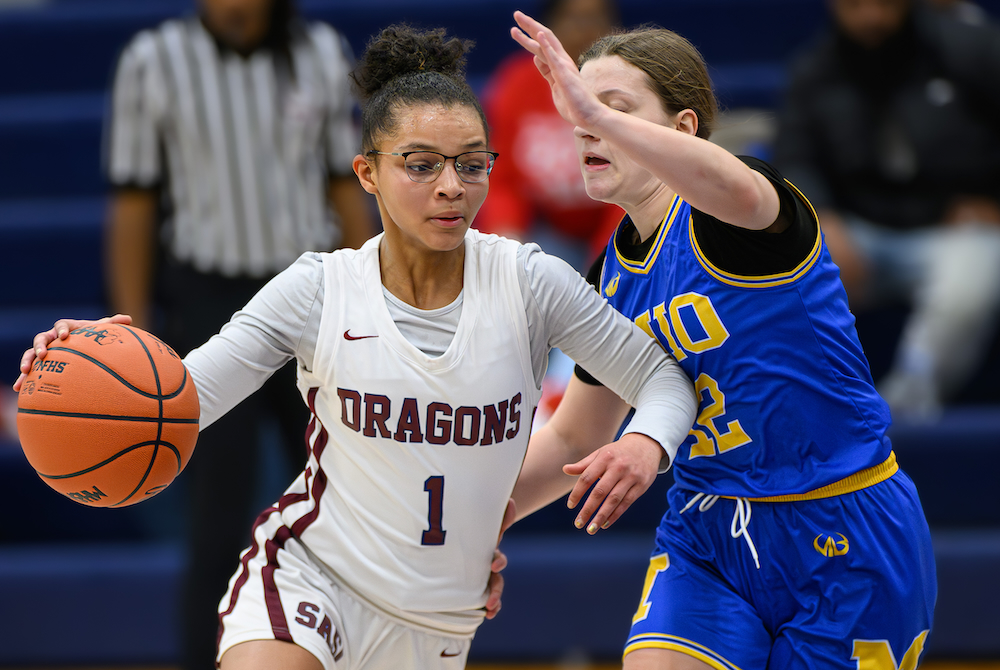
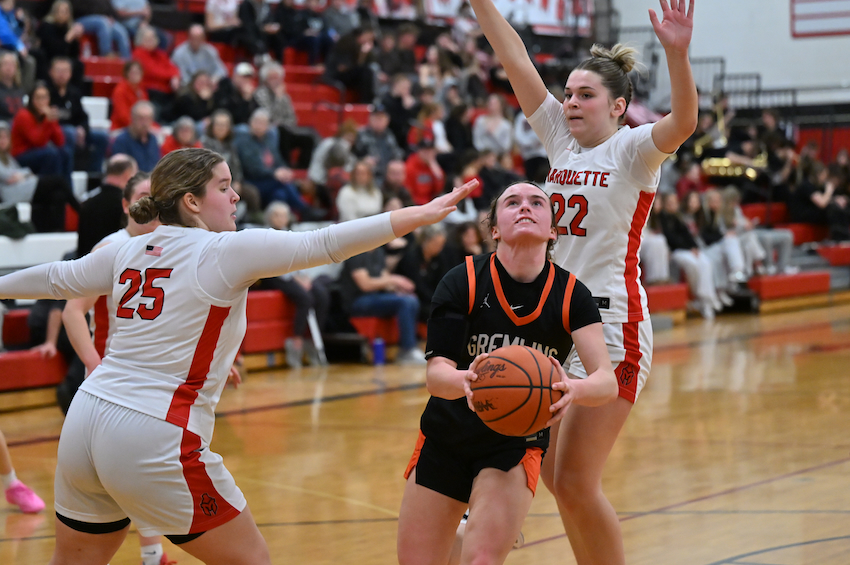
PHOTOS (Top) Saginaw Arts & Sciences Academy’s Symone Brandt (1) drives during a 51-43 loss to Mio on Friday. (Middle) Houghton's Kate Filpus cuts between Marquette's Kylie Smith (25) and Hayley Taylor (22) and takes a shot. (SASA/Mio photo by Kolleth Photo. Houghton/Marquette photo by Cara Kamps.)