


Classes Still Create Hoosier Hysteria
July 27, 2017
By Rob Kaminski
MHSAA benchmarks editor
This is the fourth part in a series on MHSAA tournament classification, past and present, that will be published over the next two weeks. This series originally ran in this spring's edition of MHSAA benchmarks.
Twenty years ago, Bloomington North High School won the Indiana High School Athletic Association boys basketball championship, defeating Delta 75-54 at the RCA Dome in Indianapolis.
The date, March 22, 1997, is at the same time revered and disdained by traditionalists in the state who saw it as the last schoolboy championship game the state would ever host.
That’s how devout the game of basketball, particularly interscholastic basketball, had become in the Hoosier state during the 87 years a state champion – one state champion, to be precise – was crowned.
Following that 1997 season, the IHSAA moved to a four-class system for its roundball tournaments, like so many of its state association counterparts had done years earlier.
It would be shocking to find more than a small percentage of current high school basketball players around the country unfamiliar with the iconic movie Hoosiers, even though the film is now more than 30 years old.
And, the storyline for that blockbuster unfolded more than 30 years prior to its release, when small-town, undermanned Milan High School defeated Muncie Central High School 32-30 in the 1954 IHSAA title game.
Perhaps it’s because of the David vs Goliath notion, or the fame of the movie that replaced Milan with the fictional Hickory and real-life star Bobby Plump with Hollywood hero Jimmy Chitwood, or the simple fact that Indiana had something other states didn’t.
Whatever the reason, plenty of opposition remains to this day to basketball classification in the state.
The fact is, the small rural schools were regularly being beaten handily by the much larger suburban and city schools as the tournament progressed each season.
Small schools also were closing at a rapid rate following the state’s School Reorganization Act in 1959, as students converged on larger, centralized county schools. From 1960 to 2000, the number of schools entering the tournament dropped from 694 to 381, and in 1997 a total of 382 schools and 4,584 athletes began competition at the Sectional level (the first level of the IHSAA Basketball Tournament).
It was at the entry level of the tournament where school administrators felt the pain of the new class system, but not necessarily for the same nostalgic reasons as the fans who either attended or boycotted the tournament.
At the Sectional round of the tournament, the IHSAA was culling just 2 percent of the revenue, with the participating schools splitting the balance. So, when Sectional attendance dropped by 14 percent in that first year of class basketball, many schools realized a financial loss. It was money they had grown to count on in prior years to help fund various aspects of the department.
Schools cumulatively received more than $900,000 from Sectional competition in 1998, but that total was down from more than $1 million in the last year of the single-class tournament.
Yet, the current format provides a great deal more opportunity and realistic chances at championship runs for schools of all enrollments.
To date, 60 additional teams have championship or runner-up trophies on display in school trophy cases around Indiana.
That was the mission in front of then-IHSAA commissioner Bob Gardner (now National Federation executive director) once the board made its decision: to give thousands more student-athletes the opportunity for once-in-a-lifetime experiences.
As any statistician knows, figures can be manipulated to tell any side of a story. Declining attendance in year one of class basketball is such a number.
The truth is tournament attendance had been on a steady downward spiral since its peak of just over 1.5 million in 1962. By the last single-class event in 1997, the total attendance was half that.
The challenge then and today, as it is for all state associations, is to find that delicate balance for those holding onto tradition, those holding onto trophies, and the number of trophies to hand out.
Editor’s Note: Stories from the Fort Wayne Journal Gazette in 1998 and from a 2007 issue of Indianapolis Monthly provided facts in this article.

Storch Returns to Retirement After Elevating Alpena Teams From Cellar to Contenders
By
Tom Spencer
Special for MHSAA.com
December 16, 2022
It wasn’t long ago that Alpena boys and girls soccer opponents took their long bus rides to play the Wildcats expecting an easy win, and most likely by securing the victory by the eight-goal differential rule, commonly known as the “mercy rule.”
 Worse yet, the Wildcats also had to take those trips across the northern part of the Lower Peninsula, as well as northern and southern journeys of two hours, dreading thoughts of experiencing yet another shortened game.
Those expectations started to change in 2011, when Tim Storch, arguably the most decorated coach in the history of Michigan high school soccer, took the reins of the Wildcats’ boys and girls programs.
Storch made the move after retiring from Troy Athens as a teacher and coach of the Redhawks’ boys and girls soccer teams.
Slowly but surely, Alpena’s mercy losses disappeared – and wins over their Big North Conference opponents became reality. Under Storch, the Wildcats went from the cellar to challenging for titles.
But now, Storch is showing some mercy on the Big North – perhaps an early Christmas present. The conference schools won’t see him on sidelines any longer. He’s retiring – again.
Storch is doing so after leading the Wildcats to wins over all conference opponents except Traverse City West. The Wildcats did get a tie this fall against the Titans, one of the BNC schools that regularly makes a deep postseason run, as Alpena stayed in the league title race most of the season.
“When I came to Alpena it was about trying to make the program relevant in the school, the community, the area, the BNC and northern Michigan,” Storch recalled. “We got to that point after some growing pains.
“Early on we took our lumps, and we were mercied by everybody,” he continued. “By the end we were competitive with everybody.”
Storch, who started the Athens soccer programs from scratch in 1981, won eight Class A or Division 1 Finals titles with the Redhawks. He’s near the top of the lists of the winningest boys and girls soccer coaches in the state. The last of his 1,109 wins was a 3-1 victory over Bay City Western during this fall’s postseason.
The Wildcats also beat conference opponent Cadillac in their District opener. They finished 14-6-3 on the season.
Storch will be dearly missed in Northern Michigan, veteran Petoskey boys and girls coach Zach Jonker pointed out. Jonker’s Northmen picked up a victory over Alpena in the Division 2 District Final – also Storch’s last game.
"Tim has had a legendary career as one of the most influential figures in Michigan high school soccer over the past 40 years while having an enormous impact on thousands of student-athletes,” Jonker said. “Over the past decade, Tim helped to dramatically raise the overall level of play in the Big North.
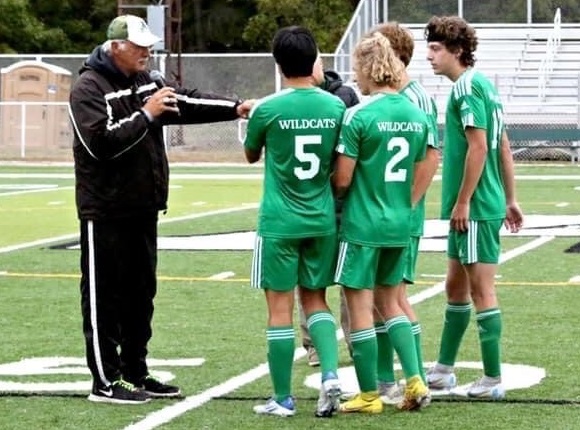 “He is one of fiercest competitors I have ever coached against, but he is also one of the most genuine and empathetic coaches I have ever encountered,” Jonker continued. “I feel fortunate to have been able to build a competitive relationship with him and call him a friend."
Storch’s last game with the Alpena girls also was a District Final, a 3-0 loss May 31 to West.
Storch is proud of what the Wildcats accomplished, noting logistics — unlike in southeastern Michigan — were a big challenge.
“We were an island,” Storch said. “We were big school in the middle of nowhere.
“We couldn’t get together and have any kind of summer program with other communities because they didn’t have soccer, and if they had soccer they were at a Class D or C level that was way beneath what we were playing in the Big North.”
Storch’s tenure, which included six years serving as the Wildcats’ athletic director while coaching, drew accolades from his coaches and athletic directors. In addition to Jonker, Gaylord AD Christian Wilson, and West boys head coach and girls assistant coach Matt Griesinger gave high praise.
They are among those who will miss the successful coach.
“Tim leaves Alpena in better shape than when he arrived, and that is the true mark of a great coach and administrator,” Wilson said. “He has been an outstanding representative of Alpena High School, both as a soccer coach and as an athletic director.
“Tim brought a level of stability and expertise and was well-thought of by players, coaches, and community members.”
Griesinger, who has led the Titans to considerable postseason success and upheld BNC dominance since taking over the West program eight seasons ago, was particularly impressed with Storch’s energy and passion for his players evident in every match.
“Tim is one of the most respected coaches in the state, and what he has done for the soccer communities in both Troy and Alpena is not just commendable, but also something that every high school coach should hope to emulate,” Griesinger stated. “Storch is a stand-up guy, and all of us other coaches in the BNC should consider ourselves lucky that our journeys in the sport overlapped.”
Storch is leaving Michigan high school sports as they face a shortage of referees and qualified coaches. He’s not certain of the exact reasons for it, but he points to time constraints and pressures faced on and off the field.
And, he knows the days of a teacher starting a career, coaching sports and sticking with it are long gone.
“My wife has always said I was a dinosaur,” Storch said with a chuckle. “Back in my day, even if you had family and kids, you still made time for coaching.
“Coaching was part of my fiber — it kind of defined me.”
Storch is quick to point out “soccer coach” was just one of three hats he wore, along with history teacher and friend.
“I’m Mr. Storch to my students,” he recalls telling his student-athletes at Athens. “I’m Coach to my kids, and I am Tim to my friends.
“They are three different hats; I learned how to wear them and how to balance them.”
Storch looks back to all the friendships he’s made around the game of soccer – with former players, fellow coaches, and referees – with excitement for the future.
He is also keeping in mind former players, referees and coaches who have passed on.
“It is kind of humbling when I think back all the years (to) coaches, referees and players I have interacted with,” he said. “We’re all here for a finite time.
“We need to make the most of it and hopefully leave the place a better place when we leave.”
 Tom Spencer is a longtime MHSAA-registered basketball and soccer official, and former softball and baseball official, and he also has coached in the northern Lower Peninsula area. He previously has written for the Saginaw News, Bay County Sports Page and Midland Daily News. He can be reached at [email protected] with story ideas for Manistee, Wexford, Missaukee, Roscommon, Ogemaw, Iosco, Alcona, Oscoda, Crawford, Kalkaska, Grand Traverse, Benzie, Leelanau, Antrim, Otsego, Montmorency, Alpena, Presque Isle, Cheboygan, Charlevoix and Emmet counties.
PHOTOS (Top) Recently-retired Alpena soccer coach Tim Storch, left, talks things over with one of his players. (Middle) Storch, holding the microphone, elevated the Wildcats’ girls and boys programs since taking over both in 2011. (Photos courtesy of Therese Shaw.)