


Classes Still Create Hoosier Hysteria
July 27, 2017
By Rob Kaminski
MHSAA benchmarks editor
This is the fourth part in a series on MHSAA tournament classification, past and present, that will be published over the next two weeks. This series originally ran in this spring's edition of MHSAA benchmarks.
Twenty years ago, Bloomington North High School won the Indiana High School Athletic Association boys basketball championship, defeating Delta 75-54 at the RCA Dome in Indianapolis.
The date, March 22, 1997, is at the same time revered and disdained by traditionalists in the state who saw it as the last schoolboy championship game the state would ever host.
That’s how devout the game of basketball, particularly interscholastic basketball, had become in the Hoosier state during the 87 years a state champion – one state champion, to be precise – was crowned.
Following that 1997 season, the IHSAA moved to a four-class system for its roundball tournaments, like so many of its state association counterparts had done years earlier.
It would be shocking to find more than a small percentage of current high school basketball players around the country unfamiliar with the iconic movie Hoosiers, even though the film is now more than 30 years old.
And, the storyline for that blockbuster unfolded more than 30 years prior to its release, when small-town, undermanned Milan High School defeated Muncie Central High School 32-30 in the 1954 IHSAA title game.
Perhaps it’s because of the David vs Goliath notion, or the fame of the movie that replaced Milan with the fictional Hickory and real-life star Bobby Plump with Hollywood hero Jimmy Chitwood, or the simple fact that Indiana had something other states didn’t.
Whatever the reason, plenty of opposition remains to this day to basketball classification in the state.
The fact is, the small rural schools were regularly being beaten handily by the much larger suburban and city schools as the tournament progressed each season.
Small schools also were closing at a rapid rate following the state’s School Reorganization Act in 1959, as students converged on larger, centralized county schools. From 1960 to 2000, the number of schools entering the tournament dropped from 694 to 381, and in 1997 a total of 382 schools and 4,584 athletes began competition at the Sectional level (the first level of the IHSAA Basketball Tournament).
It was at the entry level of the tournament where school administrators felt the pain of the new class system, but not necessarily for the same nostalgic reasons as the fans who either attended or boycotted the tournament.
At the Sectional round of the tournament, the IHSAA was culling just 2 percent of the revenue, with the participating schools splitting the balance. So, when Sectional attendance dropped by 14 percent in that first year of class basketball, many schools realized a financial loss. It was money they had grown to count on in prior years to help fund various aspects of the department.
Schools cumulatively received more than $900,000 from Sectional competition in 1998, but that total was down from more than $1 million in the last year of the single-class tournament.
Yet, the current format provides a great deal more opportunity and realistic chances at championship runs for schools of all enrollments.
To date, 60 additional teams have championship or runner-up trophies on display in school trophy cases around Indiana.
That was the mission in front of then-IHSAA commissioner Bob Gardner (now National Federation executive director) once the board made its decision: to give thousands more student-athletes the opportunity for once-in-a-lifetime experiences.
As any statistician knows, figures can be manipulated to tell any side of a story. Declining attendance in year one of class basketball is such a number.
The truth is tournament attendance had been on a steady downward spiral since its peak of just over 1.5 million in 1962. By the last single-class event in 1997, the total attendance was half that.
The challenge then and today, as it is for all state associations, is to find that delicate balance for those holding onto tradition, those holding onto trophies, and the number of trophies to hand out.
Editor’s Note: Stories from the Fort Wayne Journal Gazette in 1998 and from a 2007 issue of Indianapolis Monthly provided facts in this article.
Preview: Power Pair Returning for Finals Rematch, New Individual Champs Set to Soar
By
Geoff Kimmerly
MHSAA.com senior editor
March 5, 2026
Hartland breaking past perennial power Rockford to win last season’s MHSAA Finals team gymnastics championship seemed to put those two on a collision course to meet again with this season’s title on the line.
Seven teams scored at least 140 points at their Regionals last weekend. But Hartland and Rockford put up the top scores by solid margins and should again be favorites at Friday’s Team Final at Milford High School.
The individual competitions Saturday are guaranteed new champions, as both 2025 winners graduated. Hartland’s Alexis Fundich was a close second in Division 1 last season but will have to hold off a group that includes other past placers and a few top challengers competing at the Finals for the first time. In Division 2, nearly half of last season’s top 10 could make a run at climbing to the podium’s highest step.
Team competition begins at 4 p.m. Friday, with individual competition in both Divisions 1 and 2 beginning at noon Saturday. For information on purchasing tickets, Finals rotations for both days and Regional results, go to the Gymnastics page – and see below for several contenders to watch:
Team
Farmington United: The program with the third-most Finals team titles in MHSAA history finished second in 2024 and third last winter and will be in pursuit of a first championship since 2019. Farmington won its Regional last week at Birmingham Groves by less than a point ahead of Huron Valley United, 143.500-142.675, but finishing first on vault (36.850) and bars (35.325) and also topping 36 points on beam.
Hartland: The Eagles won last season’s team title by 2.05 points ahead of Rockford, and the title was the program’s first since 1999. They posted the highest Regional score in the state last week, 147.750, to win at East Lansing by nearly seven points and with scores of 36.150 on bars, 36.825 on vault, 37.200 on beam and 37.575 on floor – the beam and floor scores exceeding what they posted at last year’s Final.
Rockford: The Rams own the record for most Finals championships – seven – and saw their three-year championship streak end with a runner-up finish last winter. But they certainly could make it four titles in five years this week after winning their Regional week with a 146.275 at their home gym. A 36.900 on beam and 37.450 scores on vault and floor were especially notable.
Division 1
Mikayla Dicks, Farmington United senior: She will compete at her first MHSAA Finals after finishing second all-around at her Regional with a 36.900 and first places on vault (9.55) and bars (9.625).
Olivia Flatt, Hartland junior: She competed on three apparatuses at last season’s Final with high places of fifth on beam and vault, and will compete all-around this time after finishing third at her Regional with a 36.375 while tying for first on beam (9.5).
Alexis Fundich, Hartland senior: The reigning all-around runner-up missed the championship last season by only a few tenths of a point and won floor. She returns after winning her Regional all-around with a 37.950 and first places on bars (9.675), beam (9.5, tied) and floor (9.825).
Kate Gostlin, Hartland senior: She will graduate having competed at Finals all four years of high school, and improved all-around from 23rd as a sophomore to 12th last season with a championship on vault. She should make another big jump all-around after finishing second to Fundich at their Regional with a 36.600 – which included a win on vault (9.8).
Isabella Janiga, Tecumseh sophomore: The Brooklyn Columbia Central student competes for Tecumseh as part of a cooperative program and finished 14th all-around last season. She’ll return after winning her Regional all-around last week at 36.300 with a first place on beam (9.425).
Grace LaFlure, Grand Rapids Kenowa Hills senior: She will also compete at the Finals for the first time after finishing second all-around at her Regional with a 36.225 that included a first place on bars (8.85).
Stella Musialowski, Huron Valley United senior: She could make a run at the all-around championship after improving from tied for 15th as a sophomore to sixth last season and winning her Regional all-around last week with a 37.225 that included a first place on floor (9.55).
Elise Watkins, Rockford senior: She’s made an impressive progression from competing on two apparatuses in Division 2 as a freshman, to finishing 18th in Division 1 all-around as a sophomore and competing on three apparatuses in Division 1 as a junior. She will enter her last Finals coming off a Regional-winning 36.425 all-around that included first places on beam (9.425) and floor (9.625).
Division 2
Taliya Andrews, East Lansing Catholic DeWitt junior: She competed on Division 1 floor as a freshman and returns to the Finals after finishing a close second at her Regional in all-around at 36.150 with a first place on floor (9.45).
Baylee Bartlett, Grand Ledge senior: She could make a run at the all-around title after finishing sixth a year ago and third last week at her Regional with a 35.200 that included a tie for first place on beam (9.3).
Rae DeFrang, Rockford junior: She won her Regional all-around at 36.900 with a first place on bars (9.15) and second places on the other three apparatuses. She finished 12th all-around at last year’s Final.
Reese DeFrang, Rockford junior: She’s the reigning Division 2 vault champion and will compete all-around at the Finals for the first time after finishing third at her Regional with a 36.025 and winning vault (9.6).
Phoebe Elder, Haslett United senior: She went from competing on three apparatuses as a sophomore to finishing 11th all-around in Division 1 last season, and could make another jump into contention after winning last week’s Regional all-around with a 36.325 and a first place on bars (9.375).
Isabel Galindo, Plymouth senior: After tying for eighth all-around last season, she enters this weekend as a contender coming off a Regional championship score of 35.200 with a first place on vault (9.175).
Lillian Green, Rockford junior: She finished third all-around at last season’s Final and heads into this weekend after scoring a 36.275 Regional all-around to finish second with first places on floor (9.3) and beam (9.3).
Olivia Lothian, Lowell junior: She went from competing on two apparatuses as a freshman to finishing fifth all-around last season. She placed fourth behind the Rockford trio at their Regional with a 35.350 and top-11 places on every apparatus.
Aubrey Woodman, Farmington United junior: She’s won bars at the Finals both of her first two seasons and could contend for the all-around title this weekend after winning her Regional with a 35.700 and another bars title (9.0).
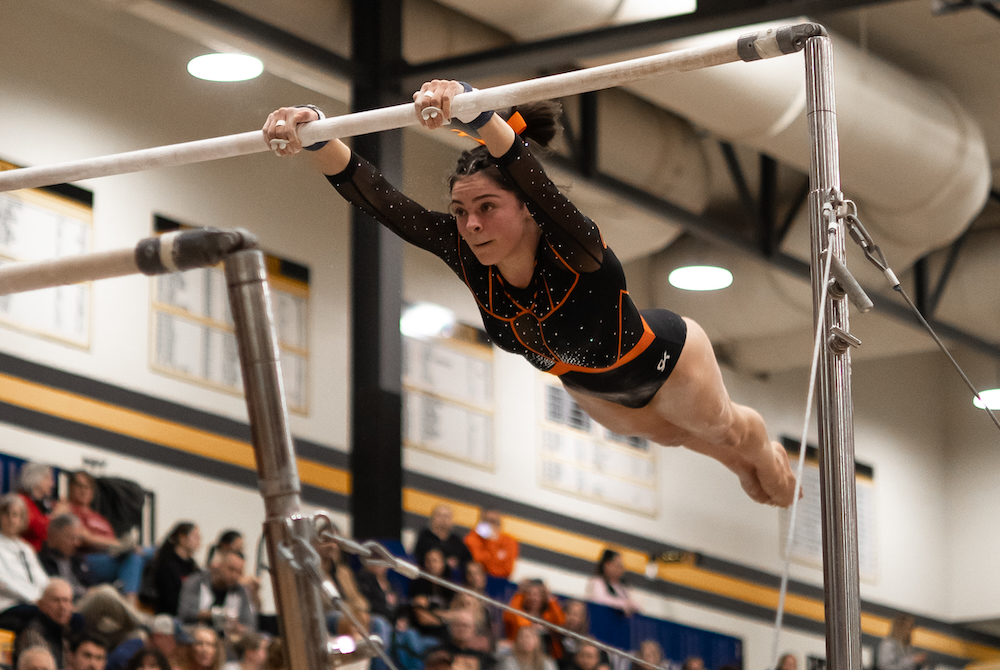
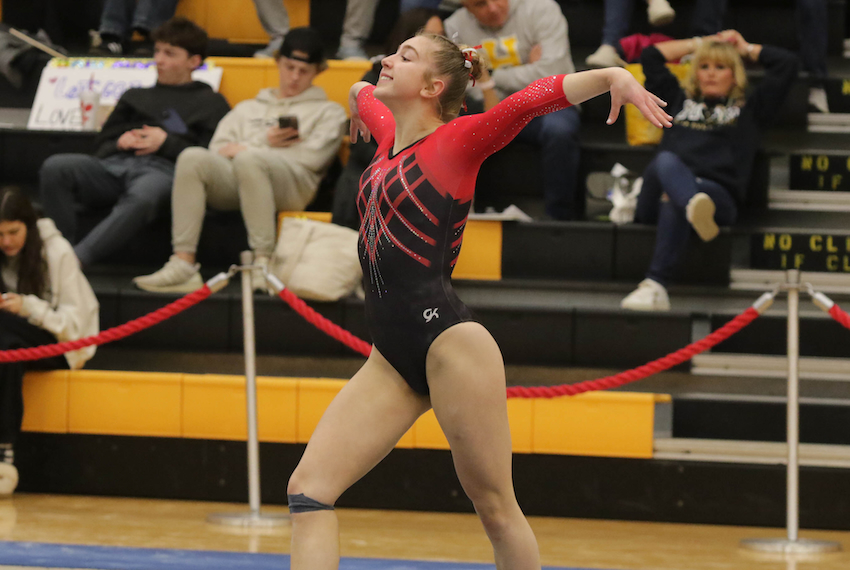
PHOTOS (Top) A gymnast performs her bars routine during last season’s MHSAA Team Final at Grand Rapids Kenowa Hills. (Middle) Haslett United’s Phoebe Elder competes on floor exercise during the Division 1 individual meet. (Click for more from High School Sports Scene.)