


Classes Still Create Hoosier Hysteria
July 27, 2017
By Rob Kaminski
MHSAA benchmarks editor
This is the fourth part in a series on MHSAA tournament classification, past and present, that will be published over the next two weeks. This series originally ran in this spring's edition of MHSAA benchmarks.
Twenty years ago, Bloomington North High School won the Indiana High School Athletic Association boys basketball championship, defeating Delta 75-54 at the RCA Dome in Indianapolis.
The date, March 22, 1997, is at the same time revered and disdained by traditionalists in the state who saw it as the last schoolboy championship game the state would ever host.
That’s how devout the game of basketball, particularly interscholastic basketball, had become in the Hoosier state during the 87 years a state champion – one state champion, to be precise – was crowned.
Following that 1997 season, the IHSAA moved to a four-class system for its roundball tournaments, like so many of its state association counterparts had done years earlier.
It would be shocking to find more than a small percentage of current high school basketball players around the country unfamiliar with the iconic movie Hoosiers, even though the film is now more than 30 years old.
And, the storyline for that blockbuster unfolded more than 30 years prior to its release, when small-town, undermanned Milan High School defeated Muncie Central High School 32-30 in the 1954 IHSAA title game.
Perhaps it’s because of the David vs Goliath notion, or the fame of the movie that replaced Milan with the fictional Hickory and real-life star Bobby Plump with Hollywood hero Jimmy Chitwood, or the simple fact that Indiana had something other states didn’t.
Whatever the reason, plenty of opposition remains to this day to basketball classification in the state.
The fact is, the small rural schools were regularly being beaten handily by the much larger suburban and city schools as the tournament progressed each season.
Small schools also were closing at a rapid rate following the state’s School Reorganization Act in 1959, as students converged on larger, centralized county schools. From 1960 to 2000, the number of schools entering the tournament dropped from 694 to 381, and in 1997 a total of 382 schools and 4,584 athletes began competition at the Sectional level (the first level of the IHSAA Basketball Tournament).
It was at the entry level of the tournament where school administrators felt the pain of the new class system, but not necessarily for the same nostalgic reasons as the fans who either attended or boycotted the tournament.
At the Sectional round of the tournament, the IHSAA was culling just 2 percent of the revenue, with the participating schools splitting the balance. So, when Sectional attendance dropped by 14 percent in that first year of class basketball, many schools realized a financial loss. It was money they had grown to count on in prior years to help fund various aspects of the department.
Schools cumulatively received more than $900,000 from Sectional competition in 1998, but that total was down from more than $1 million in the last year of the single-class tournament.
Yet, the current format provides a great deal more opportunity and realistic chances at championship runs for schools of all enrollments.
To date, 60 additional teams have championship or runner-up trophies on display in school trophy cases around Indiana.
That was the mission in front of then-IHSAA commissioner Bob Gardner (now National Federation executive director) once the board made its decision: to give thousands more student-athletes the opportunity for once-in-a-lifetime experiences.
As any statistician knows, figures can be manipulated to tell any side of a story. Declining attendance in year one of class basketball is such a number.
The truth is tournament attendance had been on a steady downward spiral since its peak of just over 1.5 million in 1962. By the last single-class event in 1997, the total attendance was half that.
The challenge then and today, as it is for all state associations, is to find that delicate balance for those holding onto tradition, those holding onto trophies, and the number of trophies to hand out.
Editor’s Note: Stories from the Fort Wayne Journal Gazette in 1998 and from a 2007 issue of Indianapolis Monthly provided facts in this article.
D2 Preview: Downriver Powers Rising to Lead Another Finals Charge
By
Geoff Kimmerly
MHSAA.com senior editor
March 4, 2022
A return of full Downriver League power will make Saturday morning’s Competitive Cheer Final feel much more like what we’re used to from Division 2.
Allen Park is back at Grand Rapids’ Delta Plex seeking a third-consecutive championship, and Gibraltar Carlson is returning after a year away and still sits second on the all-time championships list with 11. Southgate Anderson is a three-time Finals champ, and together they finished first-third in the league and their Regional over these last many weeks.
Division 2 competition begins at 10 a.m. Saturday. Tickets cost $10 and may be bought at the Delta Plex, and all four Finals will be broadcast live on MHSAA.tv and viewable with a subscription. More information, including the spectator seating chart, is posted at MHSAA.com.
Below is a look at all eight finalists:
ALLEN PARK
League finish: First in Downriver League
Coach: Julie Goodwin, 17th season
Championship history: Four MHSAA titles (most recent 2021), four runner-up finishes.
Top score: 794.16.
Team composition: 28 total (nine seniors, 11 juniors, six sophomores, two freshmen).
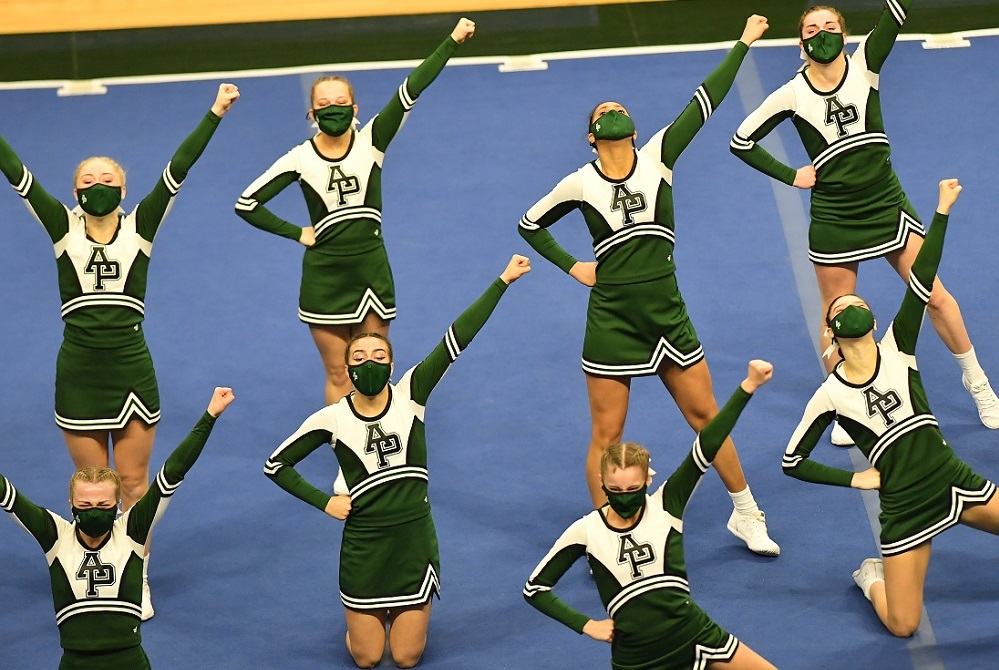
Outlook: The Jaguars are competing for a third-straight Division 2 title and seventh-straight top-two Finals finish. They are again undefeated heading into Finals weekend, having broken 790 points in five of their last six competitions. Many of the team’s leaders have championship experience and multiple all-state honors – seniors Adreanna Carone and Cassidy Kuhn and junior Emma Buffa are returning first-team selections from 2021, while senior Cassidy Reardon and junior Kristine Beste made the second team last season and juniors Madisyn Setser and Emma Williams earned honorable mentions.
CEDAR SPRINGS
League finish: First in Ottawa-Kent Conference Gold
Coach: Katy Hradsky, first season
Championship history: Seeking first top-two Finals finish.
Top score: 755.08.
Team composition: 17 total (nine seniors, one junior, six sophomores, one freshman).
Outlook: Cedar Springs is making its fourth-straight trip to the Finals and improved from seventh in 2020 to sixth last season. This will be the first appearance with Hradsky as head coach, but she was a major part of the program as the junior varsity coach the previous eight seasons after serving as co-head coach at Sparta from 2011-13. Cedar Springs posted its second-highest score, 753.58, to finish Regional runner-up. Senior Abbey Salisbury made the all-state second team last season.
DEARBORN DIVINE CHILD
League finish: First in Detroit Catholic League Bishop
Co-coaches: Amber Genevich, 19th season; Shelley Popiel, fifth season
Championship history: Division 2 runner-up 2011-14.
Top score: 782.86
Team composition: 20 total (three seniors, three juniors, seven sophomores, seven freshmen)
Outlook: Divine Child is returning to the Finals after two seasons away, riding a wave of strong scores with four straight of 761 or better and three of those reaching at least 773. Senior Makenna Yost and juniors Reese Eberth both earned all-Regional recognition last season.
DEWITT
League finish: Third in Capital Area Activities Conference Red
Coach: Candace Heskitt, 14th season
Championship history: Division 2 runner-up in 2020, 2015 and 2007.
Top score: 765.86 at Regional.
Team composition: 25 total (five seniors, four juniors, five sophomores, 11 freshmen).
Outlook: The Panthers have moved up from sixth in 2019 to third in 2020 to runner-up last season and enter this weekend coming off their first competition championship of this season. DeWitt is trending upward with its four highest scores coming in its four most recent events. Senior Anneliese Phillips made the all-state second team last season, and senior Hilary Ballard earned honorable mention.
GIBRALTAR CARLSON
League finish: Second in Downriver League
Coach: Alyssa Tocco, first season
Championship history: 11 MHSAA titles (most recent 2019), six runner-up finishes.
Top score: 790.18 at District
Team composition: 23 total (three seniors, nine juniors, three sophomores, eighth freshmen).
Outlook: Carlson is back at the Finals having finished first or second in Division 2 every season from 2008-20. Tocco is a past three-time Division 2 runner-up as an athlete on Allen Park’s team and a national runner-up collegiately, and served as an assistant at Plymouth the last five seasons before taking over the Marauders. They’ve finished first or second at all of their competitions this winter. The team didn’t compete during the 2021 postseason, but senior Destiny Rogers earned an all-state honorable mention in 2020 as a sophomore on that Finals runner-up team.
GRAND RAPIDS FOREST HILLS NORTHERN
League finish: First in O-K White
Coach: Carly Sienkiewicz, fifth season
Championship history: Seeking first top-two Finals finish.
Top score: 757.04
Team composition: 18 total (two seniors, nine juniors, five sophomores, two freshmen).
Outlook: Forest Hills Northern is returning to the Finals for the first time since 1998 after winning its second-straight league title and reaching Regionals for the second time in three seasons. The Huskies’ top four scores have come over their four most recent competitions, including in winning the District title with a 756.82 two weeks ago. Junior Julie Fiser earned all-District recognition last season as FHN just missed advancing.
MUSKEGON REETHS-PUFFER
League finish: Second in O-K Green
Coach: Lisabeth Smith, first season
Championship history: Seeking first top-two Finals finish.
Top score: 750.64 at Regional
Team composition: 23 total (four seniors, nine juniors, three sophomores, six freshmen).
Outlook: Reeths-Puffer is returning to the Finals for the first time since 2018, after winning its District and posting its top score in finishing third at the Regional. Smith is a past Reeths-Puffers cheer athlete and coached in the program immediately after graduation, later taking over the Muskegon High program before taking a few years off and returning to coach the Rockets this winter. Reeths-Puffer just missed the Finals last season, but seniors Lillyanna Schoonbeck and Summer Curtis, junior Makenna Anthony and sophomore Kendall Eek all earned all-Regional recognition.
SOUTHGATE ANDERSON
League finish: Third in Downriver League.
Coach: Colette Norscia, 19th season
Championship history: Division 1 champion 2012, 2013 and 2014.
Top score: 782.44 at District.
Team composition: 22 total (four seniors, 10 juniors, three sophomores, five freshmen).
Outlook: Anderson improved from sixth in 2020 to a close fifth last season, and its top score this season is more than six points higher than heading into last year’s Finals. The Titans have surpassed 771 three times and 761 in seven competitions. Senior Savannah Thomas and juniors Bella Plonka and Alexis Morris earned all-Regional recognition last season.
PHOTO Allen Park competes during last year’s Round 1 at Breslin Center. (Click for more from Hockey Weekly Action Photos.)