


Classes Still Create Hoosier Hysteria
July 27, 2017
By Rob Kaminski
MHSAA benchmarks editor
This is the fourth part in a series on MHSAA tournament classification, past and present, that will be published over the next two weeks. This series originally ran in this spring's edition of MHSAA benchmarks.
Twenty years ago, Bloomington North High School won the Indiana High School Athletic Association boys basketball championship, defeating Delta 75-54 at the RCA Dome in Indianapolis.
The date, March 22, 1997, is at the same time revered and disdained by traditionalists in the state who saw it as the last schoolboy championship game the state would ever host.
That’s how devout the game of basketball, particularly interscholastic basketball, had become in the Hoosier state during the 87 years a state champion – one state champion, to be precise – was crowned.
Following that 1997 season, the IHSAA moved to a four-class system for its roundball tournaments, like so many of its state association counterparts had done years earlier.
It would be shocking to find more than a small percentage of current high school basketball players around the country unfamiliar with the iconic movie Hoosiers, even though the film is now more than 30 years old.
And, the storyline for that blockbuster unfolded more than 30 years prior to its release, when small-town, undermanned Milan High School defeated Muncie Central High School 32-30 in the 1954 IHSAA title game.
Perhaps it’s because of the David vs Goliath notion, or the fame of the movie that replaced Milan with the fictional Hickory and real-life star Bobby Plump with Hollywood hero Jimmy Chitwood, or the simple fact that Indiana had something other states didn’t.
Whatever the reason, plenty of opposition remains to this day to basketball classification in the state.
The fact is, the small rural schools were regularly being beaten handily by the much larger suburban and city schools as the tournament progressed each season.
Small schools also were closing at a rapid rate following the state’s School Reorganization Act in 1959, as students converged on larger, centralized county schools. From 1960 to 2000, the number of schools entering the tournament dropped from 694 to 381, and in 1997 a total of 382 schools and 4,584 athletes began competition at the Sectional level (the first level of the IHSAA Basketball Tournament).
It was at the entry level of the tournament where school administrators felt the pain of the new class system, but not necessarily for the same nostalgic reasons as the fans who either attended or boycotted the tournament.
At the Sectional round of the tournament, the IHSAA was culling just 2 percent of the revenue, with the participating schools splitting the balance. So, when Sectional attendance dropped by 14 percent in that first year of class basketball, many schools realized a financial loss. It was money they had grown to count on in prior years to help fund various aspects of the department.
Schools cumulatively received more than $900,000 from Sectional competition in 1998, but that total was down from more than $1 million in the last year of the single-class tournament.
Yet, the current format provides a great deal more opportunity and realistic chances at championship runs for schools of all enrollments.
To date, 60 additional teams have championship or runner-up trophies on display in school trophy cases around Indiana.
That was the mission in front of then-IHSAA commissioner Bob Gardner (now National Federation executive director) once the board made its decision: to give thousands more student-athletes the opportunity for once-in-a-lifetime experiences.
As any statistician knows, figures can be manipulated to tell any side of a story. Declining attendance in year one of class basketball is such a number.
The truth is tournament attendance had been on a steady downward spiral since its peak of just over 1.5 million in 1962. By the last single-class event in 1997, the total attendance was half that.
The challenge then and today, as it is for all state associations, is to find that delicate balance for those holding onto tradition, those holding onto trophies, and the number of trophies to hand out.
Editor’s Note: Stories from the Fort Wayne Journal Gazette in 1998 and from a 2007 issue of Indianapolis Monthly provided facts in this article.
CAAC, SW Teams Find Home in New League
By
Pam Shebest
Special for MHSAA.com
January 21, 2020
Two struggling hockey leagues found a perfect match, thanks to the behind-the-scenes work of commissioners, athletic directors and coaches.
 The Capital Area Activities Conference, a multi-sport league, had just four hockey teams.
The Southwest Michigan High School Hockey League was down to five.
Merging the two leagues was a no-brainer for all involved.
“We learned (the CAAC) was a small league like us,” Portage Northern athletic director Chris Riker said. “It’s tough to have a league with just five teams. By putting our two leagues together, and we had already played a lot of those teams, it just made a lot of sense.”
The new 10-team league, called the South Central High School Hockey League, is bringing a new excitement to both areas and came together very smoothly in less than a year.
Forming a new league boiled down to one thing: “survive and thrive,” said Randy Allen, a former MHSAA assistant director and retired CAAC commissioner.
“I’m tickled pink, and I give high marks to the coaches and athletic directors.”
The league is divided into the Central and South divisions, with five teams in each.
Most teams in the league are co-op teams with Jackson Lumen Christi in the Central and Mattawan, Portage Central and Portage Northern in the South the only teams made up of students from one school.
Other teams in the Central Division are the Capital City Capitals (DeWitt, Lansing Catholic, Mason, St. Johns), Mid-Michigan Marauders (Holt, Grand Ledge, Eaton Rapids, Portland, Potterville), East Side Stars (East Lansing, Williamston, Haslett, Bath, Laingsburg) and Okemos (with Fowlerville).
 Co-op teams in the South are the Kalamazoo Eagles (Gull Lake, Battle Creek Harper Creek, Battle Creek Pennfield, Paw Paw, Parchment, Plainwell) and Kalamazoo United (Loy Norrix, Kalamazoo Central, Hackett Catholic Prep).
The first big showcase event featuring all 10 teams is set for Friday and Saturday at Wings West in Kalamazoo.
“One of the other cool things about this new league is we’re bringing them all together for the ‘Annual Youth Hockey Fights for Autism’ at Wings West Feb. 15, and all 10 teams will be playing,” said Frank Noonan, commissioner of the old SWMHSHL and now commissioner of the new league.
Riker said the new league “creates some excitement the way we structured the season with playing in your division and playing crossover games.
“We’re going to have a big championship game where the two No. 1 teams play each other, the second-place teams meet and so on (Feb. 22 at Wings West).”
There are other benefits as well, Noonan said.
“The best thing for hockey in the area is they have set opponents they’re going to play every year and, for the kids who earn (end-of-season) awards, it means more,” he said.
“There are 10 teams competing for the awards rather than our typical six-team old division, so it’s more prestigious, more of an honor to win an award in the new league.”
MHSAA Assistant Director Cody Inglis, who took over administration of hockey for the Association when Allen retired in 2014, put Riker – a member of the MHSAA’s Representative Council – in touch with Allen. The two jump-started talks last March.
One key was getting the Eagles to become a school-based team rather than a club one.
“Karyn Furlong (Gull Lake athletic director) was willing to jump on and sponsor the Eagles,” Riker said. “She did all the leg work in getting the schools on board.
“The Eagles organization also deserves a lot of recognition for saying, hey, we’ve been in this club status and now we’re willing to come in and be a school sport.
“Now they have the opportunity to play in the state tournament, which they’ve never had.”
The MHSAA Semifinals and Finals are set for March 12-14 at USA Hockey Arena in Plymouth.
Allen, who went on to serve as commissioner of the CAAC until retiring at the start of this school year, first floated the idea of merging the two leagues to coaches from his conference.
“They were all in favor of it,” he said. “(Inglis) talked with (Riker), and we met to talk.
 “At the athletic directors conference (in March 2019), we kept inching closer to forming a new league. We did not hear one word of objection through the entire process. We had 110-percent backing.
“After everybody covered all the bases, we made it final and came up with the official name.”
Allen said the new league has “great leadership from the athletic directors and (Noonan), who took the lead on everything.”
He added that one perk of the new league is getting officials together. “Now we get officials to be part of one overall group, and there is a possibility of mentoring,” Allen added.
Capital City Capitals coach Travis Van Tighem likes the new league.
“It’s great to get some more natural rivals,” he said. “Our league got to be so small we played a lot of other (non-league) teams or showcase games.
“When more games have meaning or some substance to them, you can see kids growing and there are some natural rivalries that it creates, so it’s exciting.”
Travel is not a problem, Van Tighem added.
“For us in Mid-Michigan, it you go outside the Lansing area, it’s going to be an hour anyway. So coming to Kalamazoo, it’s an hour 20 or hour 15, but if we go anywhere else, except for Jackson, it’s going to be at least an hour,” he said.
“Athletic directors and coaches got together, and it really came together nicely. It’s been great so far.”
Other league facilities besides Wings West are Optimist Ice Arena (Jackson), Summit Sports and Ice Complex (Dimondale) and Suburban Ice (East Lansing).
 Pam Shebest served as a sportswriter at the Kalamazoo Gazette from 1985-2009 after 11 years part-time with the Gazette while teaching French and English at White Pigeon High School. She can be reached at [email protected] with story ideas for Calhoun, Kalamazoo and Van Buren counties.
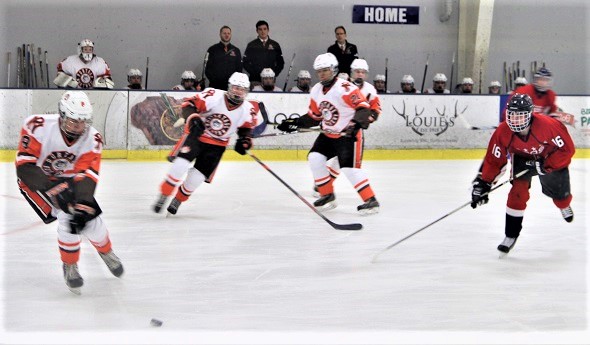
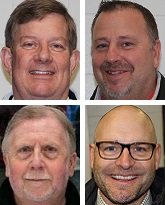
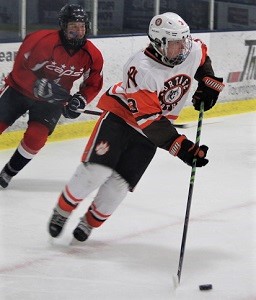
PHOTOS: (Top) Portage Northern and Capital City face off in an SCHSHL crossover Jan. 9 at Wings West. (Middle) Clockwise from top left: Frank Noonan, Chris Riker, Travis Van Tighem and Randy Allen. (Below) Northern’s Nolan McCarthy (3) charts his next move with the puck. (Photos by Pam Shebest.)