

And the MHSAA Survey Says ...
April 2, 2015
By Rob Kaminski
MHSAA benchmarks editor
A survey of MHSAA member schools was conducted in the fall of 2014 aimed to determine opinions for and against a myriad of out-of-season coaching/contact period topics within the school year.
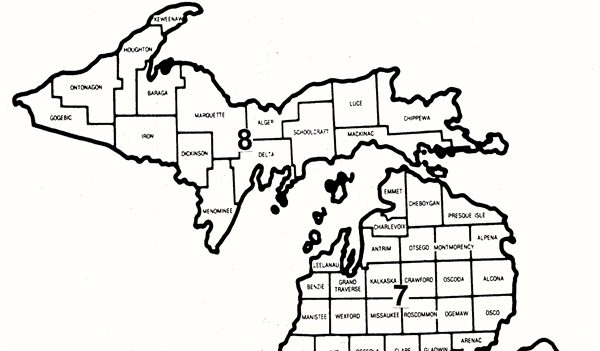
Below are some of the summaries drawn from that survey, plus a map of zones referred to in a number of points.
Survey Summary and Highlights
The larger the school, the higher the percentage of students who are involved in organized non-school sports.
The Detroit metro area (Zone 3) has the highest percentage of respondents in each of two groups in which the highest percentage of students are involved in organized non-school sports ... the 60 to 80% and 40 to 60% groups. The Grand Rapids area (Zone 6) ranks second.
The northern Lower Peninsula (Zone 7) and the Upper Peninsula (Zone 8) have the highest percentage of respondents in the group in which the lowest percentage of students are involved in organized non-school sports . . . the 0 to 20% group. This is also true of Zones 1, 2 and 5, although less dramatically.
In the majority of schools, coaches work with students out of season under the three- or four-player rule for a few weeks just before the season. This is generally true regardless of school classification or geographic zone.
In nearly 80% of schools, the frequency of coaches working with students out of season under the three- or four-player rule is one or two days a week.
100% of schools that sponsor basketball hold open gyms for basketball. Two-thirds of volleyball schools hold volleyball open gyms. Half of lacrosse schools hold lacrosse open gyms. Open gyms in baseball, softball and soccer occur in 40 to 45% of responding schools. Open gyms are less common for other sports.
More than half of all schools conduct open gyms for only a few weeks, just before the season begins.
In 85% of schools, the frequency of open gyms is one or two days a week.
The multi-sport athlete is common in schools of every classification, but more common in Class C and D schools than in Class A and B.
The multi-sport athlete is common in schools of every geographical zone, but more common in Zones 1, 2, 4, 7 and 8 than in Zones 3, 5 and 6.
Two-thirds of schools do not ban athletes from out-of-season workouts while in-season in a different school sport. Permitting weightlifting is most common (84%), then three- or four-player workouts (70%), then conditioning (66%) and open gyms (65%), and finally non-school competitions (57%).
Single-sport coaches are more common in smaller schools than larger (perhaps because fewer sports are sponsored in smaller schools).
For one question, schools were asked to rate ideas from 1 (I like the concept) to 6 (I do not like the concept). Average would be 3.5.
More than 60% of schools favor a no-contact period for all out-of-season sports at the start of every other sport’s season. (Support ranges from 55% for Class A schools to 65% for Class D schools and from 56% for Zones 1 and 3 to 71% for Zone 7.)
More than 72% of schools favor (in conjunction with a no-contact period) a defined contact period out of season. Support ranges from 69% for Class B schools to 76% for Class D schools and from 64% in Zone 6 to 88% in Zone 1.
Two-thirds of schools favor setting a limit on the number of contact days for out-of-season coaching. Support ranges from 63% for Class A schools to 72% for Class C schools and from 50% for Zone 2 to 73% for Zone 1.
More than 68% of schools favor setting a limit on the number of contact days in a week. There’s almost no difference based on school class. Support ranges from 58% in Zone 6 to 76% in Zone 5.
Counting days more than players – that is, allowing practice with any number of students for a defined number of days over a period of time – is favored by more than 72% of schools. Support ranges from 69% for Class D to 76% for Class A and from 59% for Zone 5 to 76.5% for Zone 3.
The least support of any idea surveyed was for allowing scrimmage competition (allowing the coach to coach any number of students from that coach’s school in competition against individuals not enrolled in that school).
More than 62% of schools favor a rule that would allow a school coach to coach a non-school team within a defined contact period; that is, a team with students from the coach’s school (and possibly other schools too), but not supported with school funds, administration, insurance, uniforms, etc. Support ranged from 58% for Class C schools to 68% for Class B schools. Support ranged from 54% for Zone 2 to 69% for Zone 6.
This is the most popular proposal (doesn’t preclude others being approved too): 84% of schools favor removing the phrase “under one roof” from Regulation II, Section 11(H) 2 a (see Tuesday's report). Support ranged from 80% for Class D schools to 86% for Class C schools and from 78% in Zone 2 to 89% for Zone 5.
Removing the portion of Interpretation 237 which prohibits setting up rotations that would allow a coach to work with dozens of players who rotate to his/her direct attention in groups of three or four is favored by 69% of schools, but with a distinct large school vs. small school difference of opinion: Class A (80.5% favorable), Class B (72.9%), Class C (61.3%) and Class D (61.7%).
Peck Bands Together to Honor Welch's Memory as Pirates Return to Diamond
By
Paul Costanzo
Special for MHSAA.com
April 15, 2026
Bill Kerr didn’t need to spend much time back at the Little League fields in Peck before his childhood friend James Welch caught his ear.
 Not in conversation, but from the dugout, doing one of the things he loved most – coaching kids.
“When I got back to Peck 10 years ago, he was coaching Little League. We started talking about how we could get him in front of more kids and doing more,” said Kerr, the Peck superintendent. “I always joked that I was recruiting him. I’ve been around coaches forever, evaluated coaches forever, and you could just hear it, even at the Little League fields. You could hear his message and how strong it was.”
Kerr brought Welch on board at Peck, first as the baseball coach and eventually as athletic director, and over a few short years he made an out-sized impact on the kids he worked with and the community at large.
Welch died unexpectedly on Nov. 6, 2025, but that impact is still being felt today on the baseball diamond and beyond.
“He was always so authentic and positive with (students),” Kerr said. “In this day and age, a lot of adults are kind of hesitant to kind of address some of the things that don’t apply on the field. He and I talked a lot about making them good people and leaders rather than worry about what type of athlete they were. That was the most important thing to him, with his baseball players, he wanted to make sure they were good people.”
The Peck gymnasium was required to host all the people who showed up for Welch’s memorial service, and school was canceled the day after his passing.
His players were there, however.
“The next day we had school off, but the school was open because staff had to report,” said Jen Kluger, Welch’s friend and assistant coach. “All the boys came in. We all sat in James’ office and talked and cried. We were just together.”
Kluger, who began working in Peck in 2023, was surprised at how much the community came together in the days after Welch’s passing.
“It happened on a Thursday, and that Sunday we had a booster meeting because the funeral was going to be at the school and the boosters were going to handle everything,” Kluger said. “Normally, we have five or six people show up, and on that day, I don’t even know how many people were there. I was blown away. Jessica Royle is the booster president and we were texting a couple days later, I was like, ‘I am blown away by all these people that just showed up.’ She was like, ‘That’s Peck. That’s what they do.’”
While the entire community was mourning Welch, it was also there to support his family – his wife Shane and son Grady, who is a junior at Peck.
 “I would say it definitely helped,” Grady said. “I felt like I wasn’t alone in grieving. Everyone in the whole community knew him, knew everything about him and what he stood for.”
The Welch family was part of the Peck community long before James began working at the school. He was a star athlete for the Pirates during the 1990s, playing football, basketball and baseball. He was part of the 1995 Peck football team that advanced to the Semifinals, and the 1994 baseball team that advanced to the Quarterfinals.
That 1994 team was inducted into the Peck High School Hall of Fame – something Welch worked with Kerr to establish – shortly after his passing.
“He was like one of those five-tool guys,” said Kerr, who graduated from Peck a year before Welch. “His best sport was football, but he was a very good baseball player.”
Now, while weather has not allowed them to get onto the field much for practice let alone play a game, Welch’s players are together again for the start of baseball season. Kluger has taken over the program as coach, which was announced in December.
“The day before we went on Christmas break, I called them all down to the gym, and I couldn’t say anything until the board approved it, so I had to sit on it for three weeks,” Kluger said. “I sat them all down, and I didn’t know how they were going to react. They didn’t seem upset about it. I got some hugs, got some claps, got some high fives.”
Not only were the players not upset, it’s the move they wanted as they had to move into a world without their coach.
“It definitely helped a lot,” Grady Welch said. “She knew how my dad ran practices, everyone knows her and she’s a nice person. It definitely helps to transition into baseball season knowing that things aren’t going to change.”
Of course, for Grady, it’s much more than simply not having a coach. He admits that the beginning of the season has been difficult – as does Kluger – but his teammates have been there to lift him up when he needs it. Many of them have been his teammates, and played for his father, since T-ball.
“I always have my space if I do need to take space,” Grady said. “But we’ve always been a group that’s been together all the time. We have a very good friendship between all of us.”
To honor James Welch, Kerr said supporters are working to create a scholarship in his name, and that his former high school number will be hung on the outfield fence at Peck.
Welch wore No. 9, as his father’s favorite player was Roger Maris. That number has been worn the past two years by Grady, who switched to it in middle school because of his dad.
Stepping onto the field in a game for the first time – which would be Thursday if weather permits – is certain to be an emotional moment for Kluger, Grady, his teammates and everyone in attendance. But it will also be the next step in honoring Welch by being together and playing the sport he loved.
“There’s a few that are going to struggle (emotionally),” Kluger said. “But I think at this point, they all want to be on the field and want to play.”
 Paul Costanzo served as a sportswriter at The Port Huron Times Herald from 2006-15, including three years as lead sportswriter, and prior to that as sports editor at the Hillsdale Daily News from 2005-06. He can be reached at [email protected] with story ideas for Genesee, Lapeer, St. Clair, Sanilac, Huron, Tuscola, Saginaw, Bay, Arenac, Midland and Gladwin counties.
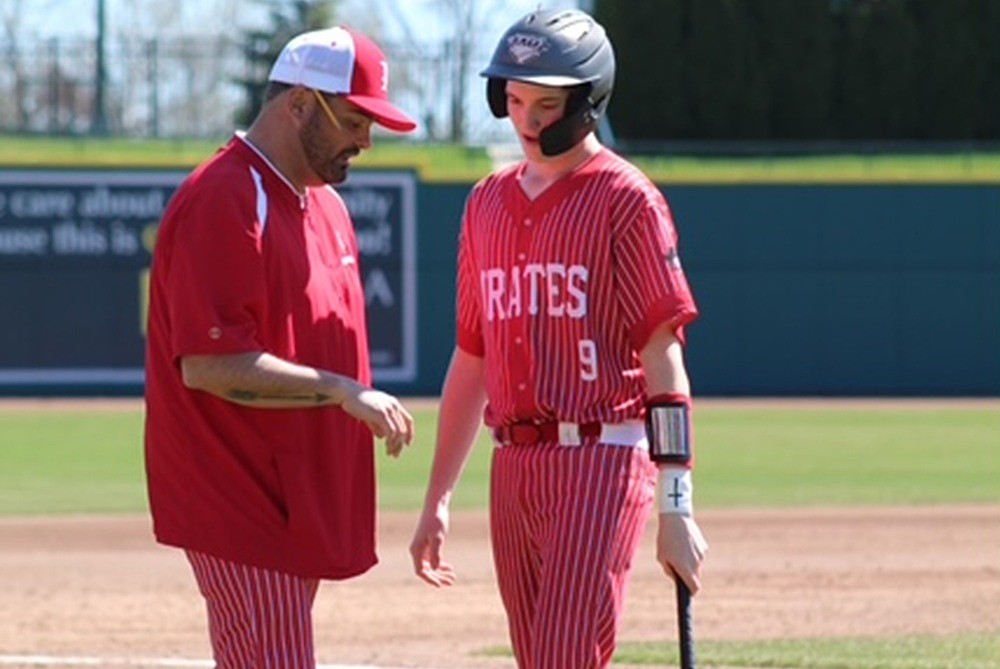
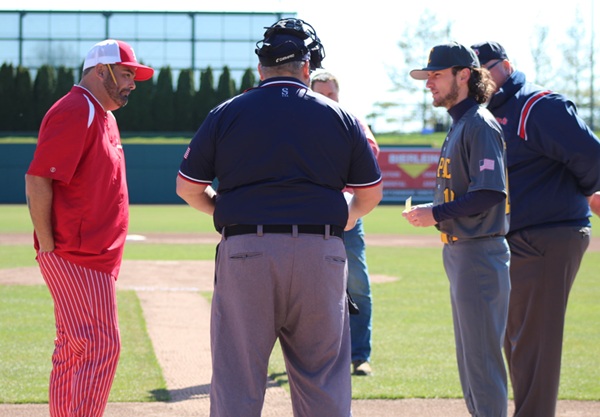
PHOTOS (Top) Peck baseball coach James Welch, left, talks with son Grady during a game from a recent season. (Middle) Welch, far left, stands at the plate for a pregame conference before taking on Capac. (Photos provided by Jen Kluger.)