

CAP Begins 2014-15 on Record Pace
By
Geoff Kimmerly
MHSAA.com senior editor
August 22, 2014
Gretchen Mohney has come to recognize coaches who think they already know it all.
Then she begins a Coaches Advancement Program lesson by describing an orange banging around inside a fishbowl – a metaphor to explain the brain inside an athlete’s skull when he or she suffers a concussion.
Her most powerful lessons have moved pupils to tears. And it’s always gratifying to witness the “Aha” moments that make the CAP educational experience so powerful.
“My favorite is when they admit that they’ve done something wrong, and they want to know how to do something better,” said Mohney, a highly-respected trainer and strength and conditioning coach who also serves as an instructor for the athletic training program at Western Michigan University. “It’s a pretty awesome moment when they realize there’s more to learn.”
More current and aspiring coaches than ever before are taking advantage of that opportunity as the 2014-15 school year kicks off.
Since this training year began July 25 at Battle Creek Lakeview, 273 current or aspiring coaches have completed CAP sessions – nearly twice as many coaches as this point a year ago and with the last session of August planned for Saturday at New Buffalo. That makes this the busiest start in CAP history, according to MHSAA assistant director Kathy Vruggink Westdorp, who joined the MHSAA staff in 2004, developed CAP for the 2004-05 school year and continues to oversee the program.
This first month’s total attendance also represents 33 percent of the 818 total CAP units completed at high schools and the MHSAA office during all of 2013-14.
“I think the big thing continues to be word of mouth that this is a quality program,” said Hamilton athletic director Jerry Haggerty, a CAP instructor for nine years. “It’s good for all coaches of all experience levels.”
Setting a standard
Since the program’s inception, nearly 6,300 coaches have completed at least the first-level unit. More than 1,000 have advanced through CAP 4.
The CAP program is broken into six levels, each addressing a set of topics:
- CAP 1: Coaches Make the Difference, The Coach as Teacher, Sports Medicine and First Aid.
- CAP 2: Effective Communication, Legal Responsibilities, Psychology of Coaching.
- CAP 3: Additional Coaching Responsibilities, Effectively Working with Parents, The Coach as Performer.
- CAP 4: Understanding Athletic Development, Strength and Conditioning, Preparing for Success.
- CAP 5: Healthy Living, Teaching Emotional Toughness, Resolving Conflicts in Athletics.
- CAP 6: Current Issues and Topics in Educational Athletics.
“Individuals who go through this have a better understanding of their philosophy, their school’s philosophy, their role and responsibility as well as the meaning behind MHSAA rules,” said Westdorp, a former principal, athletic director, teacher and coach in the Grand Rapids area who was named 2013 Coach Educator of the Year by the National Federation of State High School Associations (NFHS) for her work with the program.
She trains and evaluates all presenters and instructors, including those who last school year administered 1,238 CAP sessions at seven universities and colleges across both peninsulas.
The non-college CAP sessions are taught by 20 instructors who pride themselves on being available anywhere there’s interest. CAP has been presented at 10 Lower Peninsula schools over the last month, with Upper Peninsula sessions planned for this fall. August 9 was particularly busy – units were taught at Jonesville, Pontiac Notre Dame Prep and Riverview Gabriel Richard – but Westdorp sees the possibility of presenting at up to five sites on the same day.
Flexibility also is an option; a group of mostly non-school coaches took CAP 2 last week in Baldwin, and were able to complete the course over two days instead of one so they could do so without interrupting their fulltime jobs. For coaches working in schools, CAP units can qualify as continuing education credits with the State Department of Education.
Colleges and universities in Michigan are licensed to present up to five levels through their undergraduate or graduate studies, and the list of those who completed courses the last few years is filled with recognizable names of former high achievers on MHSAA courts and fields. Southwestern Michigan College in Dowagiac will offer courses for the first time this fall.
Certification in the program occurs after completion of CAP 1 and 2, and then after each subsequent unit, with those completing CAP 6 earning Masters Elite Certification.
The topics of CAP sessions “bleed” into each other, Mohney said, and come with plenty of first-person examples to make them relevant to coaches who then realize they aren’t alone facing issues most encounter.
“I talk to them because I’ve been there. … (I say,) ‘Now, let’s talk real.’ I place them in a real situation,” Mohney said. “’The biggest thing is you guys don’t have to know everything. You just need to coach, be aware of this, this and that. And these are some ideas to go about your plan so you can decrease your stress.’
“Any time a coach hears that, it’s a beautiful thing. Because I’m not sure what coach in high school is in coaching for the money.”
Raising the bar
Certainly, some of this month’s heightened CAP participation can be attributed to an MHSAA Representative Council action in March. Beginning Aug. 1, 2016, varsity head coaches hired for the first time at an MHSAA member school must have completed CAP 1 or CAP 2. Westdorp said some who wish to become head coaches in that near future are getting a jump by completing CAP courses now.
But that’s only a slice of the success story.
Haggerty has directed Hamilton’s athletic department for 15 years and said all of his coaches have taken either CAP 1 or 2. Many coaches take the courses on their own; others are required to do so by their athletic directors.
The Capital Area Activities Conference will offer CAP 1 three times this school year, with 100-150 coaches from their 20 member schools expected for each session. Others leagues and conferences are designing similar arrangements.
Michael Roy coached boys basketball at Lawton and girls hoops at Vicksburg and was certified under the predecessor to CAP – the MHSAA’s former Program for Athletic Coaches’ Education (PACE). He’s beginning his 13th year as Vicksburg’s athletic director, and after hosting several CAP classes over the years decided to begin the program himself this month.
“The need for knowledgeable and experienced coaches is greater than ever before. I thought if I was going to make it mandatory for my coaches to become CAP certified, that I needed to get CAP certified and lead by example,” Roy said. “The heart of any athletic team or program is its coaching staff. CAP is the surest way for coaches to access everything they need to know how to be a good coach. They learn the art of effective coaching through one of the best-designed coaches education programs in the country. CAP is second to none.”
Haggerty has spoken with athletic directors who have completed the program and then recognize when their coaches employ strategies learned at CAP sessions. An increasing pool of coaching candidates are heading into interviews with CAP certification in hand, and Westdorp has seen coaches bringing their CAP binders to practices to have those lessons available for quick reference. She’s also watched many CAP graduates using their skills at the highest level – the MHSAA Finals.
A comment by Duke men’s basketball coach Mike Krzyzewski sits at the front of those CAP binders: “A common mistake among those who work in sport is spending a disproportional amount of time on x’s and o’s as compared to time spent learning about people.”
Haggerty starts each session telling his pupils, “I do this for two reasons; one because I think it’s important to look at the non-x and o coaching realms; and two, because this is great fun for me.’”
And those coaches who come into CAP thinking they know enough? Mohney said most finish the first unit looking forward to beginning the next.
“CAP has a lot to do with understanding what you’re about, understanding your role and responsibility in athletics and your leadership role,” Westdorp said. “When I start programs, I talk about my work roles in life, and then (I tell coaches), ‘I want to tell you where I felt I was more influential, and that was as a coach.
“’And don’t ever forget it..’”
Click for more on the Coaches Advancement Program.
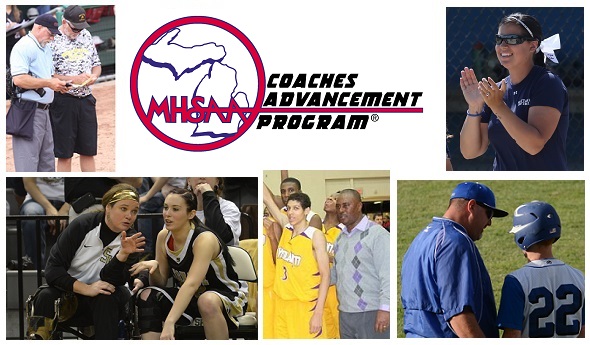
PHOTOS: These coaches, counter-clockwise from top left, all have completed at least one CAP unit: Bay City Western softball coach Rick Garlinghouse, St. Ignace girls basketball coach Dorene Ingalls, Ypsilanti Community boys basketball coach Steve Brooks, Beal City baseball coach Brad Antcliff and Mattawan softball coach Alicia Smith.
Mackey Leaving Court with 500+ College Hoops Wins, Many More Lessons Shared
By
Jason Juno
Special for MHSAA.com
July 24, 2026
IRONWOOD — Dennis Mackey made a big impact on generations of athletes at Gogebic Community College, so much so that college officials named the basketball court after him while he was still coaching.
 Mackey retired from coaching in April after 38 years at GCC, 19 with the women and 19 with the men. Even after all of those years, and more than 500 wins, the memories and lessons from his playing days at Ewen-Trout Creek still resonate with him.
He was always doing something athletically, football in the fall, baseball in the summer, track & field in the spring. His home being basketball-centered E-TC – the tiny Upper Peninsula school with nine combined boys and girls MHSAA Finals appearances – hoops was always mixed in.
“Basketball was the winter sport, but no matter the season we always found time to get to the gym and shoot hoops,” Mackey said. “Whether it was during the lunch hour, after school, on weekends, or after practices, we seemed to gravitate to the gym for some action.”
And if they didn’t go to the gym, there were outdoor courts in Ewen, Bruce Crossing and Trout Creek to get shots up.
“Basketball was the main sport in those communities and probably is still to this day,” Mackey said. “Looking back now, I must say the experiences growing up playing basketball at E-TC was awesome.”
Mackey, a 1981 graduate, played on the varsity team all four years of high school. The Panthers lost in the Regional Final at Northern Michigan University’s Hedgcock Fieldhouse both his junior and senior seasons.
“We had deep and talented teams but fell short of our goal of reaching the state finals both years,” Mackey said.
He won the Ed Helakoski Award as the most valuable senior in the Porcupine Mountain Conference. Even though he was a 1,000-point scorer, he took pride in other aspects of the game.
“I played the forward position, oftentimes guarding the opposing team’s best inside player,” Mackey said. “I prided myself on being a hardworking and unselfish player. I really enjoyed passing the ball to teammates for their scoring opportunities.”
Mackey went on to play basketball at Gogebic. After graduating from Northern Michigan University, he eventually got a call about an opening for a part-time business instructor and women’s basketball coach at Ironwood’s college.
He was excited to take over the team heading into the 1988-89 season. Six years into his tenure, he led a balanced Samsons team to the program’s first national tournament. They won another Region 13 title three years later.
Another E-TC graduate, Deke Routheaux, retired as men’s coach after the 2005-06 season. Mackey didn’t make the switch, instead opting to coach his daughter Caitlin in her first season at Gogebic. The job opened up again a year later, and he debuted as men’s coach in for 2007-08. They men won Region 13 championships in both 2011 and 2013, just missing trips to the national tournament both years.
He said the goal was to win more games and Region titles, but his teams usually left it all on the court.
 Mackey finished his tenure with the women with a record of 256-227 and a 277-263 record with the men. “It’s often said that teams tend to take on the identity of their coach,” Mackey said. “As I walk out the door, I’ll leave knowing my teams, like their coach, were known as fierce competitors.”
His signature saying is printed on the Lindquist Center court, “Coach Mackey Court,” — ”Once a Samson, Always a Samson.”
He wants the entire college to succeed, beyond just the basketball program. He took a lot of pride in giving local players a chance to play college basketball. He still supports them after they graduate.
Players came back yearly to play in their main fundraiser, the Spring Thaw Classic.
When GCC named the court after him, many of those he left an impact on filled the Lindquist Center gym on a random Tuesday game night in November.
Many appreciate the impact he had on their lives. He knows the importance of sports, whether it’s at the college level that he’s been at the last nearly 40 years, or at E-TC, where he got his start.
“Participation allows many to express themselves in ways that open doors to other life opportunities,” Mackey said. “High school athletics provide opportunities for youth to develop individual skills while learning life lessons at the same time. No matter the sport, learning to be a great teammate is challenging for most young people. Dedicating one’s time and efforts to improving oneself while also helping the team be better can be difficult. We all strive to be the best and win games, but are we willing to do the work to achieve the desired results? Everyone enjoys receiving the accolades, but many are unwilling to sacrifice the time and energy required to improve and develop individual skills, which enables this to happen.”
All three of wife Andrea (who was a big help to the GCC program as well) and his kids, Caitlin, Jesse and Adam, played high school basketball and then for Gogebic as well. Dennis said Adam was a similar player to him but a better scorer — he’s Ironwood’s all-time leader — who also wanted to get his teammates involved. They all teach at Ironwood now; Adam is the boys varsity basketball coach and Jesse the varsity girls coach.
The Mackeys continue to pass on many life lessons via high school sports.
“The thrill of victory and the agony of defeat not only applies to the games we play but to life in general,” Dennis said. “Success in high school is often measured with wins versus losses, but in the game of life the valuable lessons learned from the sports we play provide a platform for future growth. There are many folks employed in a variety of vocations who often credit their youthful days of playing sports as the impetus for their success later in life. The bonds created with teammates and opponents often last a lifetime. These bonds are immeasurable and help many advance in all facets of life.”
2026 Made In Michigan
July 16: Country Day Two-Time Champ Moore Building Perennial Winner at Harvard - Report
July 9: Multi-Sport Career at TC West Helps Gillis Thrive as Pro in Game She Once Left Behind - Report
July 2: Inspired by Home, Eager to Give Back, Spencer Hosts Hoop City Alumni Games - Report
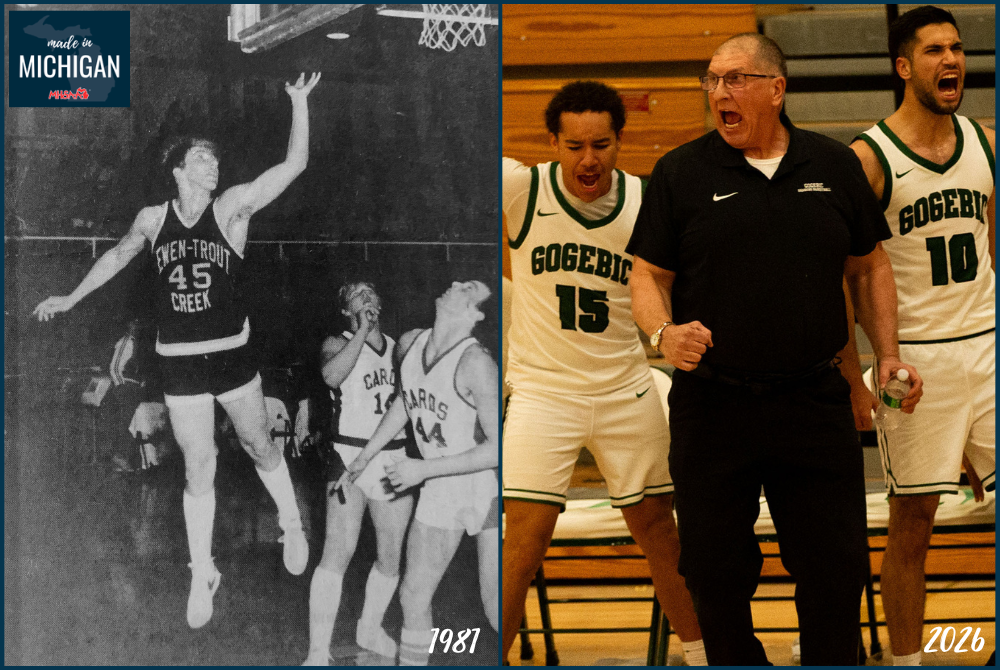
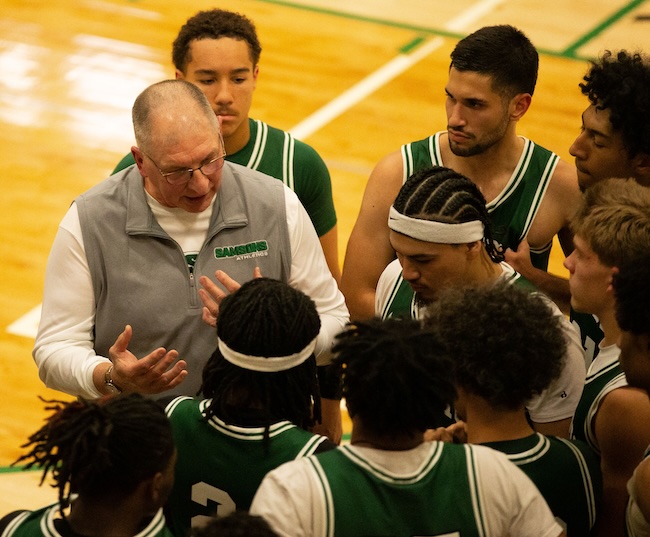
PHOTOS (Top) At left, Dennis Mackey (45) gets up a shot for Ewen-Trout Creek against Wakefield as a senior during the 1980-81 season. At right, Mackey coaches up his Gogebic Community College men’s basketball team this past summer. (Middle) Mackey huddles with his players during a break. (GCC photos by Jason Juno. Ewen-Trout Creek photo courtesy of the Ironwood Daily Globe.)