

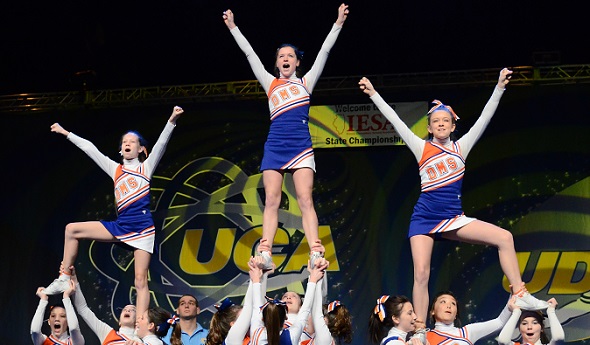
A League of Their Own in Illinois
May 20, 2014
By Rob Kaminski
MHSAA benchmarks editor
Imagine the scene: thousands of spectators roaring their approval as hundreds of cross country runners hit the finish line. A couple thousand others cascade applause on the wrestling mats as referees raise the hands of 19 champions.
Now, here’s the kicker, imagine this is taking place during postseason play for junior high/middle school student-athletes.
Again, that’s postseason, and junior high/middle school.
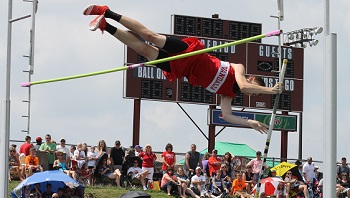
 “I guess when you see a kid cross the finish line in first place and 5,000 people are cheering, or watch a student run a race, throw the shot, or pole vault in front of that many at our track & field series, the proof is in the pudding,” said Steve Endsley, executive director of the Illinois Elementary School Association.
“The environment, the feedback we get; it’s the greatest thing in the world to some who experience our tournaments. But, I temper that in saying this is not the Olympics, the pros, or even high school. Success at our level doesn’t guarantee future success. We want you to do your best, we want to prepare you to do your best, but understand this is junior high.”
If understanding that is difficult for some athletes and parents involved in IESA athletics, it’s also a foreign language to state high school associations across the country. The IESA is the only organization in America which exclusively governs interscholastic activities for grade levels 7-8.
Most states include junior high/middle schools in their rules and regulations, but few, if any, conduct tournaments.
“We’ve been doing it for so long, it’s accepted. Schools know that at the end of the regular season, they enter Regional play. The payoff is we have state series, a culminating activity, and it’s a good thing that’s going on,” Endsley said.
From the organization’s first postseason event in 1930 during which boys basketball tournaments took place in a lightweight (boys less than 100 pounds) and a heavyweight division, the IESA has grown to sponsoring more than 20 boys and girls activities.
 Measures have been taken in recent years to alleviate travel concerns at the end of the season. The IESA has added classifications in some sports, while keeping the number of teams which advance to the Finals the same. So, for instance, where 16 teams might have gone to two different sites in the past, now four different sites host eight schools.
Admittedly, Endsley adds that the tournament series might add to some competitiveness, but since all schools enter the tournament, there might be less emphasis on winning during the regular season, and thus, heightened participation for those of all skill levels.
“If you don’t want the win-at-all-cost mentality, then step up to the plate at your member school and handle it that way,” Endsley said.
The refrain from association leaders around the country is that success in conveying the values and ideals of school sports is totally dependent on those in charge at the local level. Beginning with the 2012-13 school year, the IESA put more of that load squarely on the individual schools by making it a local decision as to whether students could participate with the school team and a club team in the same sport during the same season.
“From an association standpoint, it seemed like only people we were penalizing when had the limitations were the honest schools which self-reported,” Endsley said. “It was difficult to penalize those schools while everyone else knew the school down the street didn’t report.
“In a perfect world, the participation rule would be in place. But, it’s not a perfect world. Club sports schedule in accordance with high school seasons, but disregard our level when it comes to non-school activity. It’s year-round. So it’s practically impossible to equitably enforce it from a state level.”
There are more than 800 member schools in the IESA, which is an affiliate member of the National Federation of State High School Associations, but a separate entity from the Illinois High School Association.
Endsley estimates the IESA comprises 50-60 percent of eligible schools in Illinois, bolstered by unique membership options which differ from the IHSA and many state associations.
“We offer a la carte membership. A school can offer activities and maybe not participate in our state series. It’s only in those activities in which schools participate in the IESA state series that they must abide by our rules and regulations. Schools want some control. I think a la carte way is the way to go.
“If they join the IESA for one sport, they receive all mailings and information, so maybe one sport gets them in, but they may later add activities. If they are not a member, they don’t know about us.”
Yet, while separate bodies, the IESA and IHSA work hand-in-hand in many respects since nearly 100 percent of the IESA’s students will matriculate into IHSA schools.
“We attend the IHSA activity advisory meetings so we can keep a finger on the pulse of topics they are discussing and items they are considering. From the student standpoint, we will take our champions and introduce them in ceremonies at the IHSA Finals when our calendars line up,” Endsley said. “They get tickets, halftime introductions, pictures in the program, and it’s well-received recognition.”
Such activities are possible because the IESA seasons are different than the IHSA’s in some sports, or end sooner. For instance, the IESA plays baseball and softball in the fall, so its champions are recognized at the IHSA Finals in the spring.
“These activities create exposure and help build interests and aspirations for our schools,” Endsley said. “It’s nice P.R. for both associations.”
Whether different seasons or same seasons, the multitude of events throughout Illinois provides ample opportunity for the state’s contest officials as well. That’s another area in which the IESA and IHSA work together.
“We don’t license officials in the IESA, but we require our schools to use IHSA officials,” Endsley said. “We get great cooperation from the IHSA, it’s a good situation for our schools, and it’s a really good thing for officials. There are always plenty of games, and new officials gain valuable experience.”
Now in the midst of its ninth decade, the IESA continues to expand, adding boys and girls bowling and golf to its roster of activities in 2011.
The Association sponsors athletics for 7th- and 8th-graders, but 5th- and 6th-graders enrolled in a member school may participate with 7th-and 8th-grade teams within that building without a waiver. If such students are in an elementary school which feeds a member school, waivers are necessary.
Valued Leaders Talk Sportsmanship
April 12, 2013
By Rob Kaminski
MHSAA benchmarks editor
Anyone who has attended an MHSAA sporting event has undoubtedly heard the public address announcements touting sportsmanship.
Sportsmanship is one of many lessons taught through school sports. But are today’s student-athletes the willing pupils in the subject? Or are too many kids opting for elective courses in showmanship offered via YouTube and cable networks?
While many involved in high school athletics have noticed a decline in sportsmanship, it’s not too late to inject this valuable ingredient back into our games. But efforts need to begin at the local level, and the scholastic environment needs to supplant community venues where poor sportsmanship often flourishes.
Seventeen coaches from all over the state chipped in to a benchmarks town hall discussion on sportsmanship.
East Kentwood’s Dave Emeott: “I think it is easy to see that sportsmanship is at least diminished. I think sportsmanship starts in the home, but we cannot always depend on the household to teach these lessons. As we sit in the stands, we realize that if this is where they learn it, then we need to get to work. I think we need to teach parents what a good sport looks like, as well as students. It is apparent that students will be the kind of sports they are permitted to be. Most coaches want good sportsmanship, but struggle with the balance of teaching character and winning or losing.”
Middleville Thornapple-Kellogg’s Tamara Benjamin: “Sportsmanship could be endangered. If a parent is allowed to sit in the stands and berate coaches, officials, and other athletes, it’s difficult for our students to see that this behavior is wrong because it is being tolerated. My expectations for our girls’ behavior are made clear the first day of practice. I hold them accountable for themselves, and we go forward each day.”
Holland’s Don Kimble: “I believe that it starts at home; always looking for a reason for failure opens the door to unsportsmanlike behavior. On our team, sportsmanship is stressed within the team first; if you cannot be a sportsman to your teammates, then you cannot be to others.”
Grand Haven’s Kimberly Vincent: “We’re all about sportsmanship and work with students and parents to set expectations. There are too many people pointing fingers at other people about this subject, and I think coaches have to set the example.”
Battle Creek Pennfield’s Mike Roach: “Youth sports programs need to concentrate on sportsmanship and the fact that there are winners and losers in sports. By not keeping score, the kids do not learn how to win, nor do they learn how to handle losing. Keep score. Teach kids that it is not the end of the world to lose, but be gracious in winning and losing.”
***
It could be true that much of the focus on poor sportsmanship is a result of just that: the spotlight on poor sportsmanship, rather than the good.
Thornapple-Kellogg’s Abby Kanitz: “I think that too much focus is put on the unsportsmanlike situations. There is much more good out there than bad; it just doesn't make for great stories. It does not take much more than one bad situation to ruin a game, competition or meet. I think sportsmanship comes from the coach. If your athletes know you have high expectations in this area, then their parents will know, too.”
Allegan’s Gary Ellis: “Sportsmanship is alive and well, though it is under attack. Students are exposed to so many examples of poor to horrendous sportsmanship on TV, that it seems to be the norm.”
Bloomfield Hills Andover’s David Zulkiewski: “I see positive sportsmanship every day with my athletes, and that’s because we focus on it and make it part of our daily practice and competition. Our team is much more than swimming or diving; it’s about excelling at life. So many of our kids will not compete in athletics after high school, so we try to give them skills they can use in the real world. Being a good sport is one of those skills.”
Grand Haven’s James Richardson: “Kids want and need structure, and will uphold the guidelines as long as they are clearly defined and enforced consistently. As coaches we need to build relationships with the kids and teach them proper behavior, and serve as models for them.”
Holt’s Mike Van Antwerp: “Sportsmanship is still around. If kids respect their opponents as individuals, they are good sports. Most of them would get along well if they were on the same team, so it’s important they realize that. The kids they play against are no different from them. If they respect the game, respecting their opponent follows.”
***
To be sure, no coach worth his or her clipboard sets out to allow poor sportsmanship. But emphasizing proper conduct early and often should be as essential as conducting tryouts.
Munising’s Cathy Mutter: “Sportsmanship is an important part of high school sports and life in general. I always tell my athletes, ‘You do not deserve; you earn. You have to work hard, be positive and be fair.’ I teach them to strive to be the best they can be on the team, in the classroom, at the jobs they have, and at home in their family life. Many programs struggle due to the fact they do not work together as a unit. You are only as strong as your weakest link.”
Rockford’s Ed Van Portfliet: “The O-K Conference and the member schools have done a great job of promoting sportsmanship, and I think it’s alive and well in our area. We teach our players it’s important to play hard, but they also have to respect their opponent and the game. We don’t tolerate actions or play from our players that would be considered disrespectful or detrimental to the game.”
Warren Regina’s Diane Laffey: “We always talk sportsmanship at our team meetings, our parent meetings and our coaches meetings. I guess it is an endangered species in some areas – but I do not feel it has gotten anywhere near that point at our school. I make every effort to make sure that our athletes, teams, coaches and parents keep sportsmanship at the top of our list.”
Allegan’s Ellis: “Leagues have a responsibility to educate their students about proper behavior at high school athletic events and how to treat their opponents. Schools need to develop leaders – on teams and in the stands – who set the tone at contests. The biggest trophy given out at our year-end awards night is the sportsmanship trophy.”
Marshall’s Sue Hutchings: “Sportsmanship starts with the coaching staff respecting the players and hammering the philosophy home. If one of our players exhibits bad sportsmanship, they are taken out of the competition and made to apologize. And trust me, it has happened. Our conference coaches are all pretty tight and have worked together for a number of years. We all share the same philosophy and have very, very little trouble with bad sportsmanship.”
***
Sometimes, proper sportsmanship is simply woven into the fabric of a given sport.
Grand Rapids Forest Hills Northern/Forest Hills Eastern’s Brian Telzerow: “Sportsmanship in golf is the leader in integrity. There is no other sport that is as self-policing as is golf. The young men and women must play with honor and integrity, calling penalties on themselves with no referees present. There is no entitlement here. After we play, players shake hands with all other competitors in their groups. We also make it a practice to say thanks to the host team and to the host course personnel. This is intentional to instill gratitude for the privilege of playing this sport.”
Portland’s Jim Niebling: “Sportsmanship may very well be endangered, but not in high school tennis and certainly not on our teams in Portland. Just this season my No. 1 singles player was playing his arch rival in the league championship match. They had gone back and forth for years and both knew the implication of winning the match for the upcoming Regional and Final tournaments where they were surely going to have to play again. The loser would be seeded lower and would have decidedly more difficult draws. But when the other player, up a set, began to cramp in the second set, looking like he may not be able to finish the match, my player walked to his cooler, pulled out a Gatorade and handed it to his opponent.
“My player ended up losing that match, and he knew that was a possibility when he handed his opponent that Gatorade. If that’s not sportsmanship, I don’t know what is.”
Grand Haven’s Richardson: “Sportsmanship is promoted on our team because in wrestling we are only in charge of ourselves and our actions. It’s a sport that holds individuals accountable. It is difficult in our sport to place blame on others.”
Grand Rapids Kenowa Hills/Grandville’s Brenda McDonald: “I always have my girls practice good sportsmanship. They always thank the home team or say, ‘Good job,’ to the opposing team. Many of the girls know the girls on other teams from previous gymnastics classes, so they enjoy seeing them again.”
High School Coaches Survey Identifies Parental Concerns
More than 3,000 high school coaches and athletic directors responded to a nationwide survey conducted by Growing Great Relationships (GGR) in cooperation with the National High School Coaches Association (NHSCA). The purpose of the survey was to understand what coaches and athletic directors see as their greatest needs concerning coach-parent and coach-athlete communication and relationships. GGR and NHSCA will use the results to design training and programs that address the identified needs.
The first section of the survey addressed issues surrounding parents of athletes. The first question asked coaches about their greatest concerns dealing with parents. More than 50 percent indicated over-involved parents as their No. 1 concern.
The second question asked coaches what they think parents are most concerned about. Overwhelmingly, nearly 80 percent reported the child’s amount of playing time as their perception of a parent’s biggest issue.
The next question asked coaches who are the most difficult parents. Athlete “wanna bes” were identified by 55 percent of the respondents.
Coaches then were asked what parents should do to support them. More than 70 percent indicated keeping them informed of personal difficulties their child was having at home. This was followed by 63 percent asking parents not to use social media regarding the team, or to gossip about the team or the coach’s expertise. Athletic directors’ responses were similar but with different percentages. Nearly 73 percent ranked not using social media or gossip about the team as the most important.
The second section of the survey asked coaches about their greatest concerns regarding relationships with their athletes. The first question asked coaches about the challenges they face communicating with student-athletes. Nearly 58 percent indicated an athlete receiving contradictory advice from parents and other coaches/advisers. This was followed closely with 55 percent stating an athlete’s inflated belief about his or her ability. Athletic director responses were similar but with somewhat different percentages. The greatest response, 70 percent, was the athlete receiving contradictory advice.
The second question asked the coaches for other factors interfering with their relationships with their student-athletes. The factor indicated by 58 percent of coaches was an athlete over-burdened with competing school demands (clubs, academics). For this particular question, the response from the athletic directors closely matched the coaches.
Athletic directors were asked that in their role what are their greatest concerns dealing with parents and athletes. The most frequent answer by 76 percent of athletic directors was parents bypassing coaches to complain directly to them.
In addition, nearly 500 coaches and athletic directors wrote in additional concerns that they have in their ability to communicate and work with athletes and their parents.
– Richard & Jane: Relationship Coaching