

Making (Health) Histories Every Year
July 23, 2015
By Rob Kaminski
MHSAA benchmarks editor
Tom Minter, recently retired from the MHSAA as assistant director, wore many hats while serving the Association and donned official’s gear in numerous sports outside of business hours.
But one of his finest refereeing efforts might have come during the 2009-10 and 2010-11 school years when he guided approximately 60 individuals representing 25 medical and professional organizations through an arduous process to upgrade the antiquated Physical Form to what is the standard today: the Pre-participation Physical Examination/Health History Form.
The form highlighted Stage 1 of the MHSAA’s 4 Hs of Health and Safety – Health Histories – and the current form is much more comprehensive, answering questions previously not asked during the quicker, more brief, evaluations.
Sudden cardiac death claims the lives of more than 300 Michigan children and young adults between the ages of 1-39 years annually. Yet, many of these deaths could be prevented through screening, detection, and treatment. One such way to detect high risk conditions that predispose to SCDY is through pre-participation sports screening of student-athletes, and the current physical form provides a mechanism.
While much more detailed, schools report that parents are more than willing to take the extra time and effort to complete the lengthier version.
“When the expanded form came out, people kiddingly made comments about its length; yet in today's day and age everyone understands we need all the information we can cultivate regarding health histories of our student athletes,” said Mark Mattson, athletic director at Traverse City Central.
Down state, feelings have been similar. “We don’t have a problem at all here,” said Anna Devitt, athletic secretary at Hartland High School. “Our parents take care of it, and haven’t balked at the length at all.”
Both agree, and are joined by many others across the state, that the next logical step is for the form to be converted to a fillable, online document so that records can be accessed by those in need via mobile, laptop or desktop.
Thus, in the “No H left behind” mantra that the MHSAA has assumed, an electronic option of the Health History form is in the early planning stages.
“As an increasing number of our schools strive to be ‘paper-free,’ or at least as much so as possible, it is time to re-invent the delivery method for perhaps our most downloaded or distributed document,” MHSAA Executive Director Jack Roberts said. “Once again, as we move forward with our ‘Heart’ initiative for the coming school year, we are also intent on bringing other projects up to speed.”
The masses are certainly enthused.
“That would be heavenly. An online version that would prevent people from submitting the forms until all the required information was in place would be fantastic,” said Mattson, who has had to turn back, or hold out students while waiting for completed forms, whether at Marquette, Maple City Glen Lake, or his current post in Traverse City. “It’s always been the same; people move too quickly and overlook required fields. It would prevent two things: one, having to hold kids out while waiting for a signature, and two, prevent parents from having to drive in to the athletic office to sign or fill in that last field. We’d know we were getting a completed form.”
At Hartland, where athletic director Jason Reck created an online emergency contact form, a system is in place which allows coaches, administrators and trainers to share necessary data for all student-athletes in addition to the MHSAA forms.
“Our parents love the online emergency contact form, and we require them to fill it out every season, not just once a year,” Devitt said. “Sometimes an athlete gets injured during one season and the next season's coach wants to know about it.”
The information on the form is populated into an Excel spreadsheet which Reck, Devitt, the school trainer and all coaches can access. They can tailor the data by sport and pull it to their mobile devices.
“We’re trying to go completely paperless, and the MHSAA physical form would be another step,” Devitt said. “Our parents and doctor’s offices would love it.”
Recent Whiteford Grad Ovall Leading Bobcats' Inaugural Girls Golf Team
By
Doug Donnelly
Special for MHSAA.com
September 2, 2026
Addison Ovall might be the youngest varsity head coach in the state of Michigan this fall.
 Ovall, who graduated in June from Ottawa Lake Whiteford, had barely taken off her cap and gown when she found herself as the new head coach of the Bobcats girls golf team. She’s also a pioneer of sorts – she helped lead the crusade for Whiteford to field a team in that sport for the first time.
The five girls on the squad tee it up for the first time Tuesday.
“I always wanted to start a girls golf team while I was a student here, but there didn’t seem much interest in it,” Ovall said. “Once I graduated, I shared my story about having played on the boys team and I think that garnered some interest. It’s something I’ve always wanted.”
Ovall was going to golf in college, but a traffic crash during which she suffered a broken wrist put those plans on the backburner. For now, her work on the course is dedicated to helping five novice golfers learn the game.
“That just led me here to coach,” she said.
Ovall learned the game when she was a kid from her father.
“Ever since I was little, I had a club in my hand,” she said. “It seems like I’ve been playing forever.”
She started high school in Toledo and played on a girls golf team as a freshman at St. Ursula Academy, a private school in northwest Ohio. She moved to Whiteford as a junior and was set to be a one-person golf team in the fall of 2025 with her mom as the head coach. That’s when she was injured in the crash and couldn’t continue the season.
Whiteford athletic director Miranda Green went through the MHSAA to get clearance for Ovall to join the boys team in the spring.
“She had played in one competition in girls golf, then got hurt,” Green said. “I had to write a letter to the MHSAA, and she was approved to play on the boys team, but she had to sit one match. She was excited to still be able to play.”
Ovall said it was a difficult transition.
 “It was terrifying, to be honest,” she said. “I had to hit from the men's tees, had to learn everything, but I think it made me a better golfer and a better person overall. I met new people, which was cool. I had college opportunities, which was awesome.”
Her season was hampered by the wrist injury, but she didn’t let it stop her. It did get in the way of playing at the college level, however.
“It was sort of difficult, but I was better off for it,” she said.
While still in high school she started lobbying other girls in school to sign up for golf.
“Toward the end of the year we had girls start showing interest in it,” she said. “That was really cool. When the school asked me to come back to coach, I was pretty nervous. I didn’t think anyone was going to come to tryouts.”
She ended up having five girls join the squad, which gives them enough to compete in dual matches and tournaments.
“It’s just been fun to get to know the girls,” she said. “We are a very young team. We are just starting out so we are trying to see what our strengths and weaknesses are.”
While the first match isn’t until next week, they have been playing daily at Whiteford Valley Golf Club, the same home course the Whiteford boys team plays on. Ovall said they typically spend an hour on the driving range, then chipping and putting for the last 45 minutes of practice. One day a week, the girls play nine holes.
“It is good to see how the game is coming together and to see what we need to improve on,” she said.
Because there are so few members on the team, Ovall can spend about 15 minutes with each golfer daily.
“After we play a round, the next day I will focus on what their biggest weaknesses were on the course,” she said.
Ovall said teaching the game is a rewarding experience.
“We have one girl who is an experienced golfer, but everyone else is really brand new to the game,” she said. “We want them to go out and have fun. We’re all able to hit the ball, which is good. Right now, we just keep going over everything getting ready for that first tournament and going over all of the rules. We’ve had a month to prepare.”
Charlie Weiser is one of the freshmen on the team. She said she decided to go out for golf because her whole family golfs. The team is getting to know the rules and having fun together, she said. In practice, she likes to focus on driving and putting, but is getting pretty good with her 8-iron.
“I just started at the beginning of summer, but it’s been going pretty good,” she said. “There have been good days and bad days.”
Green said she didn’t have any apprehension about turning the new program over to Ovall.
“Honestly, it was a no-brainer,” she said. “She is the perfect person to do it. I’m excited for her. Hopefully she can keep the program growing.”
 Doug Donnelly has served as a news and sports reporter at the Adrian Daily Telegram and the Monroe News for 30 years, including 10 years as city editor in Monroe. He's written a book on high school basketball in Monroe County and compiles record books for various schools in southeast Michigan. He is now publisher and editor of The Blissfield Advance, a weekly newspaper. E-mail him at [email protected] with story ideas for Jackson, Washtenaw, Hillsdale, Lenawee and Monroe counties.
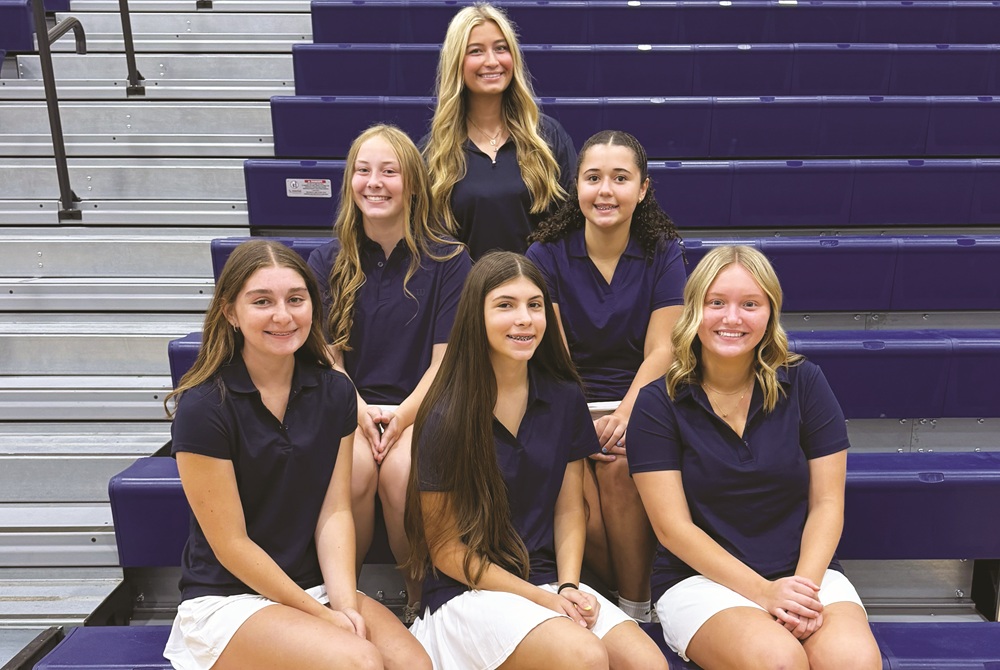
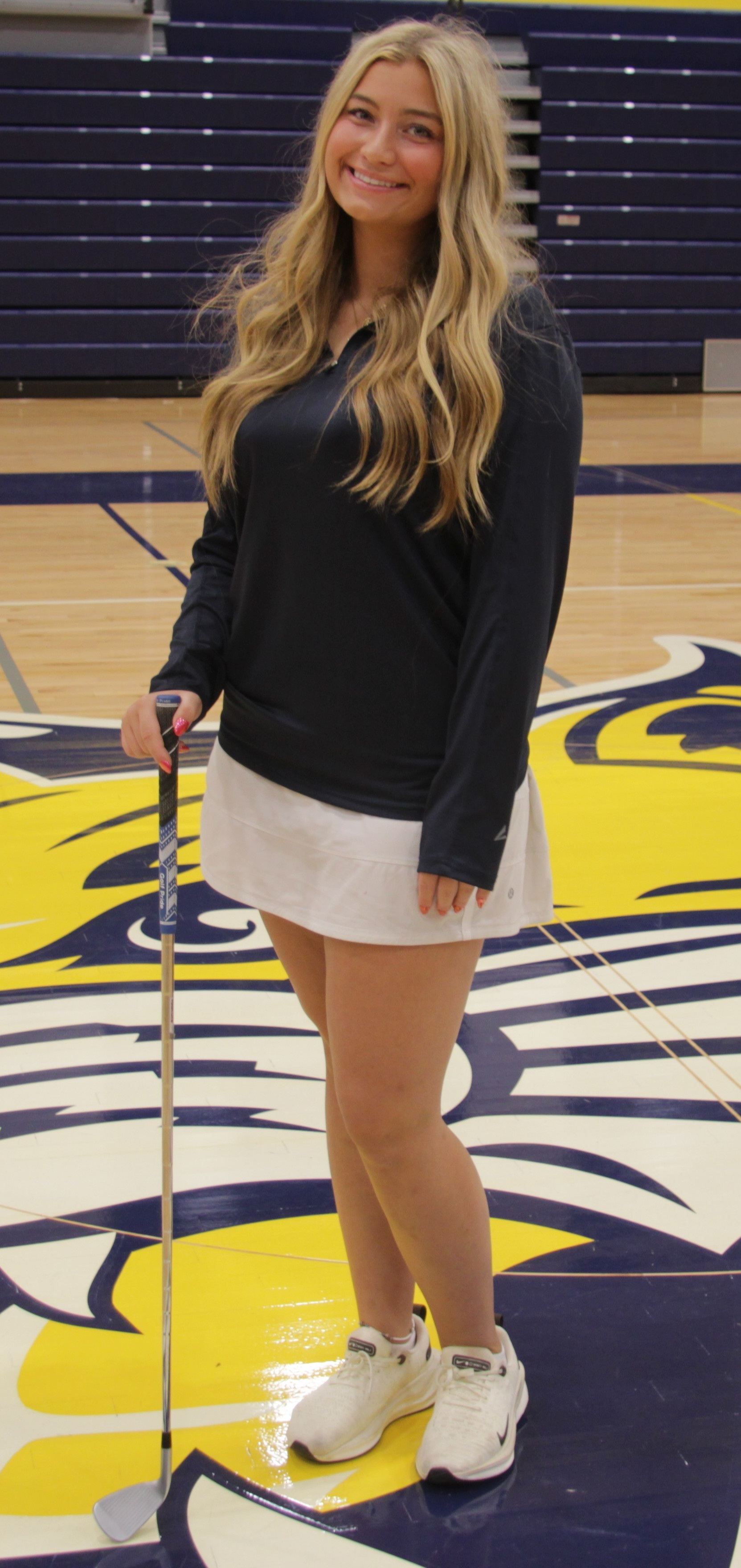
PHOTOS (Top) This fall’s Whiteford girls golf team is the school’s first. Top row: Coach Addison Ovall. Middle row: Grace Grosteffon and Avee Ingram. Bottom row: Addy Emch, Charlie Weiser and Brenna Allen. (Below) Ovall. (Photos by Doug Donnelly.)