

Making (Health) Histories Every Year
July 23, 2015
By Rob Kaminski
MHSAA benchmarks editor
Tom Minter, recently retired from the MHSAA as assistant director, wore many hats while serving the Association and donned official’s gear in numerous sports outside of business hours.
But one of his finest refereeing efforts might have come during the 2009-10 and 2010-11 school years when he guided approximately 60 individuals representing 25 medical and professional organizations through an arduous process to upgrade the antiquated Physical Form to what is the standard today: the Pre-participation Physical Examination/Health History Form.
The form highlighted Stage 1 of the MHSAA’s 4 Hs of Health and Safety – Health Histories – and the current form is much more comprehensive, answering questions previously not asked during the quicker, more brief, evaluations.
Sudden cardiac death claims the lives of more than 300 Michigan children and young adults between the ages of 1-39 years annually. Yet, many of these deaths could be prevented through screening, detection, and treatment. One such way to detect high risk conditions that predispose to SCDY is through pre-participation sports screening of student-athletes, and the current physical form provides a mechanism.
While much more detailed, schools report that parents are more than willing to take the extra time and effort to complete the lengthier version.
“When the expanded form came out, people kiddingly made comments about its length; yet in today's day and age everyone understands we need all the information we can cultivate regarding health histories of our student athletes,” said Mark Mattson, athletic director at Traverse City Central.
Down state, feelings have been similar. “We don’t have a problem at all here,” said Anna Devitt, athletic secretary at Hartland High School. “Our parents take care of it, and haven’t balked at the length at all.”
Both agree, and are joined by many others across the state, that the next logical step is for the form to be converted to a fillable, online document so that records can be accessed by those in need via mobile, laptop or desktop.
Thus, in the “No H left behind” mantra that the MHSAA has assumed, an electronic option of the Health History form is in the early planning stages.
“As an increasing number of our schools strive to be ‘paper-free,’ or at least as much so as possible, it is time to re-invent the delivery method for perhaps our most downloaded or distributed document,” MHSAA Executive Director Jack Roberts said. “Once again, as we move forward with our ‘Heart’ initiative for the coming school year, we are also intent on bringing other projects up to speed.”
The masses are certainly enthused.
“That would be heavenly. An online version that would prevent people from submitting the forms until all the required information was in place would be fantastic,” said Mattson, who has had to turn back, or hold out students while waiting for completed forms, whether at Marquette, Maple City Glen Lake, or his current post in Traverse City. “It’s always been the same; people move too quickly and overlook required fields. It would prevent two things: one, having to hold kids out while waiting for a signature, and two, prevent parents from having to drive in to the athletic office to sign or fill in that last field. We’d know we were getting a completed form.”
At Hartland, where athletic director Jason Reck created an online emergency contact form, a system is in place which allows coaches, administrators and trainers to share necessary data for all student-athletes in addition to the MHSAA forms.
“Our parents love the online emergency contact form, and we require them to fill it out every season, not just once a year,” Devitt said. “Sometimes an athlete gets injured during one season and the next season's coach wants to know about it.”
The information on the form is populated into an Excel spreadsheet which Reck, Devitt, the school trainer and all coaches can access. They can tailor the data by sport and pull it to their mobile devices.
“We’re trying to go completely paperless, and the MHSAA physical form would be another step,” Devitt said. “Our parents and doctor’s offices would love it.”
1st Day of Practice Begins Final Run for Father & Son Ostipow at Forest Hills Northern
By
Geoff Kimmerly
MHSAA.com senior editor
August 12, 2026
GRAND RAPIDS – For one obvious reason, no player on the Forest Hills Northern football team has received more wake-up calls from the head coach over his lifetime than Owen Ostipow.
But the one he and a handful of his teammates received about 4 p.m. Monday may prove memorable – especially if it ends up setting the tone for a successful fall.
The first practice of this season was set to begin at 3:45 p.m. That’s when Ostipow and others arrived, thinking they were early. That not being the case, and a few conversations over the confusion later, the Huskies headed to the goal line where varsity head coach Eddie Ostipow – Owen’s dad – opened what was to be his final first day of practice, at least for a while, by sending his team through push-ups and sprints as a reminder to sharpen up immediately for the work to come.
“Definitely a wake-up call for some of us to just get in line and get order. A lot of the guys were a little late today, me included,” Owen Ostipow said. “Absolutely deserved.”
Most likely, that brief bumpy start will end up as little more than a sidenote as Coach/Dad and his senior all-state candidate son/quarterback ride together through one more season, Owen before heading off to play at Ferris State and Eddie on the way to retiring after 27 years as a head coach in the West Michigan and Greater Lansing areas.
A total of 602 varsity football teams were scheduled to begin practices Monday, as were teams playing every fall sport at every MHSAA member school.
At Forest Hills Northern, that meant the beginning of the end of a recent era.
Eddie Ostipow will be retiring as head coach after this fall and from teaching later this school year, providing more time to watch his oldest son Evan’s football games at Hope College and next season Owen’s as he has committed to sign with the two-time reigning Division II national champion Bulldogs.
 Of course, Owen nor Evan nor younger siter Auden were even on the radar when Eddie began his varsity coaching career at Charlotte as a 24-year-old in 1999 and led the Orioles to a combined 47-17 record over six seasons and the Division 3 Semifinals in 2004. He left after that season to coach three at East Kentwood, then returned to Charlotte for five more seasons before taking over at Ada Forest Hills Eastern and building the Hawks toward an 11-2 record and Division 4 Semifinal run in 2015 that remains that program’s most successful finish.
Ostipow moved on to coach Greenville from 2016-18, then took over at Forest Hills Northern in 2019. He enters this fall with a combined record of 116-112 while frequently matching up at his various stops with statewide powers like DeWitt early on, later Rockford and Muskegon, then Grand Rapids West Catholic and these days Muskegon, Mona Shores and Byron Center all during Ottawa-Kent Conference Green play.
On Monday, about 70 players took to FHN’s stadium turf to get things underway, including 45 varsity players. The Huskies are coming off two straight 4-5 finishes, last year after losing 14 players to injuries – including nearly half of those for the season – during the first half on opening night.
But they also return an all-region quarterback in Owen Ostipow, who ran for 1,435 yards and 22 touchdowns last season and threw for eight more scores. And that’s a great way to start anew.
“We’ve got an opportunity. We have a chance to surprise some people,” Eddie Ostipow said. “I like being the underdog sometimes too, so I think that makes it exciting. If you can get your kids to buy into that, I think that’s something that can be really powerful.
“My thing as a coach, I always try to have a perspective of what’s possible for us and then push them like crazy to get there. If we can get every ounce of effort and intensity and focus out of them, then I think we’ve had a great year.”
Of course, as life roles change, perspectives can evolve as well. Ostipow has gone from teaching and coaching kids who were less than a decade younger to turning 52 years old with Evan graduated, Owen on the way and Auden heading into her sophomore year.
 His football staff at FHN is a collection of coaches who were part of the program before him and others who were with him at some of his other stops. None go back to his days at Charlotte, but athletic director can – he was an all-state receiver for the Orioles under Ostipow before graduating in 2005. Sherman then played at Northern Michigan, came home to coach with Ostipow at Charlotte and again at Forest Hills Eastern, and he inherited his old coach in taking over at FHN in 2024.
“Coaching, he lives it, probably a bit more than he should. But that’s the hobby,” Sherman said. “His passion, he’s always working on something – he always has some nuance or change, something new he’s trying to learn.
“I joke sometimes, when you have kids sometimes you soften up a little bit, but he’s not soft. We’re going to have expectations (this season), we’re going to have all those things. But as you go through it, and then you become a parent, you sometimes see that lens a little different.”
As a now-veteran coach as well, Ostipow has had opportunities to cheer on former players who have gone on to major accomplishments.
In January, his former quarterback Trinidad Chambliss nearly took Ole Miss past Miami at the Fiesta Bowl, just missing out on a chance to play in the College Football Playoff title game. On the opposite sideline celebrating that 31-27 Hurricanes win was Jack Clark, a member of the Miami staff who starred for Ostipow at Forest Hills Eastern and owns a national championship ring after serving on Michigan’s staff during its 2024 run. Another 2005 Charlotte graduate, Chad Richardson, has a Super Bowl ring from serving as director of game presentation for the Los Angeles Rams during their 2022 surge, and he’s now with the Buffalo Bills in the same capacity as they prepare to open a new stadium. Matt Packowski was a junior on that 2004 Orioles team and now is a Division I college football referee.
There surely will be more to come, and Ostipow did not sound Monday like a coach on his way out. But he’ll do his best to be fan for a while and cheer on the Huskies who came through his household as well before possibly making a return to the sideline when their playing days are done.
“I feel like it’s kinda special. Most people don’t get to get coached by their dad, and I think it’s a little more extra special because I remember when my brother was a senior, and I started on varsity as a sophomore, that was the first time I’d seen (my dad) cry,” Owen Ostipow said. “It was just kinda heartbreaking. You watch (your kids) grow, and then they’re just gone.
“Now it’s going to be me. Maybe we’ll see that again from him, but you never know.”
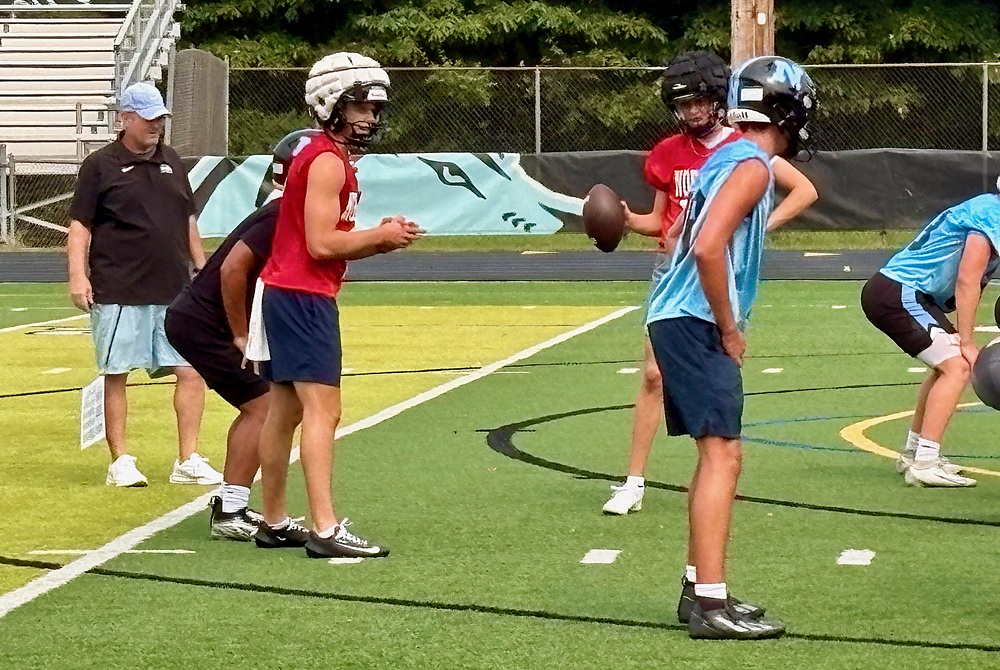
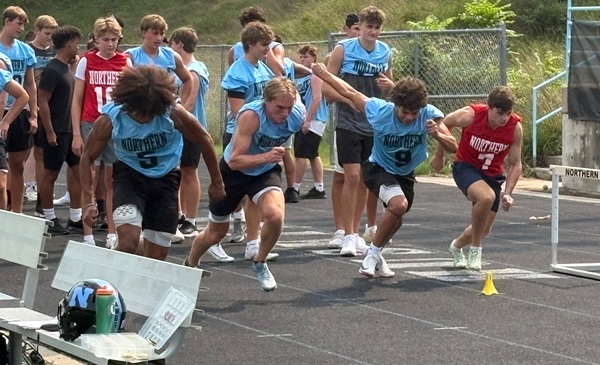
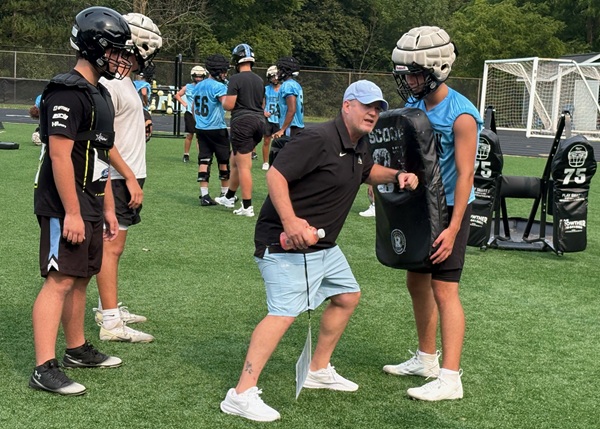
PHOTOS (Top) Forest Hills Northern coach Eddie Ostipow, far left, watches his senior son Owen (white helmet cap) run the offense during Monday’s first practice of the season. (Middle) Owen Ostipow, far right, runs sprints on the track with his teammates. (Below) Eddie Ostipow works with the Huskies linemen.