

Seng Leads, Coaches Others to do Same
By
Geoff Kimmerly
MHSAA.com senior editor
January 25, 2018
Meg Seng misses coaching – in her words, “those relationships really are what it’s all about … stronger than just about anything other than family.”
But the coach in Seng continues to show the way in her work every day.
Seng will be honored next month with the MHSAA’s 31st Women in Sports Leadership Award for her work at Ann Arbor Huron and Greenhills over more than 30 years in educational athletics.
The award also will recognize Seng’s teaching, training and empowering of the next generation of coaches and especially women aspiring to follow her into leadership positions in a field where they remain underrepresented.
“I’ve always loved sport, and early on found I had a knack and an interest in coaching. So to be able to share with other young women what I think is a really noble profession makes it a passion for me,” Seng said. “I think it’s a great endeavor, and I’d love for more women to have the opportunity and the confidence to seek out some of those positions.”
Seng will receive this year’s award during the WISL Banquet at the Crowne Plaza Lansing West.
Each year, the Representative Council considers the achievements of women coaches, officials and athletic administrators affiliated with the MHSAA who show exemplary leadership capabilities and positive contributions to athletics.
Seng is in her 28th year at Greenhills School, serving as the athletic director the last 15 after 13 teaching physical education and health. Previously a scholarship athlete playing both volleyball and softball at Indiana University – and winning a pair of Big Ten championships on the diamond – Seng coached both sports at Ann Arbor-area high schools over nearly two decades and has continued as a role model for emerging coaches.
“I’m pretty sure I’ve been to every single (WISL) conference, and so for years, I’ve certainly been in the audience watching these great women be recognized,” Seng said. “To have followed for that long and now be on stage, it’s a tremendous honor for me – that group of women and their value to sport in Michigan is not lost on me at all. I truly respect that group, and I’m really proud to be part of it.”
 A 1977 graduate of Maine South High School in Park Ridge, Ill., Seng began coaching at the college level after her playing days with the Hoosiers were done. She served first as a graduate assistant softball coach at Louisiana Tech University in 1983-84 while studying for her master’s degree, and then as a softball assistant at Illinois State University for 1984-85.
Seng took over the Ann Arbor Huron volleyball program in 1985, and over 12 seasons stretching two tenures led her team to five league titles and a District championship in 1993. She also served as Huron's co-head varsity softball coach from 1986-90.
She completed her teacher certification at Eastern Michigan University in 1990 and began teaching at Greenhills that year, later coaching that school’s varsity volleyball team from 1993-2000 and leading the Gryphons to a District title in 1997.
In 2001, Seng co-founded The Academy of Sports Leadership (TASL), a non-profit organization that provides education and training for women interested in becoming coaches and hosts a five-day residential camp for high school girls with that aspiration. In 2003, Seng became Greenhills’ athletic director and began her work as well contributing to the Michigan Interscholastic Athletic Administrators Association (MIAAA) and National Interscholastic Athletic Administrators Association (NIAAA), serving on committees for both including as part of the MIAAA’s Leadership Academy faculty since 2011 and the NIAAA’s certification committee since 2014. She served as the MIAAA’s Executive Board president in 2013-14.
At Greenhills, Seng has hosted more than 20 MHSAA tournament events in various sports at the District, Regional and Quarterfinal levels, and she’s served on a variety of MHSAA committees as well as currently the Multi-Sport Participation Task Force. She also is an instructor for the MHSAA Coaches Advancement Program.
“Meg Seng has been a leader at every level of educational athletics – as an accomplished coach, respected athletic director and someone who empowers women interested in following her lead and filling the need we have in school sports for more women in all forms of leadership positions,” MHSAA Executive Director John E. “Jack” Roberts said. “She personifies the Women In Sports Leadership Award, and we’re delighted to present her with this honor.”
Seng received the MIAAA Jack Johnson Distinguished Service Award in 2012 and her region’s Athletic Director of the Year Award in 2008. She also received the Pathfinder Award in 2004 from the National Association for Girls and Women in Sports (NAGWS), and under her leadership Greenhills received the Exemplary Athletic Program Award from the MIAAA in 2017. She also received the Girl Scouts’ Leaders and Best Award in 2005.
In addition to her work with The Academy of Sports Leadership, she’s served since 2009 on the board as a founding member of the Michigan Softball Academy, which annually raises money for the American Cancer Society. She is published for her work in coaching education and recruitment and has spoken on various occasions on ways to provide opportunities for young women in coaching. She will present on recruiting and retaining female leaders at the annual statewide MIAAA conference this March.
 “Meg sees a need and takes initiative to put a committee, group or process in place to solve and satisfy this need,” Holly athletic director Deb VanKuiken said in her letter recommending Seng for the WISL Award. “I truly respect and admire her. She has a great mind and a great heart for athletes and coaches alike. She leads, and she serves.”
Part of filling that need is helping athletic directors find candidates and helping candidates feel confident.
Seng monitors coaching at the high school and college levels, and has watched the percentage of female coaches at the college level fall drastically since Title XI. She also hears a few things – from women finishing college athletic careers who don’t feel qualified to coach, and also from athletic directors who would love to hire women coaches but aren’t finding candidates.
“Our Academy is a grassroots organization just trying to get young girls to follow that dream and show them the possibilities,” Seng said. “It’s a primer on coaching; we show them all the things coaches do and hope it sticks, that they say, ‘I can do that.’
“Part of what we do is try to empower them to take some of those risks.”
In addition to the MIAAA and NIAAA, and NAGWS, Seng is a member of the National Association for Sport and Physical Education (NASPE) and American Alliance for Health, Physical Education, Recreation and Dance (AAHPERD).
The first Women In Sports Leadership Award was presented in 1990
Past recipients
1990 – Carol Seavoy, L’Anse
1991 – Diane Laffey, Harper Woods
1992 – Patricia Ashby, Scotts
1993 – Jo Lake, Grosse Pointe
1994 – Brenda Gatlin, Detroit
1995 – Jane Bennett, Ann Arbor
1996 – Cheryl Amos-Helmicki, Huntington Woods
1997 – Delores L. Elswick, Detroit
1998 – Karen S. Leinaar, Delton
1999 – Kathy McGee, Flint
2000 – Pat Richardson, Grass Lake
2001 – Suzanne Martin, East Lansing
2002 – Susan Barthold, Kentwood
2003 – Nancy Clark, Flint
2004 – Kathy Vruggink Westdorp, Grand Rapids
2005 – Barbara Redding, Capac
2006 – Melanie Miller, Lansing
2007 – Jan Sander, Warren Woods
2008 – Jane Bos, Grand Rapids
2009 – Gail Ganakas, Flint; Deb VanKuiken, Holly
2010 – Gina Mazzolini, Lansing
2011 – Ellen Pugh, West Branch; Patti Tibaldi, Traverse City
2012 – Janet Gillette, Comstock Park
2013 – Barbara Beckett, Traverse City
2014 – Teri Reyburn, DeWitt
2015 – Jean LaClair, Bronson
2016 – Betty Wroubel, Pontiac Notre Dame Prep
2017 – Dottie Davis, Ann Arbor Huron
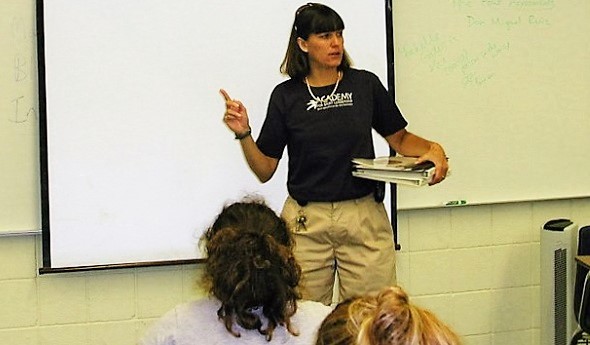
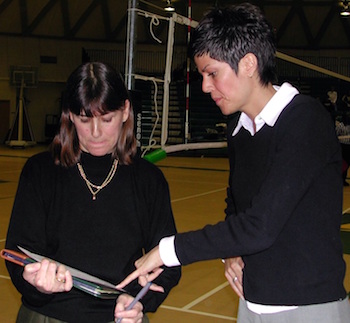
PHOTOS: (Top) Ann Arbor Greenhills athletic director Meg Seng instructs in the classroom; she taught at Greenhills for 13 years and continues teaching as part of CAP and the Academy of Sports Leadership. (Middle) Seng, left, also was a successfull volleyball coach at Ann Arbor Huron and Greenhills. (Photos courtesy of Meg Seng.)
Uyl to Serve as MHSAA's Next Executive Director
By
Geoff Kimmerly
MHSAA.com senior editor
May 8, 2018
Mark Uyl's impact on educational athletics has stretched from his hometown across this state and our country as a teacher, coach, administrator and one of the nation's most respected voices in sport officiating.
The Caledonia native and assistant director for the Michigan High School Athletic Association over the last 14 years is now charged with leading the Association as it continues in the work he has championed for two decades.
 Uyl, 44, has been selected as the next executive director of the MHSAA by its Representative Council. He will succeed retiring Executive Director John E. “Jack” Roberts in August. Roberts, who has served as executive director since the fall of 1986, announced his retirement April 24.
Uyl joined the MHSAA staff in January 2004 and coordinates the Association’s nearly 10,000 officials in addition to serving as director of baseball and administrator of the MHSAA’s catastrophic and concussion care insurance plans. He also has served as director of cross country and wrestling during his tenure.
As assistant director, Uyl was instrumental as the MHSAA became the first state high school athletics association to offer concussion care insurance, which provides gap coverage to assist in covering costs for athletes who are injured while participating in MHSAA-sponsored sports. As an official himself, Uyl has worked to build a stronger relationship with those working high school events that has included an increase in training and support. As a sport director, Uyl has sought to create the best experiences for Michigan high school teams, including with the move of the MHSAA Baseball and Softball Finals to Michigan State University in 2014.
“The foundation built here by Jack Roberts over the last 32 years is the strongest in the country, and I’m honored to have the opportunity to lead our staff in building on that foundation,” Uyl said. “There will be many ways we’ll continue to protect the same values of educational athletics, while also looking for new ways and new opportunities to best serve the students and our member schools in Michigan.”
In addition to his full-time MHSAA duties, Uyl has officiated collegiate baseball since 1997 and is regarded as one of the best at that level. In addition to umpiring major conference baseball all over the United States, Uyl was part of the crews for the 2014 and 2017 College World Series. He also officiated college football for 12 years with several NCAA postseason assignments, and did serve as coordinator of officials for the Michigan Intercollegiate Athletic Association. He was registered with the MHSAA for at least three sports beginning in 1992 and worked the Baseball Finals in 1999.
Additionally, Uyl served on the board of directors of the National Association of Sports Officials (NASO) from 2012-15 and as its chairperson during his final year. Currently, he serves as the high school representative on the Officiating Development Alliance (ODA), which consists of the supervisors of officials for the NFL, NBA, MLB, NHL, CFL, MLS and NCAA Division I sports.
The Council made its decision at the conclusion of its annual Spring Meeting on May 7 in Gaylord. Uyl will become only the fifth full-time executive in the MHSAA’s 94-year history, following Charles E. Forsythe (1931-42, 1945-68), Allen W. Bush (1968-78), Vern L. Norris (1978-86) and Roberts.
“Mark has spent the past 14 years as a highly effective assistant director for the MHSAA,” said Representative Council President Scott Grimes, who serves as Assistant Superintendent of Human Services for Grand Haven Area Public Schools. “He is a proven leader in the organization committed to providing outstanding service to both internal and external constituents. The positive relationships he has fostered with school administrators will help make this a very smooth transition.”
Prior to his time at the MHSAA, Uyl first taught and coached and then served as athletic director and assistant principal at Middleville-Thornapple Kellogg High School, the latter from 2001-03. Before becoming an administrator there, Uyl served as athletic director at Caledonia High School in 2000-01.
 During his tenure as an assistant director at the MHSAA, Uyl also served a four-year term on the Baseball Committee for the National Federation of State High School Associations (NFHS).
“Mark was the obvious choice to become the next executive director of the MHSAA,” Roberts said. “Mark has the proper student-focused perspective of educational athletics, excellent person-to-person communications skills and a deep practical understanding of what is happening day to day in school sports in our state and nationally.”
Uyl graduated from Caledonia High School in 1992, and from Calvin College in 1996 with a bachelor’s degree in history and physical education. He later received a master’s in educational leadership from Grand Valley State University. At Calvin, Uyl was a four-year starter on the baseball team, earning all-conference honors twice and serving as team captain.
Uyl resides in DeWitt with his wife Marcy, an accomplished educator and coach who has served as a high school varsity basketball coach since 1994. They have three children: Jackson (17), Grant (15) and Madison (11).
The MHSAA is a private, not-for-profit corporation of voluntary membership by more than 1,500 public and private senior high schools and junior high/middle schools which exists to develop common rules for athletic eligibility and competition. No government funds or tax dollars support the MHSAA, which was the first such association nationally to not accept membership dues or tournament entry fees from schools. Member schools which enforce these rules are permitted to participate in MHSAA tournaments, which attract more than 1.4 million spectators each year.
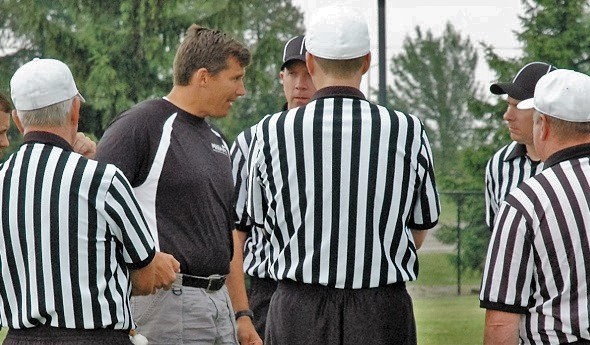
PHOTOS: (Top) MHSAA Assistant Director Mark Uyl provides pointers to football officials during a summer clinic in 2011. (Middle) Uyl speaks at the NASO officiating summit in 2013 in Grand Rapids.