


Teaching ABC's of Pressure Situations
October 30, 2013
 By Eric Martin
MSU Institute for the Study of Youth Sports
Coaches have seen the signs: Athletes having too much or not enough energy prior to a game, quickening breathing, sweating more than usual, being unable to focus on important details, and having their minds wander from the present to “what if” scenarios and past mistakes.
Athletes deal with pressure in many ways. Although some handle it well, many do not have the tools to perform to their full abilities in these situations. Most athletes place a high importance on succeeding in sport, and when athletes reach regional, district, or state championships, the pressure they feel may become overwhelming.
How athletes handle this increased pressure can often mean the difference between winning and losing. Therefore, helping athletes deal with it is something coaches should consider prior to athletes encountering these high-stakes situations.
Unfortunately, there is no magic elixir for helping your athletes work under pressure. But if these ABC’s of pressure situations are followed, your athletes will be much better equipped to cope, and the chances of their performance levels dropping significantly will be reduced.
1. Act the Part
How you as coaches act influences your athletes. For better or worse, athletes notice your emotions in response to these situations and take cues from how you handle pressure.
You are a demand on your players’ attention – you can add or reduce your players’ perceived stress by how you act. Understanding the demand you place on players requires self-awareness. How do you respond when a key call goes against you? Do you have nervous habits that athletes may notice? What messages are you providing to your athletes – both verbally and non-verbally? Athletes pick up on these non-verbal cues, so you must be aware of how you respond to these situations.
It is important to remember emotions are not always negative – rather acting differently than normal can be a signal to your athletes that you are stressed. Strive to be consistent in your actions – whether you are coaching during a preseason match or championship contest. These situations are stressful for you too, but you need to be the constant your athletes look to for stability.
2. Breathing – Remember to do it
It seems like a simple thing, but when athletes’ emotions are running high, they forget how to breathe – or, at least, forget how to breathe properly. Worse, they often think they are breathing normally but don’t notice breaths are becoming shorter and shallower. Teaching athletes to breathe properly when not in pressure situations will help them have the tools to rely on when they encounter more intense scenarios.
For proper breathing, athletes need to do so from the belly and not the chest. The pace of this breathing should be 6-2-7; that is, have athletes take a deep breath from the abdomen for six seconds, hold for two seconds, and then finally slowly exhale completely for seven seconds. This breathing strategy is ideal for pregame situations to quiet nerves and help athletes get ready to play, but a condensed version (3-2-3) can also be used for quick breaks in the action like a timeout or court change.
3. Control the controllables
During times of high pressure, athletes sometimes feel they do not have control over their own performances. It is important to help athletes focus on things they can control and not worry about those that cannot be changed or are outside their influence.
Instead of athletes dwelling on aspects that are out of their control like unusual game times for championship finals or a referee’s bad call, help them focus on completing their warm-up preparations and how they can respond to poor calls. Helping focus athletes’ attention on things they can control will help them better handle pressure situations and leave them feeling less helpless
Athletes’ emotions are typically out of their control, but how they view them and respond to these emotions are under their control. Author and preacher Charles R. Swindoll said, “Life is 10 percent what happens to you and 90 percent how you react to it!” Be sure your athletes know how to respond when difficult situations arise.
Conclusion: Fearlessness is an assembly
Not all athletes react to pressure situations in the same manner, but all athletes can benefit from these simple suggestions. Remember to ACT THE PART of how you want your athletes to act, teach your athletes proper BREATHING techniques, and help athletes focus on CONTROLLING THE CONTROLLABLES.
Good preparation is the key to performance. Increase self-monitoring and give athletes the tools to succeed in pressure situations; they, in turn, can be in a better position to succeed. However, like any skills, they must be practiced accordingly, and one session will not solve all issues. Devote the time to train athletes in these skills, and when the need arises they will have them ready to use.
Good luck this season!
Martin is a third-year doctoral student in the Institute for the Study of Youth Sports at Michigan State University. His research interests include athlete motivation and development of passion in youth, sport specialization, and coaches’ perspectives on working with the millennial athlete. He has led many sessions of the MHSAA Captains Leadership Clinic and consulted with junior high, high school, and collegiate athletes. If you have questions or comments, contact him at [email protected].
Oakridge's Schugars Always To Be 'Coach'
April 22, 2013
By Geoff Kimmerly
Second Half editor
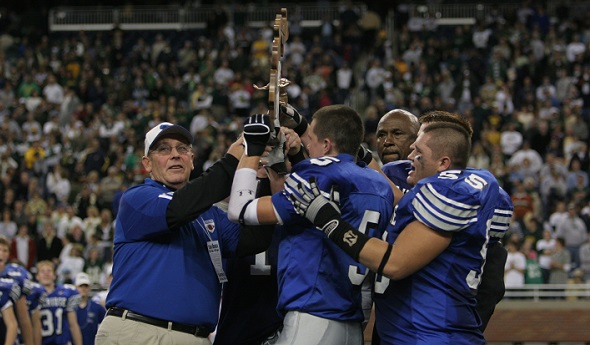
Jack Schugars led five Muskegon Oakridge teams to MHSAA football championship games during his 32 seasons running the program. He finished his high school coaching career in 2010 with a record of 262-78.
And of course, he impacted hundreds of lives in a community that, according to a former assistant, considers him a "saint."
Schugars was honored last week with the Duffy Daugherty Award for his outstanding achievements in high school football. Each spring, the Duffy Daugherty committee – made up of football supporters and media from the Lansing area – recognizes a high school coach along with a past or current college coach. The college award is among those recognized by the College Football Hall of Fame.
Among previous high school honorees present to congratulate Schugars during Thursday's banquet in East Lansing were Farmington Hills Harrison’s John Herrington, Birmingham Brother Rice’s Al Fracassa and former East Lansing coach Jeff Smith.
Schugars – now an assistant at Ferris State University – led his 1997, 2005 and 2008 teams to MHSAA titles, while his 1990 and 2003 teams finished MHSAA runners-up. He is a member of the Muskegon Sports Hall of Fame (class of 2009), the Michigan High School Coaches Association Hall of Fame (2008) and the Michigan High School Football Coaches Association Hall of Fame (1993). He received the MHSFCA’s highest honor, the Jim Crowley Award, in 2000.
The Schugars family is rooted in education. He also taught biology at the high school for 38 years, while his wife Julie taught English. Their daughter Amanda teaches in Battle Creek, and son Eric teaches and is the defensive coordinator at Traverse City Central.
Below are brief excerpts from the introduction of Schugars by his former football assistant and current Oakridge softball coach Joe Coletta, followed by Schugars' closing words of wisdom.
‘Faith, Family, Football’
(Coletta) “To Jack, those are not just words of hollow meaning. They are his compass.
 “Jack has won countless awards for his accomplishments on the football field. He absolutely refused to let anyone outwork him or his teams in preparation for a football game.
“But in my opinion, his strength as a football coach is his ability to take a kid that most people would give up on: a kid that some might label as no good, troublemaker, not worth the effort. He found a way to love the unlovable.
“He would give those kids direction; he would mentor them to be young men and young women and take them to where they could not possibly take themselves.
"When you can do that for a person, you let them see their worth as a human being and make a lasting impact so you can change the rest of their lives.
“That, to me, is what sets Jack apart from most coaches.”
What's most important
(Schugars) “The reason I'm on this Earth is to love the Lord your God with all my heart and soul and love your neighbors as yourself.
“So when I speak at clinics, when I talk to coaches, I tell them the greatest thing they can do for their team is to love their players.
“That is the greatest thing a coach can do. Love your players and be true role models each day.
“I could not ask for a better career than when ... a (former) player in the Navy Seal team calls me Coach. Lawyers, doctors, bankers, they call you Coach.
"Wow, that's a great word: Coach. That's what it's all about. Being a coach. Building relationships that will last a lifetime.
"I love the hundreds of players that are part of the Oakridge football family. And I hope I continue to build men out of boys, continue at the college level."
PHOTOS: (Top) Former Muskegon Oakridge football coach Jack Schugars holds up the 2005 Division 5 championship trophy with his players after their victory at Ford Field. (Middle) Schugars (right, with headset) monitors his team's play on the field against Jackson Lumen Christi.