


Get Prepped for a Fantastic Finale
May 24, 2013
By Geoff Kimmerly
Second Half editor
We love this time of year. And not just because school is nearly out for summer.
There’s little argument that the week ahead is the most exciting of each MHSAA school year. And you’ll want to set your bookmarks for MHSAA.com and Second Half for updated results and coverage not just next week – but through the rest of this spring season.
 The MHSAA.com Score Center is our home for scores from all District softball, baseball and soccer games, which begin Tuesday. You also can view real-time brackets for every District by going to the “Sports” page for each, and updated brackets for lacrosse by visiting our girls and boys pages for that sport as well.
In the Lower Peninsula, we’ll have same day or next morning results as golf Districts are played, and first-day results from next weekend’s Girls Tennis Finals on May 31 – followed by final results at the conclusion of play June 1. We’ll post Finals results for Upper Peninsula golf and tennis as we receive them Wednesday and Thursday, and then results for all seven Lower and Upper Peninsula Track and Field Finals as they come in June 1.
But results are only the start. As we have during the fall and winter, Second Half will provide coverage including photos from every MHSAA Final – beginning with Wednesday’s Upper Peninsula Girls and Boys Golf and Boys Tennis Finals. Keep an eye on Second Half throughout the week, or follow the Second Half feed on the cover page of MHSAA.com.
Transfer rule clarification
We released Monday the actions our Representative Council took earlier this month at its Spring Meeting, including an addition to the athletics-related portion of our transfer rule. Based on some questions we’ve received and read, here’s some further explanation of what will be installed for 2014-15:
The longer period of ineligibility for athletes who transfer because of athletics is not new. This has previously existed for cases in which a school could prove that it lost a student to another school purely for sports-related reasons.
What’s new is what must be proven and by whom for the longer ineligibility period to take effect. Now, a school that lost a student does not have to file a report with the MHSAA for the case to be considered. As long as one of a set of offending activities can be verified – including practicing, competing or training with a member of the new school’s coaching staff during summer or non-school sports activities or seasons – that student will have to sit 180 days instead of the usual period of roughly a semester. The 15 exemptions that allow a student to be eligible immediately – like making a full move to a new district or a student’s school closing – may still apply.
So, to conclude: The longer athletics-related ineligibility period is not new, just how athletics-related transfers are considered and reported. Click to read the full release.
Kickoff is coming
And that means we’re collecting varsity football schedules.
In fact, we have most of them thanks to our athletic directors, their secretaries, coaches and many others who chip in to help us keep complete and accurate information throughout the season.
But there are still plenty of steps in getting ready for August – and a huge one is locking down correct leagues for our teams this season, especially as schools continue to switch things up.
Check out your school’s schedule page by click on the “Schools” button in the menu bar at the top of MHSAA.com and searching for your school. Once on the school page, click the blue “Boys” button next to football. The schedule will appear in the middle of the page, with standings to the left.
See an error in a schedule or the standings? Email me at [email protected]. I thank you in advance.
Kramer’s words of wisdom
Long before Roy Kramer served as athletic director at Vanderbilt University, commissioner of the Southeastern Conference and creator of the Bowl Championship Series (BCS) for Division I college football, he coached multiple sports at East Lansing High School.
He recently was named winner of this year’s Duffy Daugherty Award, given in honor of the former Michigan State University coach to a valued coach or contributor to college football. The award, presented in East Lansing, is among those recognized by the College Football Hall of Fame.
Kramer finished his acceptance speech with a stirring endorsement of the sport that brought the crowd of more than 300 to its feet. If you’re a fan, former or current player or coach, see below.
PHOTO: Athletes race toward the finish of a relay during this spring's Alma College Invitational. (Click to see more at HighSchoolsSportsScene.com.)
Country Day Proves Coach's Intuition True in Claiming Record 16th Finals Win
By
Keith Dunlap
Special for MHSAA.com
November 1, 2025
GRAND LEDGE — Often at the start of a season in August, Detroit Country Day boys soccer coach Steve Bossert said he will tell his wife that “we don’t have it this year.”
But before he could mutter those words this fall, Country Day went up to a tournament up at the Boyne Mountain Sports Complex in the middle of August and went 3-1 in four games.
At that point, Bossert had some different words for his wife.
“After we came back from that Boyne trip, I said, ‘I think we’re pretty good,’” Bossert said. “And then a couple of weeks after that, I said that ‘we might do this.’”
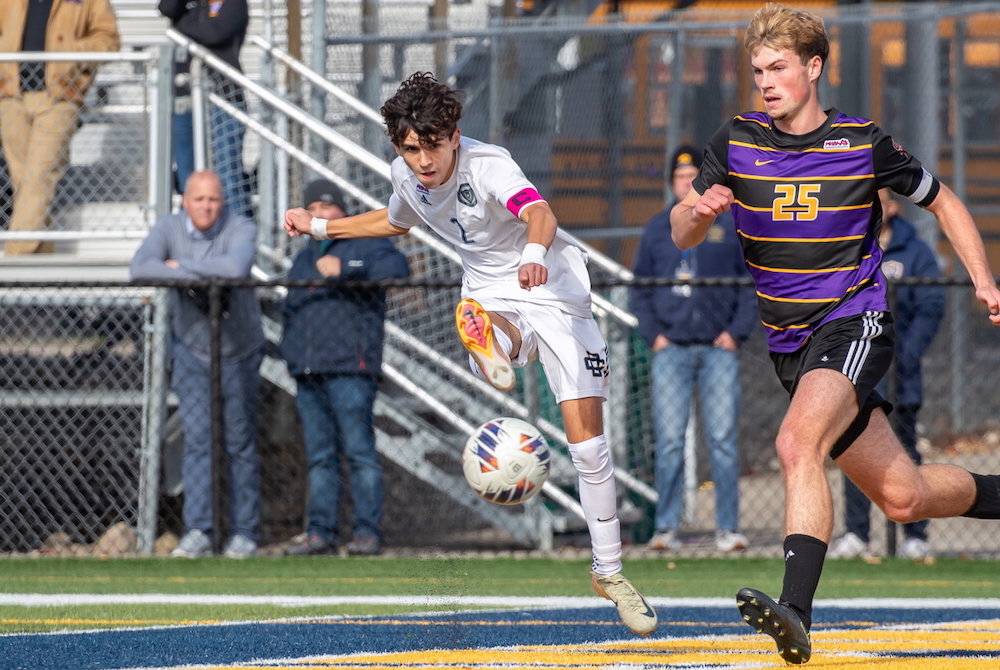
What “this” turned out to be was Country Day adding to its already record total of Finals championships won, as the Yellowjackets captured their 16th with a 4-1 win over South Haven in Saturday’s Division 3 Final.
 It took Country Day seven years since winning its 15th title in 2018, but Country Day delivered in dominant fashion.
Country Day scored three goals during the first 18:50 of the game and never looked back in a one-sided effort, outshooting South Haven 31-5.
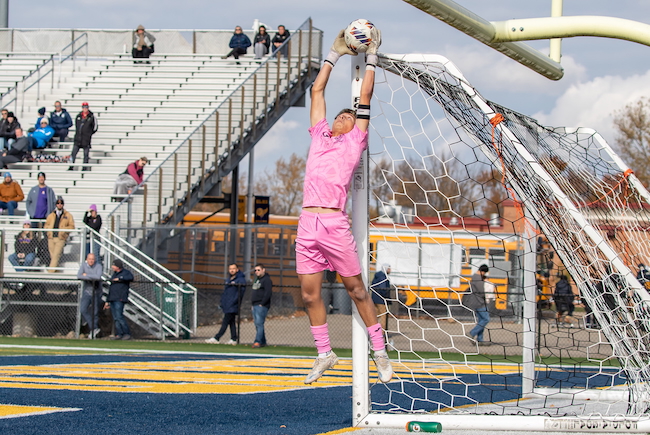
If not for 14 saves and overall brilliant play by South Haven senior keeper Alex Jaimes, the final score might have been more lopsided.
Senior Micah Zacks had two goals and an assist, and senior Tino Haratsaris had two assists to lead Country Day (22-2-1).
“We knew it was a good goalie, but we just had to keep shooting,” Zacks said. “There wasn’t much to it. Just keep shooting, and they’ll eventually go in. That’s what we did.”
South Haven (18-5-4) was attempting to win its first Finals title since being co-champion with Jackson Lumen Christi in 2003, but simply ran into a buzzsaw in Country Day.
“Overall, the season was something to be proud of,” South Haven head coach Randy Bautista. “Coming into the tournament we were not ranked. We beat tough opponents and ranked opponents throughout the playoffs. … Unfortunately it didn’t go our way today. But we keep our heads up and keep going.”
Country Day opened the scoring with 29:29 left in the first half on a beautifully constructed goal.
Stationed in front of the South Haven goal, Zacks headed a pass within the box to sophomore teammate Rye Clegg, who headed the ball himself into the goal to make it 1-0 Country Day.
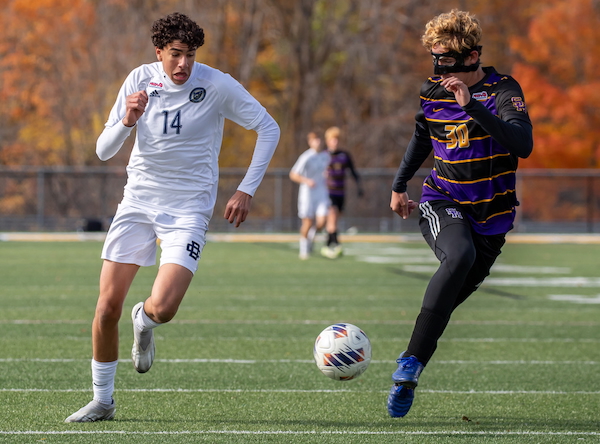 The Yellowjackets took a 2-0 lead with 24:50 left in the first half on a goal by senior Yousef Darwich, who tapped the ball into an open goal after South Haven’s keeper couldn’t quite corral a strong cross sent in by Country Day junior Luke Hourani.
The Yellowjackets then went up 3-0 with 21:10 to go in the first on a goal by Zacks, who sent home the ball off of a corner kick.
With 36:35 remaining in the game, Country Day took a 4-0 lead when Haratsaris brilliantly maneuvered around a defender and sent a pass in front of the goal to Zacks, who buried the chance.
South Haven got on the board with 1:17 remaining on a goal by junior Jaden Bolhuis, who fired a shot from roughly 30 yards away that went under the crossbar.
PHOTOS (Top) Country Day’s Tino Haratsaris (2) connects on a shot while South Haven’s Isaac Chalupa (25) rushes to defend. (Middle) South Haven keeper Alex Jaimes goes high to get his hands on the ball. (Below) DCD’s Yousef Darwich makes a run with the Rams’ Luke Swearingen defending. (Photos by Adam Sheehan/Hockey Weekly Action Photos.)