


Let's Play 2 (or 3, or 4)
February 16, 2012
A few conversations I had at last week's Women In Sports Leadership conference further affirmed a point I've been making for years -- high school athletes, if they'd like, shouldn't hesitate to play multiple sports.
Doing so does not hurt, but might just help their chances at landing that prized college scholarship -- on top of adding another layer to the high school sports experience.
Reaffirming this for me last week was Michigan State softball coach Jacquie Joseph, who spoke on that subject at the WISL conference. She's heading into her 24th season as a head coach at the Division I college level -- so she's been around for some of the evolution of both high school sports specialization and college recruiting. Plus, she coaches a sport that sees its share of athletes playing just that one.
Later, I spoke with a high school coach who leads teams in three sports and also played one at the Division I college level. She's a believer in this as well.
Some of the things I've been told over the years about playing more than one sport:
- It allows an athlete to learn more skills and hone more parts of his or her athleticism.
- Using another range of movement further helps condition an athlete's body and make it more resistant to injury.
- It's hardly rare to see a college football coach watching a prospect's basketball game -- coaches like to see how athleticism transfers across sports, and sometimes will see something from an athlete playing basketball that he didn't show on the football field. (Football and basketball are used in this example, but the same applies to a number of similar situations.)
- Athletes get an opportunity to play whatever they'd like only this once (unless they turn out to be that rare college athlete who takes on more than one sport at that level).
These are hardly new arguments. But they are always worth repeating -- especially when the people frequently making them (college coaches) are the ones single-sport athletes often are trying to impress.
Valley Lutheran Full of Returning Players Patiently Aiming for Return to Finals Weekend
By
Paul Costanzo
Special for MHSAA.com
August 20, 2026
Kate Belt and her Saginaw Valley Lutheran volleyball teammates are locked in on what’s in front of them.
 That means blocking out the urge to look ahead to their ultimate goal of a Finals title, even though they’re ranked No. 1 in Division 3 and returning nearly an entire roster from last year’s Semifinal team.
“We talked about it a little bit, but we aren’t really big on talking about it early in the season, because our next goal is our first round of Districts,” said Belt, an all-state senior setter. “We’re going to try to take it one game at a time. We want to always be prepared for the next game, keep the focus and keep the goal 100 percent on what’s next.”
It’s the attitude a team needs to have heading into a promising season to make sure it doesn’t get tripped up while overlooking an opponent. But just because it’s necessary, doesn’t mean it’s easy.
“It’s hard not to think early on, ‘Oh, we could go win a state championship,” Belt said. “So, it’s pretty hard. But I think Coach does a really good job of keeping us on the right track and in the right mindset to take care of that.”
Belt is one of eight seniors returning from a Valley Lutheran team that advanced to the Division 3 Semifinals a year ago with a roster filled exclusively with sophomores and juniors.
They lost in three sets there against Kalamazoo Christian, but 10 players saw action in all three games of the match, gaining valuable experience.
“We thought we had a real good chance against Kalamazoo Christian, but we didn’t play our very best in last year’s Final Four,” Valley Lutheran coach Jon Frank said. “The coaches and I kind of thought that (Kalamazoo Christian) has been there four years in a row, and it’s an intangible but it’s worth something to be acclimated to the scenario. We have three new players, but it’s still the same core group. We had 10 players last year, and all 10 of them played every single set in the postseason. That’s a coach’s dream.”
Valley Lutheran did suffer one major loss from last year’s roster, as junior Braelin Rodammer, a third-team all-state selection a year ago, is injured and will miss this fall.
 At 5-foot-10, she was the tallest presence on the front line for the Chargers, but Belt still has plenty of weapons around her.
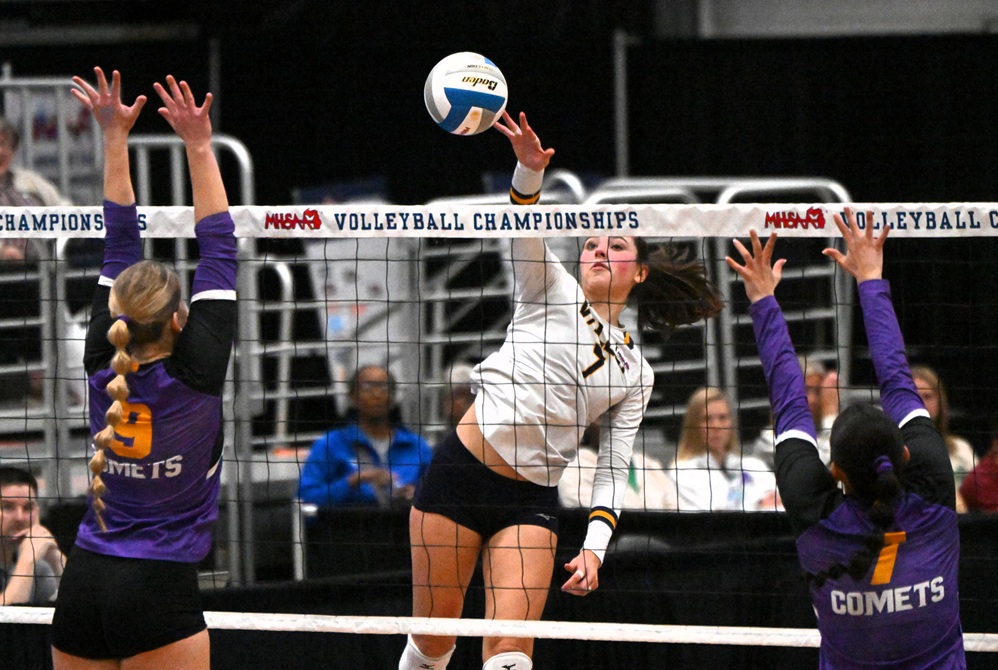
Reagan Webb had more than 400 kills as a junior outside hitter in 2025, while Grace Parker had more than 300 as a sophomore middle. Both are back, as is Hannah Hemme, who Belt personally called out as having a massive offseason.
“She’s just become an offensive weapon for us in practice,” Belt said. “Even her defensive play has been amazing. Her serve-receive and blocking has been really good. That work ethic is something that we want to embody.”
Frank said Valley Lutheran has always been a scrappy team, anyway, adding that they’ve never had “that 6-foot girl that can just pound it.”
Seniors Hayden Sherman (660 digs in 2025) and Elsie Hultberg (363 digs) are at the base of that defense.
“We’re so strong defensively, that’s always been our thing,” Frank said. “We serve hard, pass well and we frustrate teams. We dig ‘em, we dig ‘em, and we block ‘em. I really love this team. We’re strong all around. We just don’t have that big banger.”
That all-around strength is helped by the fact this group of seniors has always been together, even for a year on the junior varsity, despite its incredible talent.
When they were freshmen, Frank had a strong roster full of seniors, allowing him to keep his talented youngsters fully together for a year before they would hit the varsity squad.
“I think it was really good for us to get to know each other on a very low-pressure team where we didn’t have to stress about the postseason,” Belt said. “I was happy he didn’t bring anyone up to varsity, because if you have to sit the bench the whole season, that sucks. All of us love playing. We’re all very competitive people.”
As sophomores, six of the eight current seniors made a surprising run to the Quarterfinal, then came together for last year’s Semifinal run.
Now they’re focused on taking the next step in front of them, to hopefully take that final step forward as a program.
“I think last season kind of gave us confidence, because we know how far we can go now,” Belt said. “Going into this season, we know nothing is going to be handed to us. Coach always says that we could lose in Districts if we don’t play well. He’s really good at keeping us humble. But also, he’s super supportive of how far we want to go.”
 Paul Costanzo served as a sportswriter at The Port Huron Times Herald from 2006-15, including three years as lead sportswriter, and prior to that as sports editor at the Hillsdale Daily News from 2005-06. He can be reached at [email protected] with story ideas for Genesee, Lapeer, St. Clair, Sanilac, Huron, Tuscola, Saginaw, Bay, Arenac, Midland and Gladwin counties.
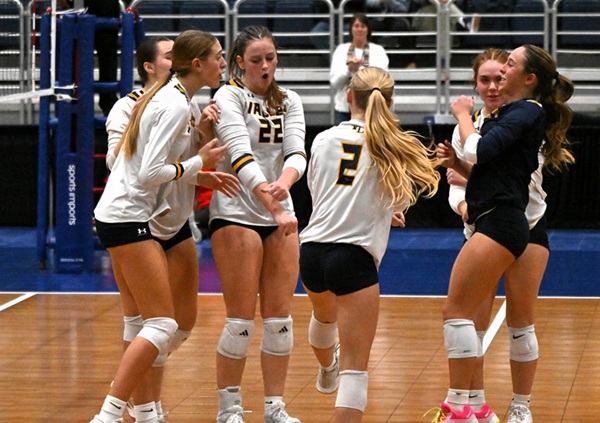
PHOTOS (Top) Saginaw Valley Lutheran’s Grace Parker (7) sends a kill attempt into the Kalamazoo Christian front line during last season’s Division 3 Semifinals. (Middle) The Chargers, including Kate Belt (22), celebrate a point.