


2017 Community Service Awards Honor 6
May 11, 2017
By Geoff Kimmerly
Second Half editor
Students representing six Michigan high schools have been selected as winners of the inaugural Community Service Awards sponsored by the Michigan High School Athletic Association and Lake Trust Credit Union for their efforts to improve the lives of others in their communities.
 Brighton senior Bailey Brown, Newaygo senior Justice Ottinger, Ann Arbor Huron junior Katie Sesi, Utica Ford senior Nikki Sorgi, Colon High School’s “Yard Squad” and Rochester Hills Stoney Creek’s Cougar Athletic Leadership Council have earned $1,000 awards to be applied to individual college scholarships, credited to their schools’ athletic departments or gifted to the groups helped by the honorees. In addition to the $1,000 award, the Lake Trust Foundation is awarding an additional $500 to each honoree, to be donated to a non-profit, 501 (c)(3) organization of the awardee’s choice.
The MHSAA and Lake Trust received 70 applications for the first-time awards from schools and students serving communities in both peninsulas and every region of the state. Individual athletes, teams, and other school groups with athletic ties at MHSAA member high schools were eligible for the awards. Nominations were accepted from students, coaches and school administrators.
“We hear all the time about the wonderful contributions athletes are making in their communities by sharing their talents off the field, and it was great to see so many examples of this work all in one place as we selected this first class of honorees,” said MHSAA assistant director Andy Frushour, who oversees brand management and student services for the Association. “We’re glad for the opportunity with Lake Trust to be able to highlight some of this great work being done all over our state.”
One honoree will be profiled daily beginning May 21 on Second Half.
Below are brief summaries of the community services provided by this year’s award winners:
Bailey Brown, Brighton: Diagnosed as a freshman with amplified musculoskeletal pain syndrome, causing nerve pain that eventually resulted in multiple surgeries, Brown dedicated her effort to children hospitalized while undergoing cancer treatment. American Girl offers dolls that do not have hair; Brown endeavored at first to buy two dolls for children whose hair had fallen out during chemotherapy, and instead raised more than $5,000 to purchase 48 dolls and other toys.
Justice Ottinger, Newaygo: Ottinger was the recipient of a donated kidney in June, 2016, and organized the “Ball is Life, Organs Are Too” event to honor his donor, Mark Linsley, and raise awareness of the need for organ donors. Hosting the event during a basketball game, Linsley signed individuals up for organ donation and sold T-shirts he had designed; more than $4,000 was raised for Gift of Life Michigan and 13 donors signed up.
Katie Sesi, Ann Arbor Huron: Earning donations by playing violin at the Ann Arbor Art Fair since she was 6, and collecting more than 300,000 cans and bottles beginning when she was 9, Sesi has raised $40,000 for C.S. Mott Children’s Hospital at the University of Michigan to benefit children with cancer. She has donated $10,000 every two years since 2010, contributing to multiple efforts including the creation of an indoor playground.
Nikki Sorgi, Utica Ford: After first organizing a toy drive for hospitalized children in 2013, Sorgi and her older sister Alex for the last three years have directed a blanket drive designed to provide homemade fleece blankets for patients of any age. Sorgi has helped in providing more than 400 homemade blankets including through Kids Kicking Cancer in Southfield and the C.S. Mott Children’s Hospital.
“Yard Squad,” Colon: Sophomores Andrew Smolarz, Isaiah Fellers and Andy Stoll, and freshmen Phillip Alva and Austin Stoll – members of the track & field team – answered a request for students to help clean up an elderly person’s yard. They’ve since cleaned three yards during weekends and while all five are playing multiple sports during the spring – and with more calls for help coming in as the Squad’s reputation grows.
Cougar Athletic Leadership Council, Rochester Hills Stoney Creek: The Council, a group of student-athletes created to serve the community, produced a Suicide Prevention Awareness event in coordination with a Stoney Creek basketball game Feb. 28. The co-chairpersons of the Council’s Special Events Committee – Isabella Ubaydi, Nate Davis and Kevin Price – planned the event and spoke during halftime on how suicide and mental illness have impacted them and their school community. Funds from T-shirts sold, concessions and additional donations allowed CALC to donate more than $4,700 to the American Foundation for Suicide Prevention.
“Lake Trust Credit Union is proud to partner with MHSAA to recognize and support these hardworking, dedicated community members,” said Lake Trust Credit Union Vice President of Culture + Engagement, Brandalynn Winchester-Middlebrook. “These students exemplify commitment to their teams and neighbors, while making remarkable impacts in our communities.”
Lake Trust Credit Union lives up to their name, with branches that stretch from Lake Michigan to Lake Huron. With over 175,000 members and $1.7 billion in assets, they’re the sixth largest credit union in Michigan. By participating in and supporting over 100 local events, they reach across the state to create stronger communities. Membership is open to anyone who lives, works, worships or attends school in their 35 county service area. Visit www.laketrust.org.
The MHSAA is a private, not-for-profit corporation of voluntary membership by more than 1,400 public and private senior high schools and junior high/middle schools which exists to develop common rules for athletic eligibility and competition. No government funds or tax dollars support the MHSAA, which was the first such association nationally to not accept membership dues or tournament entry fees from schools. Member schools which enforce these rules are permitted to participate in MHSAA tournaments, which attract more than 1.4 million spectators each year.
Adrian Madison's Isom Leads at All Levels
By
Geoff Kimmerly
MHSAA.com senior editor
February 21, 2019
Over more than three decades, Adrian Madison athletic director Kris Isom has taken on responsibilities not only in her league and regionally, but statewide as a member of the MHSAA Representative Council – in addition to her athletic department responsibilities at the high school and junior high.
And yet, she still teaches multiple classes and coaches at least one of the district’s teams every year, serving and building relationships at the most local level of her wide influence on educational athletics.
She’s made those relationships a priority, also serving as class advisor to Madison students through last year when her daughter Rachel graduated. One year during the 1990s, in fact, the graduating class even dedicated its yearbook to her.
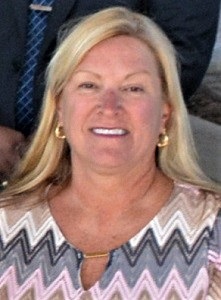 “I like being in the classroom and coaching because I still have a connection with kids, know who they are,” Isom said. “Being at a smaller school, you’re able to know who kids are, but at the middle school especially I don’t know a lot. Getting involved in coaching has helped me put a name with a face so I will know them coming up.”
She continues to impact students at Madison and beyond, and will be recognized for her many contributions with the 32nd Women In Sports Leadership Award during halftime of the Division 3 Girls Basketball Final on March 23 at Calvin College’s Van Noord Arena.
Each year, the Representative Council considers the achievements of women coaches, officials and athletic administrators affiliated with the MHSAA who show exemplary leadership capabilities and positive contributions to athletics.
Isom is in her 33rd year as athletic director at Adrian Madison, taking over athletics for the high school and junior high after serving as a teacher and coach for a year at Clinton. She has served as part of the MHSAA Representative Council since 2008, representing Class C and D schools from the state’s southeastern section.
“I’m very honored by this award, not only because it’s for women in leadership. I’ve been doing this 33 years and I’ve seen more and more women in this profession … that for all things considered is a man’s profession,” Isom said. “Having a daughter, who while she’s not following my footsteps, but getting her in the business world eventually, it’s a good feeling.”
Isom’s contributions to high school sports and its participants are many and at all levels. Within her district, she has coached basketball, volleyball, sideline cheer, track & field and softball – at least one sport every year, including as the eighth grade girls basketball coach this season.
At the league level, Isom has served as president of the Tri-County Conference since 2002 after previously serving as vice president and secretary/treasurer. Serving more of her neighboring districts, Isom has hosted numerous District, Regional and Quarterfinal competitions and MHSAA Coaches Advancement Program (CAP) sessions.
At the statewide level, Isom has provided her expertise as a member of the Representative Council and as a 33-year member of the Michigan Interscholastic Athletic Administrators Association and National Interscholastic Athletic Administrators Association. She also assists MHSAA staff annually in selecting members of the 16-student Student Advisory Council.
She was named the MIAAA’s Region 6 “Athletic Director of the Year” in 2000 and received the MHSAA’s Allen W. Bush Award in 2016 to recognize her many behind-the-scenes contributions.
“Kris Isom continues to provide a steadying presence on our Representative Council. She researches issues and really brings a voice of reason to the discussion – not only to the full Council, but to the Executive Committee as well,” MHSAA Executive Director Mark Uyl said. “She does a great job representing the southeastern corner of the state, bringing a small-school perspective to the table time after time. We’re thankful for her leadership and glad to present her with the Women In Sports Leadership Award.”
Part of leadership is being an example, and Isom has served as one for many. Of course that growing group included her daughter who this year left home to study in the dental hygiene program at Jackson College but has frequently been by Mom’s side for the many activities.
“Hopefully, (she learned) to be assertive, that she needs to be a good listener, and obviously you have to be a mediator,” Kris Isom said. “Hopefully seeing all those aspects, and dealing with situations and different issues, she’ll be a better problem solver, be more open (to the idea) that there is more than one side of a story.”
A graduate of Clinton High School, Isom received her bachelor’s degree in science and teaching certification in physical education and health in 1984 from Michigan State University. She earned her master’s in elementary education in 1986 from Eastern Michigan University and also has completed graduate courses from Fresno Pacific University.
In addition to the MIAAA and NIAAA, Isom is a member of the Michigan Association for Health, Physical Education, Recreation and Dance (MAHPERD) and the Michigan State University Alumni Association. She’s active with The Clinton United Church of Christ in various service projects, including an annual fundraiser for cancer research, and also participates in local Meals on Wheels, American Red Cross and Habitat for Humanity projects.
The first Women In Sports Leadership Award was presented in 1990.
Past recipients
1990 – Carol Seavoy, L’Anse
1991 – Diane Laffey, Harper Woods
1992 – Patricia Ashby, Scotts
1993 – Jo Lake, Grosse Pointe
1994 – Brenda Gatlin, Detroit
1995 – Jane Bennett, Ann Arbor
1996 – Cheryl Amos-Helmicki, Huntington Woods
1997 – Delores L. Elswick, Detroit
1998 – Karen S. Leinaar, Delton
1999 – Kathy McGee, Flint
2000 – Pat Richardson, Grass Lake
2001 – Suzanne Martin, East Lansing
2002 – Susan Barthold, Kentwood
2003 – Nancy Clark, Flint
2004 – Kathy Vruggink Westdorp, Grand Rapids
2005 – Barbara Redding, Capac
2006 – Melanie Miller, Lansing
2007 – Jan Sander, Warren Woods
2008 – Jane Bos, Grand Rapids
2009 – Gail Ganakas, Flint; Deb VanKuiken, Holly
2010 – Gina Mazzolini, Lansing
2011 – Ellen Pugh, West Branch; Patti Tibaldi, Traverse City
2012 – Janet Gillette, Comstock Park
2013 – Barbara Beckett, Traverse City
2014 – Teri Reyburn, DeWitt
2015 – Jean LaClair, Bronson
2016 – Betty Wroubel, Pontiac Notre Dame Prep
2017 – Dottie Davis, Ann Arbor Huron
2018 – Meg Seng, Ann Arbor Greenhills
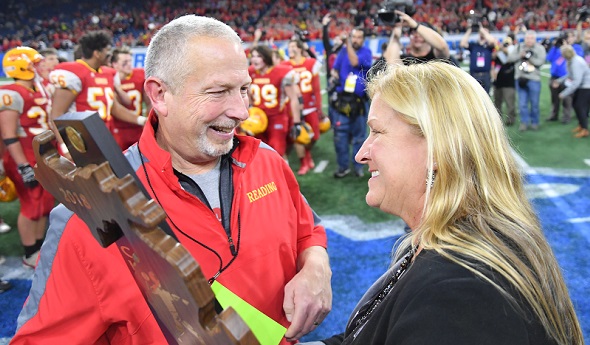
PHOTO: Adrian Madison athletic director Kris Isom, right, presents the Division 8 football championship trophy to Reading coach Rick Bailey in November at Ford Field.