


43 Percent of Athletes are Multi-Sport
August 19, 2019
By Geoff Kimmerly
Second Half editor
Nearly 43 percent of athletes at MHSAA member high schools continued to participate in two or more sports in 2018-19, according to the Multi-Sport Participation Survey, reinforcing similar data collected for the first time two years ago and providing a foundation for work by the MHSAA’s Multi-Sport Task Force as it prepares to continue efforts this fall to promote the multi-sport high school experience.
Early and intense sport specialization has become one of the most serious issues related to health and safety at all levels of youth sports, as overuse injuries and burnout among athletes have been tied to chronic injuries and health-related problems later in life. In early 2016, the MHSAA appointed the Task Force on Multi-Sport Participation as part of a continued effort to promote and protect participant health and address the issues leading to early sport specialization.
The multi-sport participation survey was created in 2018 to provide data on the prevalence of sport specialization at MHSAA member high schools. This year’s survey received responses from 82.9 percent of member high schools and measured how multi-sport participation exists at schools. The collection of survey results annually is expected to show how schools are succeeding in promoting a multi-sport high school experience, providing another tool as schools work to guide students toward a well-rounded interscholastic sports career.
From schools that responded to this year’s survey, 42.9 percent of students participated in athletics in 2018-19 – 46.3 percent of boys and 39.5 percent of girls. The overall participation number was up nearly half a percent from 2017-18 (42.5), with the boys percentage holding steady and the girls increasing nearly a full percent from a year ago. Class D schools – those with the smallest enrollments – again enjoyed the highest percentage of athletes among the entire student body, at 57.1 percent, followed by Class C (50.7), Class B (45.8) and Class A (39.4).
Of those athletes counted by responding schools, 43 percent participated in more than one sport – including 45.1 percent of boys and 40.4 percent of girls – with all three of those percentages nearly identical to those derived from the first survey a year ago. Class D again enjoyed the highest percentage of multi-sport athletes, 61.8 percent, followed by Class C (56.7), Class B (48.7) and Class A (35.4).
Similar results for overall sport participation and multi-sport participation relative to enrollment size were seen by further breaking down Class A into schools of fewer than 1,000 students, 1,000-1,500 students, 1,501-2,000 students and more than 2,000 students. Similarly to 2017-18 for both sport participation as a whole and multi-sport participation specifically, the smallest Class A schools continued to enjoy the highest percentages, while percentages then decreased for every larger size group of schools.
Also of note, the percentage of two-sport athletes at every school measure around one-third of athletes – from 29.2 percent at Class A schools to 35.7 at Class B, 37.2 at Class C and 35.6 at Class D. However the number of athletes participating in three sports decreased substantially relative to the increase in school enrollment, with 22.5 percent of Class D athletes playing three sports, 18.2 in Class C, 12.4 in Class B and 6.0 percent in Class A.
The MHSAA Task Force on Multi-Sport Participation will be meeting this fall to discuss creating a program to measure multi-sport participation at MHSAA member schools and to recognize “achievers” – that is, schools that surpass the norm given their enrollment and other factors that affect school sports participation.
For 2018-19, in Class A, Marquette posted the highest percentage of multi-sport athletes with 85.9 percent, up 3.3 percent from its top-ranking Class A percentage from 2017-18. Grand Rapids Northview also topped 80 percent multi-sport participation, with 83.1 percent of its athletes playing two or more sports. Orchard Lake St. Mary’s, Detroit East English and Gibraltar Carlson all saw multi-sport participation from at least 70 percent of their athletes.
In Class B, four schools again achieved at least 80 percent multi-sport participation – Coloma (87.2 percent), Gladstone (86.7), Flat Rock (83.2) and Dundee (80.2), while 10 schools had 70 percent or more athletes playing at least two sports.
Six Class C schools reported more than 80 percent of its athletes taking part in more than one sport – Schoolcraft (87.1), Mayville (86.2), Manton (85.3), Houghton Lake (84.9), Cass City (84.7) and Decatur (83.5) – and 12 schools total with 75 percent or more athletes participating in multiple sports. There were 14 Class D schools with multi-sport participation at 80.9 percent or higher, with Gaylord St. Mary (93.2), Waterford Our Lady of the Lakes (91.5) and Watersmeet (90.3) topping the survey not just for Class D but among all schools that responded.
The full summary report on the Multi-Sport Participation Survey is available on the “Health & Safety” page of the MHSAA Website.
Applications Available for 2026-27 MHSAA/Farm Bureau Insurance Scholar-Athlete Awards
By
Geoff Kimmerly
MHSAA.com senior editor
October 6, 2026
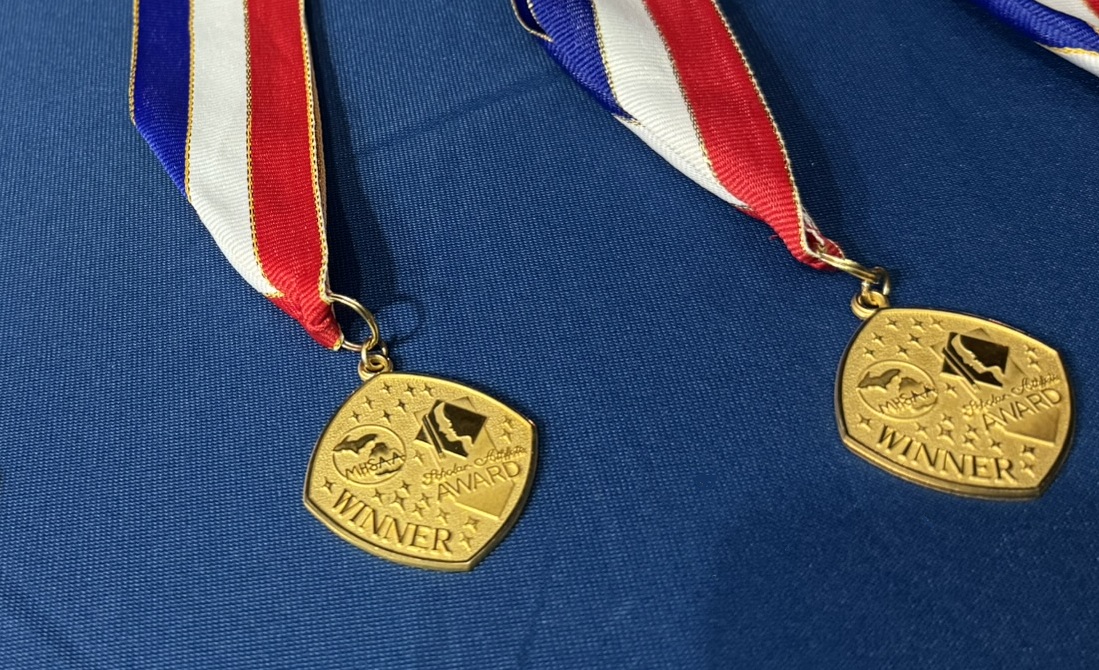
One of the Michigan High School Athletic Association’s most popular programs, the Scholar-Athlete Award, will again with Farm Bureau Insurance present 32 $2,000 scholarships to top student-athletes at member high schools during the 2026-27 school year.

The MHSAA/Farm Bureau Insurance Scholar-Athlete Award highlights the value extracurricular activities play in the total education of high school students, often improving their academic achievements in the process. The Scholar-Athlete Award is in its 38th year. Since the award’s inception in 1988-89, Farm Bureau Insurance has presented more than $1 million in scholarships through this program.
The first 30 scholarships will be presented on a graduated basis across the MHSAA’s traditional class structure. From Class A schools, six boys and six girls will receive scholarships; from Class B schools, four boys and four girls; from Class C schools, three boys and three girls; and from Class D schools, two boys and two girls will be honored. The final two scholarships will be awarded at-large to minority recipients, regardless of school size. The scholarships may be used at the institution of higher learning the recipients attend during the first year at those colleges.
Applications from individual schools will be limited to the number of available scholarships in their enrollment class. Class A schools may submit the names of six boys and six girls, Class B schools may submit four boys and four girls, Class C may submit three boys and three girls and Class D may submit two boys and two girls.
Students applying for Scholar-Athlete Awards must be graduating during the 2026-27 school year, carrying an unrounded 3.5 (on a 4.0 scale) grade-point average and have won a varsity letter in a sport in which the MHSAA sponsors a postseason tournament: baseball, girls and boys basketball, girls and boys bowling, competitive cheer, girls and boys cross country, field hockey, football, girls and boys golf, gymnastics, ice hockey, girls and boys lacrosse, girls and boys skiing, girls and boys soccer, softball, girls and boys swimming & diving, girls and boys tennis, girls and boys track & field, girls and boys volleyball and girls and boys wrestling.
Applicants will be required to show involvement in other school and community activities and submit an essay on the importance of sportsmanship in educational athletics.
Information – including answers to a number of frequently asked questions – and links to the application are available online on the Scholar-Athlete Award page. Applications are available in digital format only and must be submitted online by 4 p.m. Dec. 4.
A committee composed of school administrators from across the state will select finalists and winners in late January, with the winners to be announced throughout February. All applicants, finalists and scholarship recipients will be announced on the MHSAA Website. The 32 scholarship recipients will be recognized during the 2027 MHSAA Boys Basketball Finals at the Breslin Student Events Center in East Lansing.
Farm Bureau Insurance of Michigan was founded in 1949 by Michigan farmers who wanted an insurance company that worked as hard as they did. Those values still guide the company today and are a big reason why it is known as Michigan’s Insurance Company, dedicated to protecting the farms, families, and businesses of this great state. Farm Bureau Insurance agents across Michigan provide a full range of insurance services – life, home, auto, farm, business, retirement, Lake Estate®, and more – protecting more than 660,000 Michigan residents.
The MHSAA is a private, not-for-profit corporation of voluntary membership by more than 1,500 public and private senior high schools and junior high/middle schools which exists to develop common rules for athletic eligibility and competition. No government funds or tax dollars support the MHSAA, which was the first such association nationally to not accept membership dues or tournament entry fees from schools. Member schools which enforce these rules are permitted to participate in MHSAA tournaments, which attract more than 1.4 million spectators each year.