

Brush Up on the New Transfer Rule
July 18, 2019
By Rob Kaminski
MHSAA benchmarks editor
Eligibility under the new “sport-specific” transfer rule begins this coming fall after circulating extensively for nearly one school year.
Unless one of the stated 15 exceptions is met, participation during the 2018-19 school year determines eligibility for 2019-20.
The new rule adopted by the Representative Council at its May 2018 meeting has found support among most audiences. A transfer student’s eligibility in 2019-20 is based upon that student’s participation from this past school year (2018-19). It will be paramount for administrators and coaches to have awareness of the sports a transfer student participated in during the previous school year.
The long-standing 15 Exceptions to immediate eligibility, such as a full and complete residential change or a student moving between divorced parents by completing of an Educational Transfer Form, did not change.
One might call the rule on the way out “The Fourth-Friday Transfer Rule.” Under this old rule, when a student enrolled at the new school determined his or her eligibility. Under the new Sport Specific Transfer rule, what a student played in the previous season determines eligibility.
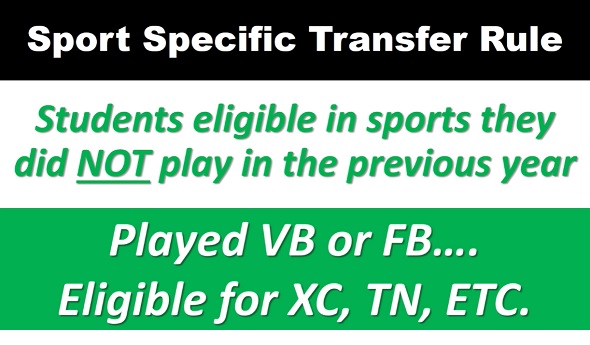
The Council passed a more lenient rule on the one hand and more restrictive on the other. The more lenient aspect is a change that finds a transfer student ELIGIBLE in any sport in which he or she did not participate in a game or a scrimmage in the previous school year.
The more restrictive portion tends to discourage students who change schools for sports reasons. A transfer student who did play a sport in the previous season – and who does not meet one of the 15 Exceptions – is NOT ELIGIBLE in that sport for the next season. If a student changes schools in mid-season, the student would be ineligible for the rest of that season in that sport and the next season for that sport.
Participation under this and other rules means playing in an interscholastic game or scrimmage after starting the 9th grade at any high school. It does not mean practice, but entering an interscholastic game, meet or scrimmage in any way. It also may involve more than one sport, so a three-sport athlete who does not have a residential change and transfers would be ineligible in those sports during the next school year – but eligible for any other sport. It also means a student cut from a team – one who never entered a scrimmage or game – may transfer and play without delay for that new school’s team. It may also mean that a student who meets one of the stated exceptions such as a residential change but enrolls in a school other than her or his school of residence, would have eligibility in sports not played in the previous year.
The new rule will tend to discourage students from changing schools for sports because they would be ineligible in any sport they have played in school the previous season for that sport. It will increase participation for some students who were otherwise not eligible under the current rule.
It is always best to contact school athletic directors who can connect with the MHSAA to verify eligibility prior to enrollment.
If the student’s new school requests in writing, the MHSAA Executive Committee may approve a waiver that reduces the period of ineligibility to 90 scheduled school days at the new school if the change of schools was for compelling reasons demonstrated with outside documentation having nothing to do with sports, curriculum, finances, and school demographics. The Executives Committee also has authority to approve immediate eligibility.

Council Approves Winter Start, Guidance
October 23, 2020
By Geoff Kimmerly
Second Half editor
The Representative Council of the Michigan High School Athletic Association confirmed during its meeting Thursday (Oct. 22) that 2020-21 Winter sports will begin on time, and also approved a series of guidelines for those sports that schools must follow as they continue to work toward limiting the spread of COVID-19 while still providing opportunities for athletes to compete.
Most high school sports traditionally begin practice during the first three weeks of November, with competition starting during mid-November and the first weeks of December. The starts of middle school Winter sports seasons are determined by local leagues and conferences; many are slated to begin during the next few weeks.
Sport-specific guidelines for all Winter sports will be posted early next week to their respective sport pages on the MHSAA Website. A number of precautions have been put in place addressing competition limits, numbers of spectators allowed and wearing of face coverings, among a variety of topics. The guidance also specifically addresses equipment and facilities for each sport.
“The Council believes it is safer to begin Winter practices on time, and keep athletes in school programs where safety precautions are always in effect,” MHSAA Executive Director Mark Uyl said. “With the vastly different circumstances faced by schools in different regions all over the state, an on-time start still allows schools to decide when they feel most comfortable beginning activity – and allows all of them to slowly ramp up their frequency of activity and numbers of spectators attending competitions.
“But let’s be clear: Our statewide COVID-19 numbers have to get better. In order for our schools to continue playing sports this winter, and in order for fans to be there to cheer them on, we must continue working to slow down this virus.”
As with Fall sports, scrimmages will not be allowed for Winter sports to limit mixing of communities outside of official competitions. The numbers of teams at regular-season competitions also will be limited, like during Fall, with a maximum of four schools/teams allowed in competitive cheer, gymnastics, swimming & diving and wrestling. Bowling and skiing competitions will be restricted to a maximum of 72 competitors at one event.
There are no school/team limits for basketball and ice hockey, as only two teams are able to play each other at one time and those sports may play only one game per day – with fans leaving after their game is complete. Host sites must strictly enforce spectator capacity limits on a game-by-game basis. The Council approved as part of these guidelines an allowance of two spectators per participant at all contests to begin the regular season. This guideline could be reconsidered by the Council later in the winter season, with a possibility of allowing more spectators later while still staying within possible Emergency Orders from the Michigan Department of Health and Human Services (MDHHS).
As per MDHHS requirements, face coverings must be worn by athletes practicing and competing in basketball, competitive cheer, ice hockey and wrestling. They are not required for athletes practicing and competing in bowling, gymnastics, skiing and swimming & diving, which all allow for appropriate social distancing – but face coverings are required for those athletes when not involved in active participation.