

Brush Up on the New Transfer Rule
July 18, 2019
By Rob Kaminski
MHSAA benchmarks editor
Eligibility under the new “sport-specific” transfer rule begins this coming fall after circulating extensively for nearly one school year.
Unless one of the stated 15 exceptions is met, participation during the 2018-19 school year determines eligibility for 2019-20.
The new rule adopted by the Representative Council at its May 2018 meeting has found support among most audiences. A transfer student’s eligibility in 2019-20 is based upon that student’s participation from this past school year (2018-19). It will be paramount for administrators and coaches to have awareness of the sports a transfer student participated in during the previous school year.
The long-standing 15 Exceptions to immediate eligibility, such as a full and complete residential change or a student moving between divorced parents by completing of an Educational Transfer Form, did not change.
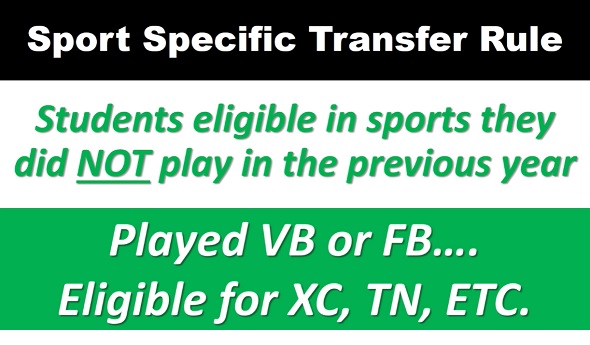
One might call the rule on the way out “The Fourth-Friday Transfer Rule.” Under this old rule, when a student enrolled at the new school determined his or her eligibility. Under the new Sport Specific Transfer rule, what a student played in the previous season determines eligibility.
The Council passed a more lenient rule on the one hand and more restrictive on the other. The more lenient aspect is a change that finds a transfer student ELIGIBLE in any sport in which he or she did not participate in a game or a scrimmage in the previous school year.
The more restrictive portion tends to discourage students who change schools for sports reasons. A transfer student who did play a sport in the previous season – and who does not meet one of the 15 Exceptions – is NOT ELIGIBLE in that sport for the next season. If a student changes schools in mid-season, the student would be ineligible for the rest of that season in that sport and the next season for that sport.
Participation under this and other rules means playing in an interscholastic game or scrimmage after starting the 9th grade at any high school. It does not mean practice, but entering an interscholastic game, meet or scrimmage in any way. It also may involve more than one sport, so a three-sport athlete who does not have a residential change and transfers would be ineligible in those sports during the next school year – but eligible for any other sport. It also means a student cut from a team – one who never entered a scrimmage or game – may transfer and play without delay for that new school’s team. It may also mean that a student who meets one of the stated exceptions such as a residential change but enrolls in a school other than her or his school of residence, would have eligibility in sports not played in the previous year.
The new rule will tend to discourage students from changing schools for sports because they would be ineligible in any sport they have played in school the previous season for that sport. It will increase participation for some students who were otherwise not eligible under the current rule.
It is always best to contact school athletic directors who can connect with the MHSAA to verify eligibility prior to enrollment.
If the student’s new school requests in writing, the MHSAA Executive Committee may approve a waiver that reduces the period of ineligibility to 90 scheduled school days at the new school if the change of schools was for compelling reasons demonstrated with outside documentation having nothing to do with sports, curriculum, finances, and school demographics. The Executives Committee also has authority to approve immediate eligibility.

Vermontville Star Named to NFHS Hall
By
Geoff Kimmerly
MHSAA.com senior editor
March 1, 2016
Record-setting Vermontville High School baseball star Ken Beardslee, who continues to hold two national strikeout records more than 65 years after his final high school pitch, was one of 12 individuals named Tuesday to the National High School Sports Hall of Fame by the National Federation of State High School Associations (NFHS).
 Beardslee, who died in 2007, will be inducted as one of five athletes selected for the 34th Hall of Fame class at a ceremony during the NFHS summer meeting July 2 in Reno, Nev.; the rest of the class is made up of coaches, administrators and an official. He was nominated through the Michigan High School Athletic Association.
Beardslee has been proclaimed as “prep baseball’s first ace” in the NFHS National High School Sports Record Book and was featured in the former print version of the book for his incredible feats from 1947-49. In his three years on the mound for Vermontville, Beardslee won 24 of his 25 starts (the team was 31-1 during that time). His 24 victories included eight no-hitters, with two perfect games, and seven one-hitters.
He set seven national records, and two still stand after 66 years: his per-game season strikeout mark of 19.0 and his per-game career strikeout mark of 18.1.
Beardslee will become the Hall of Fame’s eighth inductee from Michigan, joining Charles Forsythe, the first executive director of the Michigan High School Athletic Association (inducted 1983); River Rouge boys basketball coach Lofton Greene (1986), Warren Regina softball coach Diane Laffey (2000), Fennville basketball, football, track and baseball standout Richie Jordan (2001), Grosse Pointe Woods University Liggett boys and girls tennis coach Bob Wood (2005), Bloomfield Hills Cranbrook hockey standout Jim Johnson (2007) and Owosso football, basketball and baseball all-stater Brad Van Pelt (2011).
“It’s been said that records are made to be broken,” wrote MHSAA Executive Director John E. “Jack” Roberts in his letter supporting Beardslee’s nomination. “But the strikeout numbers Ken Beardslee recorded in the late 1940s have stood the test of time, just like some of the shutout and strikeout numbers 2009 Hall of Fame honoree David Clyde amassed some 20 years later. But Clyde never came close to Beardslee’s 19.0 Ks per game in a season or 18.1 per game for a career, and neither has anyone else.”
Beardslee is listed 10 times in the MHSAA record book. He shares the record for career no-hitters and is second with two career perfect games and a 0.32 career earned run average. In addition to his two national strikeout records still standing, he’s listed in the MHSAA records with games of 26, 25 (both extra innings) and 20 strikeouts (in seven innings) during the 1949 season. His 209 strikeouts that spring rank fourth for one season in MHSAA history, and his 452 over three seasons rank 12th on the career strikeouts list.
Beardslee was drafted by the New York Yankees immediately after graduating from high school and pitched in the minor leagues from 1949 to 1956, when an injury ended his playing career. Beardslee went on to scout for the Pittsburgh Pirates for 21 years, and he received a World Series ring after the team’s championship win in 1971. He also went on to write eight books including novels, poetry and an instructional on pitching.
He is survived by his wife Marilene, who is expected to attend the ceremony this summer to accept his honor.
The National High School Hall of Fame was started in 1982 by the NFHS. This year’s class increases the number of individuals in the Hall of Fame to 447.
The 12 individuals were chosen after a two-level selection process involving a screening committee composed of active high school state association administrators, coaches and officials, and a final selection committee composed of coaches, former athletes, state association officials, media representatives and educational leaders. Nominations were made through NFHS member associations. Also chosen for this class were athletes Steve Spurrier (Tennessee), Marlin Briscoe (Nebraska), Joni Huntley (Oregon) and Tom Southall (Colorado); coaches Chuck Kyle (Ohio), Peg Kopec (Illinois), Pete Boudreaux (Louisiana) and Jack Holloway (Delaware); administrators Tim Flannery (NFHS) and Ennis Proctor (Mississippi), and official Eugene “Lefty” Wright (Minnesota).
For more on this year’s Hall of Fame class, visit the NFHS Website. For more on Michigan’s past inductees, visit the MHSAA Website.