

Clinic to Serve Voices of Our Communities
December 20, 2017
By Geoff Kimmerly
Second Half editor
Roger Smith was a senior at Lake Orion High School in 1993-94 when he got his first public address announcing opportunity, filling in for varsity boys basketball games after the longtime announcer decided to take a season off.
Tony Coggins was only a freshman when he grabbed the microphone for the first time – getting that chance when his dad, Flushing athletic director Dale Coggins, couldn’t find anyone else to announce middle school football games.
Steve Miller actually started as a game official during his senior year of high school at East Detroit, and is a college football official today – but with the PA bug keeping him in that part of the game as well.
All three have similar getting-started stories – they jumped in with little to no experience but with both feet, found mentors to emulate (including one in common, longtime MHSAA and Michigan State University voice Erik O. Furseth), and honed their craft over decades on their ways to becoming mainstays in their communities and regulars at MHSAA Finals in multiple sports.
Miller, Coggins and Smith will share those experiences and wisdom as instructors at the MHSAA’s Public Address Announcers Clinic on Jan. 6 at the MHSAA Office in East Lansing. The day will provide an opportunity not just for training, but for announcers statewide to come together and discuss the key contribution they make to high school sports all over our state.
“I don’t claim to be an expert, but I’ve done it enough years now too that I’ve had emergency situations and really odd requests,” Smith said. “I’m the only football announcer here (at Lake Orion), and I never get to get with my fellow colleagues. So it’s nice to have that network, to know there are other people out there who do it, and to learn from others and to see mistakes that I probably still am making and how to get better and situations I haven’t thought about.”
The clinic will use a curriculum developed by the National Association of Sports Public Address Announcers and focus on the role of the public address announcer, public address announcing expectations (school, state association and NASPAA), public address announcing philosophy, sportsmanship/NASPAA Code of Conduct, announcing Do's and Don'ts, scriptwriting and handling emergency situations.
Registration is limited to 75 attendees, but spots are available. Click for the registration form.
“The public address announcer helps set the tone for educational athletic events,” said John Johnson, MHSAA Director of Broadcast Properties. “At the high school level, we expect our announcers to inform everyone of what’s happening – not to entertain them – and to be a welcoming and reassuring presence. This clinic provides information they can’t get anywhere else.”
Miller initially hoped to work in sports television growing up, then switched lanes to education. He teaches mathematics and applied technology at Harrison Township L’Anse Creuse, where he started doing PA in 1999 for girls basketball games.
 Coggins’ middle school football debut came in 1985, and 33 years later he’s going strong. Now in his 18th year announcing where he teaches at Holly, Coggins lends his voice to football, basketball, baseball, softball, volleyball, competitive cheer and swimming & diving events. Smith is in his 17th year back at his alma mater, where he teaches broadcasting. He primarily announces football and basketball although he’s helped with baseball, softball and swimming as well, using the opportunity to practice what he preaches to his students in the classroom.
“I have zero athletic ability whatsoever, which is interesting because my father was an all-state running back. But I enjoy being involved, and I've always been the one for history and statistics and knowing what's going on,” Coggins said. “This is a way for me to be involved. It's a way for me to use a talent I've been given; public speaking has always come pretty naturally for me.
“So I worked at my craft to get better. I got better from watching the people around me, from studying the people I like, and the people – if I saw someone I didn’t care for – I'd make a note and say to myself, ‘Don't do that.’ I take feedback from people very personally, and I mean that in a good way. If somebody takes the time to come up and say ‘You did this well; I think you should change this,’ that means they care about the program also. We all have the same goal in mind, and that's to make the experience good for the high school student and the parents, the fans, that come there.”
Miller began learning his craft by attending MHSAA championship events and paying special attention to Furseth, the longtime and legendary voice of Football and Basketball Finals. Nearly two decades after getting his start, Miller also is the voice of University of Michigan men’s and women’s lacrosse and has announced MHSAA Finals in multiple sports since 2005.
In 2012, he officiated the Division 1 Football Final at Ford Field, then moved to the press deck to announce the Division 3 Final that night.
“There are a lot of great examples of how to do this at this level, and also not great examples,” Miller said. “The biggest issue is just doing it the right way and knowing what’s expected at our level – being the informational voice instead of the cheerleader. I was fortunate; I took the lead from guys like Eric who knew that was what was expected. And it just wasn’t my personality or my style to start yelling and screaming.”
The conference registration fee of $75 includes the NASPAA’s second edition of “The Voice Above The Crowd” – the official public address announcing manual for amateur sports – plus a one-year membership in the NASPAA and lunch.
All three instructors are members of the NASPAA and continue to announce MHSAA Finals in football, basketball, baseball and softball.
“I’m super honored to be involved in those kinds of events, to be able to provide a soundtrack to some of the biggest moments in people’s lives,” Miller said. “Knowing I’m providing a service is big for me, and it’s kinda neat being the invisible voice … the invisible soundtrack that helps make the experience special for them.”
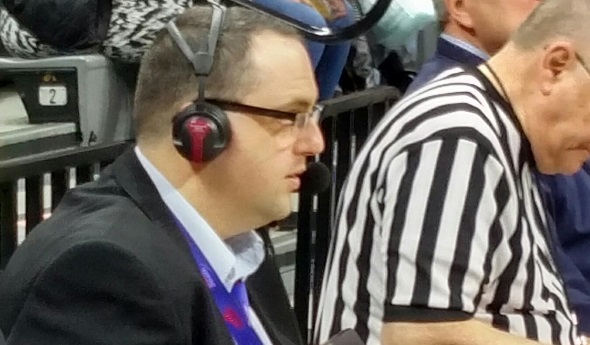
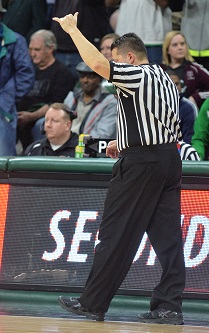
PHOTOS: (Top) Steve Miller calls a basketball game during an MHSAA Finals weekend at the Breslin Center at Michigan State University. (Middle) While officials regulate action on the court, announcers like Roger Smith (lower left) call the shots from the PA seat.

Scholar-Athlete Finalists Announced
By
Geoff Kimmerly
MHSAA.com senior editor
January 25, 2013
The 120 finalists for the Michigan High School Athletic Association's Scholar-Athlete Award for the 2012-13 school year have been announced.
The program, which has been recognizing student-athletes since the 1989-90 school year, will honor 32 individuals from MHSAA member schools who participate in at least one sport in which the Association sponsors a postseason tournament. Farm Bureau Insurance underwrites the Scholar-Athlete Award, and will present a $1,000 scholarship to each recipient. Since the beginning of the program, 576 scholarships have been awarded.
Scholarships will be presented proportionately by school classification, with 12 scholarships to be awarded to Class A student-athletes, six female and six male; eight scholarships will be awarded to Class B student-athletes, four female and four male; six scholarships will be awarded to Class C student-athletes, three female and three male; and four scholarships will be awarded to Class D student-athletes, two female and two male. In addition, there also will be two at-large honorees which also are part of the general judging process, may come from any classification, and are designated by their school at the time of entry.
Every MHSAA member high school could submit as many applications as there are scholarships available in its classification, and could have more than one finalist. Saline has five finalists this year, while Kalamazoo Hackett and Muskegon Mona Shores have three. Eleven schools each had two finalists: Ann Arbor Gabriel Richard, Comstock Park, Grosse Ile, Hillsdale Academy, Macomb Dakota, Okemos, Oxford, Portland, Rock Mid-Peninsula and Sand Creek.
Multiple-sport participation remains the norm among applicants. The average sport participation rate of the finalists is 2.48, while the average of the application pool was 2.16 – both within a tenth of last year’s rates in those categories. There are 59 three-plus sport participants in the finalist field, and all but one of the 28 sports in which the MHSAA sponsors postseason tournaments are represented.
Of 409 schools which submitted applicants, 54 submitted the maximum allowed. This year, 1,675 applications were received. All will be presented with certificates commemorating their achievement. Additional Scholar-Athlete information, including a complete list of scholarship nominees, can be found on the MHSAA Website.
The applications were judged by a 66-member committee of school coaches, counselors, faculty members, administrators and board members from MHSAA member schools. Selection of the 32 scholarship recipients will take place in early February. Class C and D scholarship recipients will be announced on February 5; Class B scholarship recipients will be announced on February 12, and Class A scholarship recipients will be announced on February 19. All announcements will be made on the MHSAA Website.
To honor the 32 Scholar-Athlete Award recipients, a ceremony will take place during halftime of the Class C Boys Basketball Final, March 23, at the Breslin Student Events Center in East Lansing.
To be eligible for the award, students must have a cumulative grade point average of 3.50 (on a 4.0 scale), and previously have won a varsity letter in at least one sport in which the MHSAA sponsors a postseason tournament. Students also were asked to respond to a series of short essay questions, submit two letters of recommendation and submit a 500-word essay on the importance of sportsmanship in educational athletics.
Farm Bureau Insurance, one of Michigan's major insurers, has a statewide force of more than 400 agents serving more than 380,000 Michigan policyholders. Besides providing life, home, auto, farm, business and retirement insurance, the company also sponsors life-saving, real-time Doppler weather tracking systems in several Michigan communities.
2012-13 Scholar-Athlete Award Finalists
BOYS CLASS A
Marcus William Barnett, St Clair Shores Lake Shore
Connor James Bos, Holland
Andrew Camp, Midland Dow
Bryan Condra, Hartland
Jarrod Eaton, St. Johns
Tristan Eggenberger, Okemos
Alex Fauer, Macomb Dakota
Thomas Greidanus, Grand Rapids Christian
Kalvis Hornburg, Traverse City Central
Reed Hrynewich, Muskegon Mona Shores
Austin Jones, Bay City Central
Tyler Scott Kemerer, Saginaw Heritage
Anthony Lamus, Saline
Jacob J. Presto, Orchard Lake St Mary's
Charles Robert Proctor, Bay City Western
David Read, Midland Dow
Harrison Schurr, Jenison
Jeremy Simon, Richland Gull Lake
Jonathan Sollish, Berkley
Thomas Spicuzza, Oxford
Jason Vander Horst, Milford
Kevin W. Walsh, Detroit Catholic Central
Pierce Watson, Lowell
Adam Whitener, Saline
GIRLS CLASS A
Kristy Allen, East Grand Rapids
Casie Ammerman, Ann Arbor Huron
Jacqueline Burke, Troy
Francesca Ciaramitaro, Grosse Pointe North
Lara Fawaz, Dearborn
Kayla Giese, Macomb Dakota
Morgan Alexandria Gilliam, North Farmington
Kristin Nicole Green, Saline
Sarah Gutknecht, Farmington
Kelly Hall, Saline
Hailey Hrynewich, Muskegon Mona Shores
Jessica Kalbfleisch, Traverse City West
Jillian Klein, Muskegon Mona Shores
Brooke Kovacic, Oxford
Teresa LaForest, St. Joseph
Elizabeth Michno, Macomb L'Anse Creuse North
Kelly Raterink, Zeeland East
Roxanne Raven, Okemos
Kerigan Riley, Livonia Churchill
Haley Schaafsma, Riverview
Carley Serowoky, Waterford Kettering
Kendall Tamler, Birmingham Seaholm
Reinie Thomas, Portage Central
Lindsay Walter, Saline
BOYS CLASS B
Michael Azzopardi, Detroit Country Day
Michael Broderick, Pontiac Notre Dame Prep
Brice Brown, Ionia
Michael Chickeral, Flat Rock
Thomas D. Finch, Otsego
Alec Robert Fisher, Battle Creek Harper Creek
Mark Gibson, Freeland
Patrick Gifford, Haslett
Andrew Hammond, Grand Rapids Forest Hills Eastern
Michael Heinrich, Ludington
Luke James Hurst, Ovid-Elsie
Matthew Liu, Bloomfield Hills Cranbrook-Kingswood
Adam Olszewski, Ann Arbor Gabriel Richard
Scott Parkinson, Grayling
Keeton Thayer Ross, Grosse Ile
Ryan Schall, Comstock Park
GIRLS CLASS B
Brittany Beeler, Spring Lake
Ashley M. Carney, Jackson Northwest
Kelsi Caywood, Sturgis
Amanda Ciancio, Comstock Park
Morgan Kathleen Cinader, Goodrich
Mary Emington, Cadillac
Hannah C. Engle, Adrian
Nicole L. Green, Portland
Haley June Obetts, Wayland Union
Molly Oren, Hamilton
Catherine Polgar, Grosse Ile
Emily Quinn, Portland
Florence Ann Sobell, Croswell-Lexington
Anjali Sood, Ann Arbor Gabriel Richard
Megan Taylor, Houghton Lake
Shelby Walsh, Livonia Ladywood
BOYS CLASS C
Brian Christopher Aldrich, Kalamazoo Hackett
Jesse Anderson, Union City
Kenner Broullire, Manistique
Jesse Corbat, Breckenridge
Parker Eldred, Blanchard Montabella
Ashwin Fujii, Ann Arbor Greenhills
Zachary A. Kerr, Saugatuck
Connor Lockman, Royal Oak Shrine Catholic
Mike O'Brien, Maple City-Glen Lake
Elliott Rains, Sand Creek
Quinton Rice, Marcellus
Luke Schaffner, Clinton
GIRLS CLASS C
Alyssa R. Briolat, Ubly
Kara Craig, Schoolcraft
Lindsey Dopheide, Lawton
Margaret Elizabeth Durbin, Boyne City
Macayla Geiner, Hart
Natalie Perry, Sand Creek
Theresa Pickell, Reese
Abigail Radomsky, Kalamazoo Hackett
Kylei Ratkowski, Bronson
Faith Schroeder, Saginaw Michigan Lutheran Seminary
Grace Smith, Kalamazoo Hackett
Nicole Winter, Watervliet
BOYS CLASS D
Charles Barchett, Watervliet Grace Christian
Charles A. Blood, Hillsdale Academy
Brett Branstrom, Rock-Mid Peninsula
Matthew R. Katz, Tekonsha
Alexander G. Knight, Lake Linden-Hubbell
Francisco Jay Noyola, Lansing Christian
Joseph Samuel Paquette, Munising
Hunter Selby, Genesee Christian
GIRLS CLASS D
Anna Marie Couture, Posen
Sarah Cullip, St. Ignace
Erica LeClaire, Dollar Bay
Elyse Kathleen Lisznyai, Hillsdale Academy
Elena Victoria Luce, Mason County Eastern
Christina Smith, Gaylord St. Mary
Kari L. Steenwyk, Ellsworth
Krysta M. VanDamme, Rock-Mid Peninsula