


Council Adopts Heat Management Policy
March 26, 2013
The adoption of a heat management policy for MHSAA tournaments and a detailed model policy to be submitted to member schools for suggested use during practice and regular-season competition was the main focus of the Representative Council of the Michigan High School Athletic Association during its annual Winter Meeting on March 22 in East Lansing.
Heat and humidity management is the next step of the MHSAA’s ongoing focus on health and safety issues in school sports. The model policy, while not setting requirements for member schools, proposes actions based on heat index – the degree of felt discomfort derived by combining temperature and humidity measurements – that are designed to minimize the risk of heat-related illness during interscholastic participation. It will be published as a recommendation for regular-season practice and competition in the 2013-14 MHSAA Handbook, and it will be mandatory for MHSAA tournaments beginning this fall.
Executive director John E. “Jack” Roberts said there are a number of member schools with solid heat management policies in place, but he hopes the adoption of this “best practice” will further raise awareness of the risks of heat-related illness while giving schools – especially those without a protocol – an opportunity to adopt a standardized policy similar to what is in place for other environmental factors such as lightning and tornadoes.
“For the past several years, we’ve used four ‘H’s’ to focus our efforts to improve the health and safety of student-athletes: Heads, Hearts, Heat and health Histories,” Roberts said. “To maintain momentum, we’ve identified several focus areas for the next four years: better acclimatization of athletes, better health and safety preparedness for coaches and modification of practice policies and contest rules to reduce head trauma and the frequency of each sport’s most injurious situations.
“Friday’s action was significant; but it’s just the next step in a continuous series of actions being taken to make school sports as healthy as possible for students.”
The heat management policy states that temperature and humidity readings should be taken at the site of the practice or competition 30 minutes prior to its start and then 60 minutes after it has begun. Recommendations for hydration and levels of activity are suggested for each of four levels of heat index readings.
Key tenets include frequency and length of water breaks, appropriate uniforms based on heat index and mandates on what time of day practices should be conducted and for how long. Practices are suggested to be postponed or moved when the heat index measures 99 to 104 degrees, and all outdoor activity (and indoor if air conditioning is unavailable) is to be stopped if the heat index rises above 104.
The Representative Council also discussed raising expectations for coaches’ education and preparedness for promoting student-athletes’ health and safety. Three proposals are under consideration for Council votes during its next three meetings:
- The first would require all assistant and sub-varsity coaches at the high school level to complete the same MHSAA rules meeting required of varsity head coaches (which includes safety information) or one of the free online sports safety courses posted on or linked to MHSAA.com. This would take effect in 2014-15 and could be voted on at the Council’s May meeting.
- The second proposal would require current CPR certification for all varsity head coaches at the high school level, with AED training a recommended component of the course. This would take effect in 2015-16 and could be voted on at the December meeting.
- The third proposal would require varsity head coaches hired to begin on or after July 1, 2016 to complete Level 1 or 2 of the MHSAA’s Coaches Advancement Program, a six-level educational regimen that aids coaches in their growth and development. This could be voted on at the Council’s March 2014 meeting.
Two sport-related actions also were taken by the Council during last week’s meeting:
- Boys lacrosse: Beginning this season, an official must be a member in good standing of an approved local boys lacrosse officials association in order to be eligible to work MHSAA tournament games. This is in addition to other existing requirements.
- Wrestling: For school years during which there are only 15 Saturdays between the first day of practice and the MHSAA Individual Finals (rather than the traditional 16 Saturdays), the number of days from the beginning of practice until the first competition shall be reduced from 23 to 19. For the 2013-14 season, the earliest day of competition is Dec. 7, instead of Dec. 11 under the previous regulation. There is no reduction in the minimum number of days when practice actually is held prior to the first competition.
The Representative Council is the 19-member legislative body of the MHSAA. All but five members are elected by member schools. Four members are appointed by the Council to facilitate representation of females and minorities, and the 19th position is occupied by the Superintendent of Public Instruction or designee.
Bedford's Gandee Honored for 'Spirit'
March 13, 2017
By John Gillis
Special from NFHS
Hunter Gandee, a student-athlete at Temperance Bedford High School, has been selected as the 2017 Section 4 recipient of the “National High School Spirit of Sport Award” by the National Federation of State High School Associations (NFHS).
The National High School Spirit of Sport Award was created by the NFHS to recognize those individuals who exemplify the ideals of the spirit of sport that represent the core mission of education-based athletics.
The mark of a “good big brother” is often to what lengths he might go to assist his younger siblings.
That sense of familial assistance has perhaps never been taken to the extremes that Hunter Gandee has repeatedly done for his younger brother Braden.
A standout student, Hunter is a junior with a 3.92 grade-point average and a member of the National Honor Society.
On the sports side, Hunter is in his third season on the varsity wrestling team, and participates in Greco-Roman and freestyle wrestling during the offseason. He's also a member of the MHSAA Student Advisory Council.
While those accomplishments are unquestionably outstanding, they might pale in comparison to what he has done for Braden.
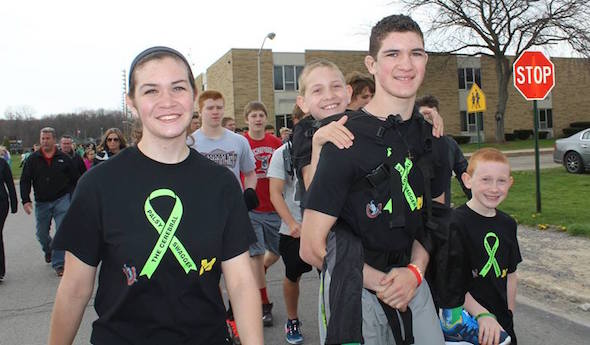
Born with cerebral palsy, Braden has limited use of his legs. Nonetheless, Hunter has taken it upon himself to help Braden know what it feels like to walk long distances – and he’s done it three times. Organized for the purpose of raising awareness of cerebral palsy, Hunter literally carries Braden on his back for long walks known as “CP Swaggers.”
In 2014, Hunter carried Braden 40 miles from the Bedford Junior High School wrestling room to the University of Michigan’s Bahna Wrestling Center. The following year, they upped the trek’s mileage to 57 miles.
However, that couldn’t foreshadow what was to follow in April 2016 when Hunter carried Braden on his back an amazing 111 miles – some 14 miles more than the first two walks combined.
About the Award: The NFHS divides the nation into eight geographical sections. The states in Section 4 are Michigan, Illinois, Indiana, Iowa and Wisconsin.
Nominations for this award were generated through NFHS member state associations and reviewed by the NFHS Spirit of Sport Award Selection Committee composed of state association staff members.
While the national winner will be recognized June 29 at the NFHS Summer Meeting in Providence, Rhode Island, the section winners will be recognized within their respective states and will receive awards before the end of the current school year.
PHOTO: Hunter Gandee, second from right, carries his brother Braden as part of their effort to bring awareness to cerebral palsy. (Photo courtesy of The Cerebral Palsy Swagger.)