

Legacy Speaks for Allen's Service
January 31, 2014
By Geoff Kimmerly
Second Half editor
Randy Allen was a face seen and a voice heard by thousands during the first two decades of his career in athletics, when he worked as a TV sports anchor and radio play-by-play personality.
But it’s fair to assume his son Dean has watched his dad at work more than anyone over the latter’s most recent 20-plus years serving high school athletic associations, including the last 13 as an assistant director at the MHSAA.
Dean Allen, now an assistant athletic director at Pontiac Notre Dame Prep, remembers many trophy presentations over the years and how his dad would step back and make sure the tournament manager or athletic director was the one handing the hardware to those who deserved the spotlight.
Randy Allen embraced a behind-the-scenes role after joining the high school association side in 1992. And as he retired from the MHSAA on Friday, it was no doubt the athletic directors, officials and coaches who worked with him behind the scenes over the last 13 years who most appreciated his many contributions to making his seasons run smoothly.
“The biggest smile you’d see on him was when the tournament was over and the kids were out there tackling each other, the excitement, the smiles on their faces when they get their medals and raise the trophy,” Dean Allen said. “For him, that’s most worth it. To see it run well, and when it’s over, seeing the kids and the community and parents and coaches, celebrating the successes they’ve had. Seeing the smiles on kids’ faces is really what it’s all about.”
Randy Allen’s name surely isn’t as recognizable to sports fans in Michigan as it was during the 1970s and 80s in Wisconsin.
That was by design.
Allen set that tone almost immediately at his first meeting as a member of the MHSAA staff – during the Michigan Interscholastic Athletic Administrators Association annual summer retreat.
“I remember telling them how glad I was to be here, and how much I looked forward to serving the membership. I just felt that was our main focus here, was to serve schools,” Allen said. “I’ve kept that thought in mind day in and day out.”
Allen knew only a handful of Michiganders when he joined the MHSAA staff. But he knew the job – and was ready for the challenges of fulfilling an aspiration while gaining knowledge of his new home on the fly.
His roots in high school athletics already dug deep.
Allen officiated baseball and softball for 25 years and also some of both at the college level. He also worked as a TV sports anchor at multiple stations near Madison, Wis., for 15 years while radio broadcasting high school football, basketball, baseball and hockey games on three networks and University of Wisconsin hockey games during the era of legendary coach Bob Johnson.
Allen went on to work in various other media roles as a producer, director and station manager, and broadcasted and produced Wisconsin high school tournament games – which led in part to his joining the Wisconsin Interscholastic Athletic Association staff as communications director in 1992.
In 2000, Allen became a seven-state regional director for iHigh.com. But an opportunity at the MHSAA two years later allowed him to pursue a goal going back to his days at the WIAA.
“I had always hoped I would get a chance to manage a sport in a state association,” Allen said. “When I came here, I went to heaven. I got to manage sports, and they were sports I knew like the back of my hand.”
Allen joined the MHSAA staff as assistant director in charge of baseball, softball, hockey and team wrestling. But that was just a start; Allen later traded in baseball and team wrestling for golf and played a leading role in the addition of bowling, which he has directed since its inception.
Allen also coordinated the junior high/middle school and MHSAA awards committees and served as staff liaison to the MIAAA, among other duties.
“Randy has been a perfect fit for his major sport responsibilities here,” MHSAA executive director Jack Roberts said. “He is a very hard worker, and he is very well liked by the coaches, officials and administrators he has served so well.”
It was during a trip to visit potential Hockey Finals sites roughly a decade ago that Roberts first brought up to Allen the possibility of bowling becoming the next MHSAA tournament addition – and the question of who on staff could run it. Roberts asked if Allen had experience in the sport.
Allen had an uncle in the bowling business and had been rolling since he was 4. “Bowling has been in my DNA since I was (a child),” Allen said. “I speak their language.”
He directed the MHSAA’s first Bowling Finals in 2004. Participation in the sport has continued to grow to 6,700 students in 2012-13.
Bowling also played a big part in making Allen something of an ambassador for the MHSAA, in that he reached out to an entire group of sports people who had not been in MHSAA conversations before.
He played a similar key role in serving others who also often work under the radar, providing training to the athletic department secretaries and middle school athletic directors during MIAAA conferences. And his experience in multiple states allowed him to provide a valuable and varied perspective.
“He always was willing to talk to someone – answer an MHSAA rules or regulation question, provide a quick fix to a school/league issue, give an anecdote to make a bad day better with a smile,” said Bear Lake athletic director Karen Leinaar, who also serves on the MHSAA Representative Council and is assistant to the executive director of the MIAAA. “And he always was a welcoming voice on the phone. No question, no person was ever a bother. He always took time and provided some type of direction.”
He’ll continue to do so.
Allen will begin Monday as commissioner of the Capital Area Activities Conference, the 27-school league that includes most of the biggest in the Lansing and Jackson areas.
“My entire life has been school sports. Not college sports, not professional sports. School sports,” Allen said. “It was my passion, what I was comfortable with as an official; I coached a little bit, I played a little bit (and) as a broadcaster.”
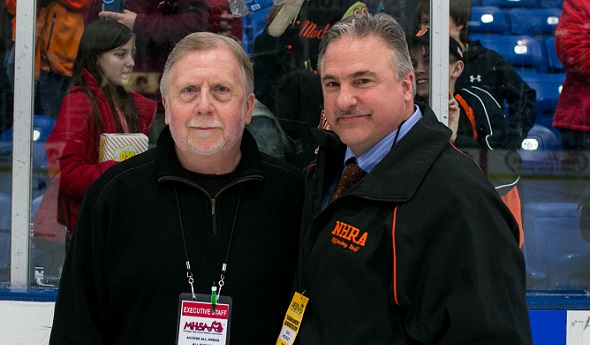
PHOTO: Retired MHSAA assistant director Randy Allen (left), with official Dan Dicristofaro, managed his final Hockey Finals in 2013.
Scholars & Athletes 2020: Class C & D
By
Geoff Kimmerly
MHSAA.com senior editor
February 3, 2020
By Geoff Kimmerly
Second Half editor
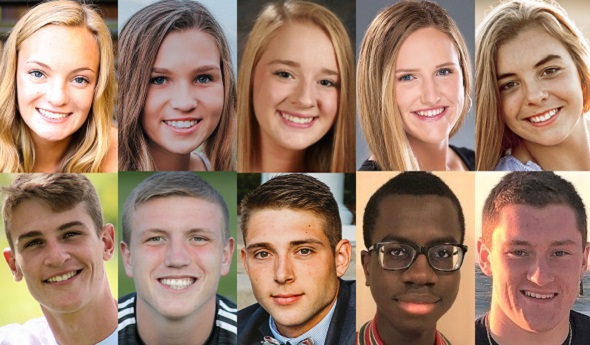
The Michigan High School Athletic Association has selected 10 student-athletes from Class C and D member schools to receive scholarships through the MHSAA/Farm Bureau Insurance Scholar-Athlete Award program.
 Farm Bureau Insurance, in its 31st year of sponsoring the award, will give $1,000 college scholarships to 32 individuals who represent their member schools in at least one sport in which the Association sponsors a postseason tournament. The first 30 scholarships are awarded proportionately by school classification and the number of student-athletes involved in those classes; also, there are two at-large honorees who can come from any classification.
Students applying for the Scholar-Athlete Award must be carrying at least a 3.5 (on a 4.0 scale) grade-point average and have previously won a letter in a varsity sport in which the Michigan High School Athletic Association sponsors a postseason tournament. Other requirements for the applicants were to show active participation in other school and community activities and produce an essay on the importance of sportsmanship in educational athletics.
Each of the scholarship recipients will be honored at a halftime ceremony during the Division 3 Boys Basketball Final, March 28, at the Breslin Student Events Center in East Lansing. Commemorative medallions will be given to the finalists in recognition of their accomplishments.
The Class C Scholar-Athlete Award honorees are: Madelyn Koski, Ishpeming Westwood; Alanna Mayer, Bronson; Kayla Moore, Madison Heights Bishop Foley Catholic; Brendan Dafoe, Petersburg Summerfield; Noah Dusseau, Petersburg Summerfield; and Hutson Hohlbein, Adrian Lenawee Christian.
The Class D Scholar-Athlete Award recipients are: Emma Springer, Three Oaks River Valley; Samantha Teachworth, Portland St. Patrick; Lesley Armah, Mount Pleasant Sacred Heart; and James Storey, Pickford.
Overviews of the scholarship recipients of the Class C Scholar-Athlete Award follow. A quote from each recipient's essay also is included:
 Madelyn Koski, Ishpeming Westwood
Played four seasons of varsity tennis, is playing her fourth of varsity basketball and will play her fourth of varsity softball this spring; also participated in track & field as a junior. Earned all-state honors in basketball while helping her team to last season’s Division 3 Quarterfinals, and was named Upper Peninsula Division 2 Player of the Year in the fall in helping the tennis team to its fourth straight UPD2 championship. Also earned all-league honors in softball and has served as captain in basketball and tennis multiple seasons. Participating in second year of National Honor Society and third of Business Professionals of America, winning a Regional award for BPA as a junior and reaching the national competition as a sophomore. Serving as vice president of BPA chapter after previously serving as treasurer. Served as youth coach or clinician for basketball, softball and tennis throughout high school. Will attend Ferris State University and study pre-pharmacy.
Essay Quote: “No athlete should have to listen to belittling comments made by spectators. This makes me appreciate those with good sportsmanship even more than I did in the past. Seeing other schools with good sportsmanship reinforced my sportsmanship. I don’t want other athletes to feel the way I did when I was a freshman.”
 Alanna Mayer, Bronson
Played three seasons of varsity volleyball, is playing her third of varsity basketball and will participate in her fourth of varsity track & field this spring. Earned all-state recognition in helping volleyball team to two Class C/Division 3 Finals championships, earned all-area honors in basketball and qualified for the MHSAA Finals in track. Also contributed to multiple academic all-state team awards in volleyball. Served as captain of all three teams. Participating in second year of National Honor Society and serving as chapter president, and also serving fourth year as student council treasurer. Participated in 4-H and earned a number of “Best of Show” awards for crafts and livestock. Participated in various volunteer projects throughout high school. Finalizing college plans but intends to study business management.
Essay Quote: “Winning is important but showing good sportsmanship is even more important because it forms the basis on how student-athletes interact and treat other people. It teaches them to respect the players on their team as well as the players on the opposing teams. It teaches them to respect their coaches, and most importantly, the referees or officials involved in their games.”
 Kayla Moore, Madison Heights Bishop Foley Catholic
Played four seasons of varsity volleyball, is playing her fourth of varsity basketball and will played her fourth of varsity softball in the spring. Earned all-state in softball and all-league in volleyball and basketball, and helped both the volleyball and softball teams to multiple District championships. Served multiple seasons as captain of all three teams. Participating in second year of National Honor Society and serving as chapter president, and also serving as student council executive board president after previously serving as historian. Serving as executive board member for Catholic Athletes for Christ and prayer leader for Mission and Ministry Club’s Be the Difference Day committee. Founded “Hoops for Hope” charity basketball event to promote cancer awareness. Will attend Saginaw Valley State University and study physical therapy.
Essay Quote: “The most popular catch of the week or the buzzer-beating shot to win the game may be recognized, but it is the acts of positive sportsmanship that are remembered for ages. While I may forget a math formula or a vocab definition, I will never forget the impact that educational athletics has had on my life and the person it shaped me to be today.”
 Brendan Dafoe, Petersburg Summerfield
Playing third season of varsity basketball, played three of varsity football and will play fourth of varsity baseball in the spring; also participated in track & field as a junior. Earned all-state honors in baseball and all-region and all-league in basketball and football, and was named Monroe County Region “Athlete of the Year” as a junior by Monroe News. Helped baseball team to 2019 Division 4 Finals championship and served as captain of both basketball and football teams. Participating in fourth year of student council and serving as president, and also participating in second year of National Honor Society. Participating in multiple volunteer efforts serving youth and the elderly. Selected to attend numerous leadership conferences and earned a Hugh O’Brian Leadership Award. Will attend University of Toledo and study nursing.
Essay Quote: “Many younger kids look up to the actions I show on and off the field and court and they replicate those behaviors. I’m a fierce competitor, but my teammates will tell me to ‘quit being so nice!’ In fact, while on second base I picked up the ball that was overthrown by the catcher and was called out because of it. I haven’t lived that down, but I love how I have the opportunity as a student athlete to lead in a positive way.”
 Noah Dusseau, Petersburg Summerfield
Played two years of varsity football and ran three of cross country, playing second of varsity basketball and will participate in fourth of track & field in the spring; also played junior varsity baseball as a freshman. Helped basketball team to league title and track team to Michigan Interscholastic Track Coaches Association team state meet runner-up finish. Carries 4.0 grade-point average and has earned 11 academic all-state honors. Served as captain of track, cross country and junior varsity football teams. Participating in second years of National Honor Society, National Technical Honor Society and Future Farmers of America; serving as NHS, NTHS and Lenawee FFA chapter presidents. Participated in Lenawee TECH Center Student Leader Organization and American Legion Boys State, and has participated in Young Life for three years. Will attend University of Toledo and study pharmaceutical sciences.
Essay Quote: “There will be many parts of life that will be challenging for everyone. It can be something as simple as failing a math test to as serious as losing a loved one. These events will happen to everyone, and there is no way to avoid them. Sportsmanship teaches us to help those that are going through adversity, whether it be our teammates or opponents, to continue pushing.”
 Hutson Hohlbein, Adrian Lenawee Christian
Played four seasons of varsity football, playing fourth of varsity basketball and will play fourth of varsity baseball in the spring. Earned all-conference honors in football and all-county in football and basketball, and helped both of those teams to District titles. Served as captain for multiple seasons of both football and basketball teams and as part of player’s council for former. Selected as representative for Southern Central Athletic Association team-building retreat as sophomore. Carries grade-point average above 4.0 and participating in second year of National Honor Society, this year as treasurer. Also serving as student council vice president after previously serving two years as a representative and as class president as a freshman. Serving third year as class chaplain. Participated as youth basketball coach and continues to officiate multiple sports. Finalizing college plans but intends to study nursing as part of a pre-medical program.
Essay Quote: “If sportsmanship were to be put on the backburner, sports would not only lose their rule-locked organization, but it would also lose its special touch. Every athlete has a reason to play the game they love so much, but without a focus on sportsmanship, an athlete’s love for the game would soon fade while things like pride, cheating, and disrespect steal their joy.”
Other Class C girls finalists for the Scholar-Athlete Award were: Anna Laurenz, Breckenridge; Makayla Fletcher, Clinton; Lauren Schnicke, Kent City; Grace Tylutki, Monroe St. Mary Catholic Central; Isabella Santiago-Lindsay, North Muskegon; Ellie DuVall, Ottawa Lake Whiteford; Ellary Pachulski, Saranac; Allyson Kemp, Unionville-Sebewaing; and Olivia Bowman, White Cloud.
Other Class C boys finalists for the Scholar-Athlete Award were: Gabriel Seir, Ann Arbor Greenhills; Jared Gottschalk, Beal City; Kendall Anthes, Cass City; Sandyn Cuthrell, Cass City; Drew Markel, Cass City; Giovanni Basanese, Iron Mountain; Jack Pedlar, Lake City; Riley McKenna, Lakeview; John Hayhurst, North Muskegon.
Overviews of the scholarship recipients of the Class D Scholar-Athlete Award follow. A quote from each recipient's essay also is included:
 Emma Springer, Three Oaks River Valley
Played four varsity seasons of volleyball, playing fourth of basketball and will play her fourth of softball this spring; also ran cross country as a sophomore. Earned all-state honors in softball and all-league recognition in both volleyball and basketball, and was part of receiving team academic all-state recognition in basketball and softball. Helped softball team to league and District titles her first three seasons and has served as captain of all three teams three times. Has served or is serving as class president, National Honor Society chapter president, Varsity Club president, Interact Club founder and president, Spanish Club officer and vice president of student congress. Participated in various volunteer efforts over all four years of high school, and also in school’s peer-to-peer program as a junior. Will attend Calvin University and study kinesiology and Spanish with aspirations of obtaining a doctorate in physical therapy.
Essay Quote: “What the River Valley community learned in its time of grieving is that sportsmanship can be so much more than an interaction between two people, or even two teams. Sometimes sportsmanship is displayed by multiple teams and countless individuals over two years and comes from those you least expect.”
 Samantha Teachworth, Portland St. Patrick
Played four seasons of varsity volleyball, is playing her third of varsity basketball and will play her fourth of varsity softball in the spring. Earned all-league recognition in volleyball and softball and has captained all three of her varsity teams. Helped volleyball team to Regional championship and basketball team to District title. Participating in third year of National Honor Society and serving this year as president of the school’s Student Advisory Committee. Also has served as president of the Ionia Future Farmers of America chapter and multiple 4-H clubs, as a church alter server prefect and township election official. Received various FFA awards and was recipient of the FFA’s Washington Leadership Conference Scholarship. Will attend Aquinas College and study political science.
Essay Quote: “When it comes to organized sports, I feel sportsmanship is one of the first things that should be taught. It is an issue that makes me nervous for the future of sports. … I watched my brother’s third-grade basketball game where a parent was getting so upset about the calls, he would follow a 15-year-old referee on the court to yell at him. It becomes a matter of self-control. We have to realize that at the end of the day, it is a game.”
 Lesley Armah, Mount Pleasant Sacred Heart
Ran four seasons of varsity cross country and will run his fourth of varsity track this spring, and played junior varsity basketball as a sophomore. Participated on cross country teams that finished first and second at MHSAA Finals. Earned AP Scholar with Honor Award and a third place in the Mid-Michigan Regional Brain Bee competition. Has represented his class as secretary/treasurer and vice president on student senate, served as co-captain of the school quiz bowl team and delegation leader for Model United Nations. Earned all- conference recognition for both quiz bowl and Model UN, helping the former to a state championship. Founded and served as president of College Prep Club and also participates in Key Club, National Honor Society, Science Olympiad and robotics. Finalizing college plans but intends to study biology.
Essay Quote: “Unsurprisingly, gracefully leaping over thirty-nine inches of cold, hard metal while in a dead sprint is a difficult task to learn and one that I struggled with for quite some time. Fortunately, whenever I got critiqued for my mediocre form or smacked head-first into a hurdled, I had my trusty group of other hurdlers waiting with words of encouragement. … Despite my numerous, humiliating falls, I constantly received sportsmanly encouragement from teammates and even other competitors that made my bumpy transition into hurdling bearable.”
 James Storey, Pickford
Played four seasons of varsity football, is playing his fourth of varsity basketball and will play his fourth of varsity baseball and participate in his third season of track & field this spring. Earned all-state honors in football and all-conference in basketball and baseball, and led Pickford to the 8-player Division 2 championship this past fall. Served as team captain in all four sports. Carries 3.99 grade-point average while dually enrolled for nine college credits, and earned school academic excellence awards in multiple subjects. Served as school and class president during four years of student government, and is participating in second year of National Honor Society. Tutors in math and serves as church volunteer. Finalizing college plans but intends to pursue a pre-medical degree with aspirations of a career in dermatology.
Essay Quote: “Sportsmanship is the one aspect of the game that makes high school athletics memorable forever. While there are times that athletes get caught up in the heat of an intense game, these are the situations where it is most important to maintain a good attitude and good sportsmanship. There will always be people who act unsportsmanlike in these situations; however, this is where student-athletes need to be leaders and deal with the situation in a sportsmanlike manner.”
Other Class D girls finalists for the Scholar-Athlete Award were: Teegan Dawson, Bellaire; Josie Koenigsknecht, Fowler; Colleen McCarthy, Onekama; Emma Engler, Peck; Kaitlyn Bricker, Pellston; and Isabel Mossel, Plymouth Christian Academy.
Other Class D boys finalists for the Scholar-Athlete Award were: Tony Piggott, Fowler; Ramy Abueita, Genesee; Alex Sutten, Marion; Adam Paga, Petoskey St. Michael Academy; Bryce Opie, Suttons Bay; and Matthew Schmidt, Three Oaks River Valley.
The Class B scholarship award recipients will be announced Feb. 11, and the Class A honorees will be announced Feb. 18.
Farm Bureau Insurance of Michigan was founded in 1949 by Michigan farmers who wanted an insurance company that worked as hard as they did. Those values still guide the company today and are a big reason why it is known as Michigan’s Insurance Company, dedicated to protecting the farms, families, and businesses of this great state. Farm Bureau Insurance agents across Michigan provide a full range of insurance services—life, home, auto, farm, business, retirement, Lake Estate®, and more—protecting nearly 500,000 Michigan policyholders.
The MHSAA is a private, not-for-profit corporation of voluntary membership by more than 1,500 public and private senior high schools and junior high/middle schools which exists to develop common rules for athletic eligibility and competition. No government funds or tax dollars support the MHSAA, which was the first such association nationally to not accept membership dues or tournament entry fees from schools. Member schools which enforce these rules are permitted to participate in MHSAA tournaments, which attract more than 1.4 million spectators each year.