

Legacy Speaks for Allen's Service
January 31, 2014
By Geoff Kimmerly
Second Half editor
Randy Allen was a face seen and a voice heard by thousands during the first two decades of his career in athletics, when he worked as a TV sports anchor and radio play-by-play personality.
But it’s fair to assume his son Dean has watched his dad at work more than anyone over the latter’s most recent 20-plus years serving high school athletic associations, including the last 13 as an assistant director at the MHSAA.
Dean Allen, now an assistant athletic director at Pontiac Notre Dame Prep, remembers many trophy presentations over the years and how his dad would step back and make sure the tournament manager or athletic director was the one handing the hardware to those who deserved the spotlight.
Randy Allen embraced a behind-the-scenes role after joining the high school association side in 1992. And as he retired from the MHSAA on Friday, it was no doubt the athletic directors, officials and coaches who worked with him behind the scenes over the last 13 years who most appreciated his many contributions to making his seasons run smoothly.
“The biggest smile you’d see on him was when the tournament was over and the kids were out there tackling each other, the excitement, the smiles on their faces when they get their medals and raise the trophy,” Dean Allen said. “For him, that’s most worth it. To see it run well, and when it’s over, seeing the kids and the community and parents and coaches, celebrating the successes they’ve had. Seeing the smiles on kids’ faces is really what it’s all about.”
Randy Allen’s name surely isn’t as recognizable to sports fans in Michigan as it was during the 1970s and 80s in Wisconsin.
That was by design.
Allen set that tone almost immediately at his first meeting as a member of the MHSAA staff – during the Michigan Interscholastic Athletic Administrators Association annual summer retreat.
“I remember telling them how glad I was to be here, and how much I looked forward to serving the membership. I just felt that was our main focus here, was to serve schools,” Allen said. “I’ve kept that thought in mind day in and day out.”
Allen knew only a handful of Michiganders when he joined the MHSAA staff. But he knew the job – and was ready for the challenges of fulfilling an aspiration while gaining knowledge of his new home on the fly.
His roots in high school athletics already dug deep.
Allen officiated baseball and softball for 25 years and also some of both at the college level. He also worked as a TV sports anchor at multiple stations near Madison, Wis., for 15 years while radio broadcasting high school football, basketball, baseball and hockey games on three networks and University of Wisconsin hockey games during the era of legendary coach Bob Johnson.
Allen went on to work in various other media roles as a producer, director and station manager, and broadcasted and produced Wisconsin high school tournament games – which led in part to his joining the Wisconsin Interscholastic Athletic Association staff as communications director in 1992.
In 2000, Allen became a seven-state regional director for iHigh.com. But an opportunity at the MHSAA two years later allowed him to pursue a goal going back to his days at the WIAA.
“I had always hoped I would get a chance to manage a sport in a state association,” Allen said. “When I came here, I went to heaven. I got to manage sports, and they were sports I knew like the back of my hand.”
Allen joined the MHSAA staff as assistant director in charge of baseball, softball, hockey and team wrestling. But that was just a start; Allen later traded in baseball and team wrestling for golf and played a leading role in the addition of bowling, which he has directed since its inception.
Allen also coordinated the junior high/middle school and MHSAA awards committees and served as staff liaison to the MIAAA, among other duties.
“Randy has been a perfect fit for his major sport responsibilities here,” MHSAA executive director Jack Roberts said. “He is a very hard worker, and he is very well liked by the coaches, officials and administrators he has served so well.”
It was during a trip to visit potential Hockey Finals sites roughly a decade ago that Roberts first brought up to Allen the possibility of bowling becoming the next MHSAA tournament addition – and the question of who on staff could run it. Roberts asked if Allen had experience in the sport.
Allen had an uncle in the bowling business and had been rolling since he was 4. “Bowling has been in my DNA since I was (a child),” Allen said. “I speak their language.”
He directed the MHSAA’s first Bowling Finals in 2004. Participation in the sport has continued to grow to 6,700 students in 2012-13.
Bowling also played a big part in making Allen something of an ambassador for the MHSAA, in that he reached out to an entire group of sports people who had not been in MHSAA conversations before.
He played a similar key role in serving others who also often work under the radar, providing training to the athletic department secretaries and middle school athletic directors during MIAAA conferences. And his experience in multiple states allowed him to provide a valuable and varied perspective.
“He always was willing to talk to someone – answer an MHSAA rules or regulation question, provide a quick fix to a school/league issue, give an anecdote to make a bad day better with a smile,” said Bear Lake athletic director Karen Leinaar, who also serves on the MHSAA Representative Council and is assistant to the executive director of the MIAAA. “And he always was a welcoming voice on the phone. No question, no person was ever a bother. He always took time and provided some type of direction.”
He’ll continue to do so.
Allen will begin Monday as commissioner of the Capital Area Activities Conference, the 27-school league that includes most of the biggest in the Lansing and Jackson areas.
“My entire life has been school sports. Not college sports, not professional sports. School sports,” Allen said. “It was my passion, what I was comfortable with as an official; I coached a little bit, I played a little bit (and) as a broadcaster.”
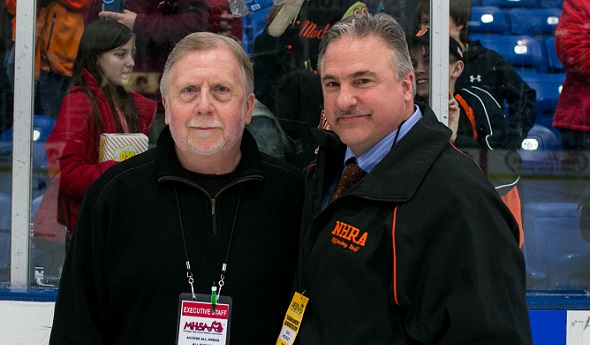
PHOTO: Retired MHSAA assistant director Randy Allen (left), with official Dan Dicristofaro, managed his final Hockey Finals in 2013.
Rice Brings Officials Expertise to MHSAA
August 2, 2018
By Geoff Kimmerly
Second Half editor
Before starting down the path toward becoming one of the nation’s most respected trainers of baseball umpires, Brent Rice was a student at small-town Concord High School who didn’t have to put much effort into succeeding academically.
But he received a challenge that has continued serving him along the way.
 It came from one of his high school coaches, who said he’d go to bat for the then-senior leaving school early to begin attending the prestigious Harry Wendelstedt Umpire School in Ormond Beach, Florida. But first, Rice would have to show the higher level of effort and commitment it would take to succeed on his quest to become a professional official.
That nudge from high school sports drove Rice’s surge into officiating, and also remained with him as he decided to come home and serve Michigan’s high schools – with nearly two decades of teaching and training experience to guide him as an assistant director for the Michigan High School Athletic Association.
Rice, who went on to umpire minor league baseball for 12 years and become administrative director and chief of instruction for the Wendelstedt school, has been named to an MHSAA assistant director’s position, effective August 13. He will be charged with supervising the nearly 10,000 registered officials in all sports and also serve as the MHSAA’s director of baseball and assist with softball.
“I went to a small school, and I learned a lot of life lessons through that and I want to be able to give back,” Rice said. “It’s where I got my start, and where I want to finish up.”
The Wendelstedt school is the most highly-attended professional umpire school in the world, and Rice has served as chief of instruction since Sept. 2000 while adding responsibilities as administrative director in Jan. 2005. Rice also umpired at various levels of minor league baseball from 2000-12, including as a crew chief, and has directed or contributed to training publications referred to by thousands of professional umpires worldwide.
Rice, 36, graduated from Concord High School in 2000 and has a bachelor’s degree from Western Michigan University. He began attending Wendelstedt as a student while a senior at Concord and currently umpires at the Division I college level in the Big Ten and Atlantic Coast Conference. He moved to Battle Creek from New Orleans four years ago, and since returning to this state has been registered as an MHSAA official for baseball, volleyball and 11 and 8-player football, working as part of a regular football crew.
He was selected for the assistant director position from a pool of nearly 70 applicants.
"Brent Rice has devoted his career to preparing the next generations of officials, and he will provide great expertise in growing our efforts to recruit, retain and train officials in all of our sports," said newly-appointed MHSAA Executive Director Mark Uyl, who formerly served as assistant director and the association's coordinator of officials. "He is a national leader in teaching and training and has been a much sought-after speaker and clinician for many years, yet brings knowledge and passion for Michigan and educational athletics.
“His experience, work ethic and relationship-building skills will make him a valuable addition to the MHSAA staff."
Rice will draw on nearly two decades of experience in administration and rules interpretation in addition to his on-field umpiring experience.
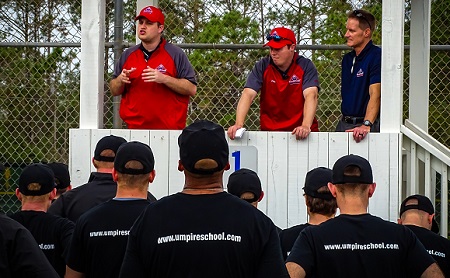
While at Wendelstedt, Rice supervised 30 Minor and Major League Baseball instructors and developed the curriculum for training future professional umpires. He led the day-to-day operations of the program, and also presented daily classroom lectures on rules and directed staff demonstrations of field mechanics.
 As the school’s administrative director, Rice was responsible for maintaining registration and enrollment records and developing programs to increase enrollment. Among his successful initiatives were recruiting programs that focused on engaging college student-athletes and military veterans.
He has directed the design, composition and annual revision of the school’s Official Baseball Rules and Interpretation Manual, the go-to source for umpires at all levels across the country and internationally. Rice also is a regular contributor to officiating publications and in the production of video training packages, and has been commissioned to rewrite the Official Baseball Rules manual used at all levels of the professional game.
Additionally, Rice has worked with both Minor League and Major League Baseball to develop various protocols and has served as a consultant for the Chinese Professional Baseball League, Korean Baseball Organization and the summer collegiate Northwoods League, as well as USA Fencing.
One area Rice would like to start work on immediately at the MHSAA revolves around tackling poor sportsmanship – a main factor driving officials away from the avocation.
Rice doesn’t see recruiting officials as the most difficult part of bolstering the MHSAA’s ranks; it’s retaining them.
“For me, the challenge is to try to find incentives outside of the box in some way … find other things to bring them along, make them feel supported and ultimately stay with you,” Rice said.
Rice played football and baseball as a student at Concord. He is working toward a master’s degree in public administration to go with his bachelor’s from WMU in political science and sociology. He and his wife Jenna have two daughters.
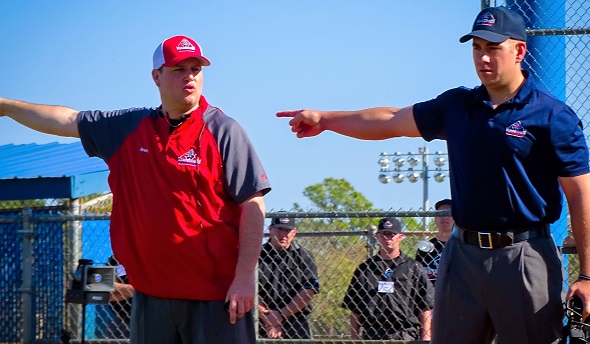
PHOTOS: (Top) Brent Rice, left, instructs an umpire during a drill at the Wendelstedt Umpire School. (Middle) Rice, far left, speaks to a group of students under his supervision. (Photos courtesy of Wendelstedt Umpire School.)