

Legacy Speaks for Allen's Service
January 31, 2014
By Geoff Kimmerly
Second Half editor
Randy Allen was a face seen and a voice heard by thousands during the first two decades of his career in athletics, when he worked as a TV sports anchor and radio play-by-play personality.
But it’s fair to assume his son Dean has watched his dad at work more than anyone over the latter’s most recent 20-plus years serving high school athletic associations, including the last 13 as an assistant director at the MHSAA.
Dean Allen, now an assistant athletic director at Pontiac Notre Dame Prep, remembers many trophy presentations over the years and how his dad would step back and make sure the tournament manager or athletic director was the one handing the hardware to those who deserved the spotlight.
Randy Allen embraced a behind-the-scenes role after joining the high school association side in 1992. And as he retired from the MHSAA on Friday, it was no doubt the athletic directors, officials and coaches who worked with him behind the scenes over the last 13 years who most appreciated his many contributions to making his seasons run smoothly.
“The biggest smile you’d see on him was when the tournament was over and the kids were out there tackling each other, the excitement, the smiles on their faces when they get their medals and raise the trophy,” Dean Allen said. “For him, that’s most worth it. To see it run well, and when it’s over, seeing the kids and the community and parents and coaches, celebrating the successes they’ve had. Seeing the smiles on kids’ faces is really what it’s all about.”
Randy Allen’s name surely isn’t as recognizable to sports fans in Michigan as it was during the 1970s and 80s in Wisconsin.
That was by design.
Allen set that tone almost immediately at his first meeting as a member of the MHSAA staff – during the Michigan Interscholastic Athletic Administrators Association annual summer retreat.
“I remember telling them how glad I was to be here, and how much I looked forward to serving the membership. I just felt that was our main focus here, was to serve schools,” Allen said. “I’ve kept that thought in mind day in and day out.”
Allen knew only a handful of Michiganders when he joined the MHSAA staff. But he knew the job – and was ready for the challenges of fulfilling an aspiration while gaining knowledge of his new home on the fly.
His roots in high school athletics already dug deep.
Allen officiated baseball and softball for 25 years and also some of both at the college level. He also worked as a TV sports anchor at multiple stations near Madison, Wis., for 15 years while radio broadcasting high school football, basketball, baseball and hockey games on three networks and University of Wisconsin hockey games during the era of legendary coach Bob Johnson.
Allen went on to work in various other media roles as a producer, director and station manager, and broadcasted and produced Wisconsin high school tournament games – which led in part to his joining the Wisconsin Interscholastic Athletic Association staff as communications director in 1992.
In 2000, Allen became a seven-state regional director for iHigh.com. But an opportunity at the MHSAA two years later allowed him to pursue a goal going back to his days at the WIAA.
“I had always hoped I would get a chance to manage a sport in a state association,” Allen said. “When I came here, I went to heaven. I got to manage sports, and they were sports I knew like the back of my hand.”
Allen joined the MHSAA staff as assistant director in charge of baseball, softball, hockey and team wrestling. But that was just a start; Allen later traded in baseball and team wrestling for golf and played a leading role in the addition of bowling, which he has directed since its inception.
Allen also coordinated the junior high/middle school and MHSAA awards committees and served as staff liaison to the MIAAA, among other duties.
“Randy has been a perfect fit for his major sport responsibilities here,” MHSAA executive director Jack Roberts said. “He is a very hard worker, and he is very well liked by the coaches, officials and administrators he has served so well.”
It was during a trip to visit potential Hockey Finals sites roughly a decade ago that Roberts first brought up to Allen the possibility of bowling becoming the next MHSAA tournament addition – and the question of who on staff could run it. Roberts asked if Allen had experience in the sport.
Allen had an uncle in the bowling business and had been rolling since he was 4. “Bowling has been in my DNA since I was (a child),” Allen said. “I speak their language.”
He directed the MHSAA’s first Bowling Finals in 2004. Participation in the sport has continued to grow to 6,700 students in 2012-13.
Bowling also played a big part in making Allen something of an ambassador for the MHSAA, in that he reached out to an entire group of sports people who had not been in MHSAA conversations before.
He played a similar key role in serving others who also often work under the radar, providing training to the athletic department secretaries and middle school athletic directors during MIAAA conferences. And his experience in multiple states allowed him to provide a valuable and varied perspective.
“He always was willing to talk to someone – answer an MHSAA rules or regulation question, provide a quick fix to a school/league issue, give an anecdote to make a bad day better with a smile,” said Bear Lake athletic director Karen Leinaar, who also serves on the MHSAA Representative Council and is assistant to the executive director of the MIAAA. “And he always was a welcoming voice on the phone. No question, no person was ever a bother. He always took time and provided some type of direction.”
He’ll continue to do so.
Allen will begin Monday as commissioner of the Capital Area Activities Conference, the 27-school league that includes most of the biggest in the Lansing and Jackson areas.
“My entire life has been school sports. Not college sports, not professional sports. School sports,” Allen said. “It was my passion, what I was comfortable with as an official; I coached a little bit, I played a little bit (and) as a broadcaster.”
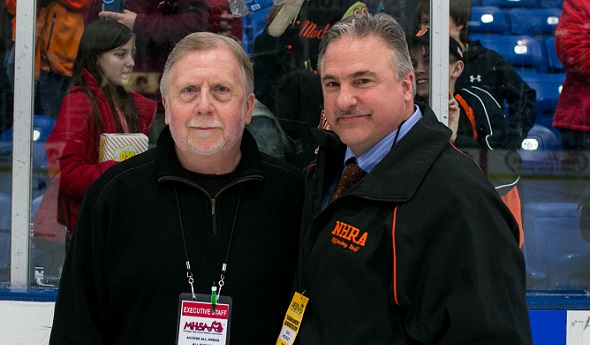
PHOTO: Retired MHSAA assistant director Randy Allen (left), with official Dan Dicristofaro, managed his final Hockey Finals in 2013.
Scholars and Athletes 2014: Class B
By
Geoff Kimmerly
MHSAA.com senior editor
February 11, 2014
By Geoff Kimmerly
Second Half editor
The Michigan High School Athletic Association has selected eight student-athletes from Class B member schools to receive scholarships through its Scholar-Athlete Award program.
Farm Bureau Insurance, in its 25th year of sponsoring the award, will give $1,000 college scholarships to 32 individuals who represent their member schools in at least one sport in which the Association sponsors a postseason tournament. The first 30 scholarships are awarded proportionately by school classification and number of student-athletes involved in those classes; also, there are two at-large honorees who can come from any classification.
 Each of the scholarship recipients will be honored at halftime ceremonies of the Class C Boys Basketball Final game March 22 at the Breslin Student Events Center in East Lansing. Commemorative medallions will be given to the finalists in recognition of their accomplishments.
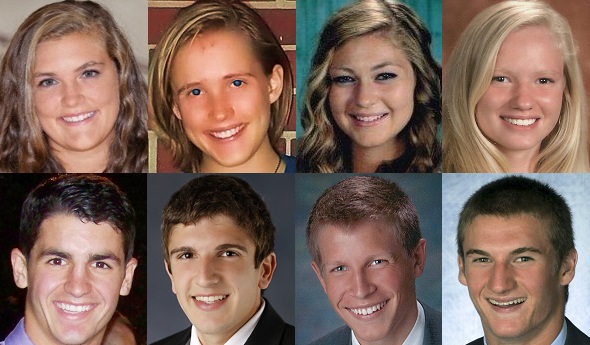
The Class B Scholar-Athlete Award honorees are: Bailey Baker, Eaton Rapids; Peyton Boughton, Sturgis; Courtney Reinhold, Saginaw Swan Valley; Roxane L. Strobel, Spring Lake; Anthony William Canonie, South Haven; John Gatti, Grosse Ile; Nicholas Linck, Grand Rapids West Catholic; and Noah Nicholl, Yale.
Overviews of the scholarship recipients of the Class B Scholar-Athlete Award follow. A quote from each recipient's essay also is included:
Bailey Baker, Eaton Rapids
Expects to graduate with a school-record 16 varsity letters – four each in volleyball, basketball, softball and track and field. Earned both all-state honorable mention in softball and was an MHSAA Finals runner-up in discus as a junior, when she made the Lansing State Journal all-area Dream Teams in both sports; also has earned all-league honors in both volleyball and basketball. Serving as captain of the basketball team for the second season and captained the volleyball team for three years. Participated in National Honor Society for three years and raised more than $1,000 for a food program among other volunteer efforts; also organized a fundraiser that led to the distribution of more than $6,000 in goods. Served on yearbook staff for three years including as editor, and also as a volunteer coach for numerous youth basketball and volleyball camps. Undecided on where she will attend college and her field of study.
Essay Quote: “Sportsmanship is the understanding that while you give everything on the court or field, at the end of the day, the opponents are the same as you – people with goals. This perspective has been reinforced through interscholastic sports – and I am better for the experience.”
Peyton Boughton, Sturgis
Ran four years of varsity cross country and will run her fourth of track and field this spring. Earned all-state in cross county the last two seasons and earned a 13th-place Finals finish as a junior. Served as captain of that team the last two years and ran her school’s record time this fall. Named academic all-state all four years of cross country and has participated in National Honor Society the last two years – serving as vice president as a junior and president this school year. She served in the same roles the last two years, respectively, with her Kiwanis Key Club and also is a member of the National Art Honor Society. Maintains all-A grades and earned an AP Scholar Award in 2013. Served on the Sturgis Area Community Foundation Youth Advisory Council for four years. Will attend the University of Michigan and study industrial design, engineering or architectural drafting.
Essay Quote: “As a runner, I’ve made it a habit to sincerely meet with and compliment my opponents on a race well run. Such an outlook on athletics has allowed me the opportunity to connect with friends I’ll never forget who’ve attended schools from 10 miles to more than 100 miles away.”
Courtney Reinhold, Saginaw Swan Valley
Played varsity volleyball for four seasons, basketball for two and will play her fourth of softball this spring. Earned all-state as a pitcher the last two softball seasons while leading the Vikings to MHSAA Division 2 Finals runner-up finishes at the end of both. Earned all-league in volleyball the last two seasons and helped her team to a Regional title in the fall. Served as team captain of all three. Maintains a 4.0 grade-point average and is a four-year member of her student government and Students Against Destructive Decisions chapter. Served as secretary of her Business Professionals of America state championship team and attended the Great Lakes Bay Regional Youth Leadership Institute. Volunteered for her community’s Make a Difference Day and youth sports camps. Will attend Grand Valley State University and study radiation therapy.
Essay Quote: “(After a volleyball District win) I looked down at my phone and I couldn’t believe what I saw: the girl, the one everyone had said we would battle it out, had sent me a personal message. She told me congratulations, and she said she could tell my teammates looked up to me and that I was a great leader. ... I was so taken back because this was also her senior year and last game, but she showed so much sportsmanship and grace to reach out to me.”
Roxane L. Strobel, Spring Lake
Played four years of varsity tennis and is in her fourth season of varsity swimming and diving. Qualified for MHSAA Tennis Finals as both a sophomore and junior and was a league or Regional singles flight champion all of her first three seasons. Also qualified for the MHSAA Swimming and Diving Finals all four years of high school and earned all-league honors her first three and all-state as a freshman. Maintains all-A grades since the beginning of high school, and participated in National Honor Society for three years including as her chapter’s vice president as a junior and president this school year. Also participated for three years as a member of the Grand Haven Community Foundation Youth Advisory Council and serves as co-chairperson. Played as principal violist in the Holland Area Youth Orchestra the last three years. Will attend the University of Michigan and study biochemistry and botany.
Essay Quote: “Through simple moments between opponents and teammates, a sense of commonality of purpose and an appreciation for the unique paths that athletes take in life can be experienced. Sportsmanship has acted, and will continue to act, as the catalyst for the development of stronger athletes, brighter scholars and better human beings.”
Anthony William Canonie, South Haven
Played four seasons of varsity soccer and varsity basketball and expects to play his fourth varsity baseball season this spring. Served or will serve as captain of each team for two seasons. Named all-state in soccer twice and owns his school’s goals and overall points records and is tied for the assists record; also named all-league three seasons in both basketball and baseball. Named academic all-state for soccer and is a three-year member of the National Honor Society. Has achieved all-A grades since the start of high school. Participated in the Youth Enrichment Services (YES) student community service organization and Fellowship of Christian Athletes both for four years and also volunteers as both a member of his church’s youth group and the Lil’ Rams Basketball Organization. Undecided on where he will attend college, but intends to study finance and accounting.
Essay Quote: “On the court, I saw (Lil’ Rams) kids running around, each trying to be superstars and not working as a team. There were sore losers and boastful winners, and I knew what my role in this program would be. I would teach the kids the importance of teamwork and good sportsmanship, just as my idols had taught me.”
John Gatti, Grosse Ile
Playing his second season of varsity ice hockey and will play his fourth season of golf this spring, and also played three seasons of varsity tennis. Qualified for the MHSAA Tennis Finals as both a sophomore and junior and was named his team’s Most Improved Player both of those seasons while earning all-league honors. Won his hockey team’s Coaches’ Award as a junior and is captain this winter; also will be captain of the golf team this spring. Served in student government four years including as executive board president. Also serves as vice president of the Michigan Associations of Student Councils and Honor Societies state board. Participated in National Honor Society the last two years and as a section leader of his marching band. Served two years as communications officer of his school’s Students Taking a New Direction organization and received a Ronald Reagan Student Leader Award. Undecided where he will attend college but will study biochemistry.
Essay Quote: “What those players seemed to understand is that the way one wins and the way one conducts himself during competition is more important than the outcome. ... Ideally, all student athletes would take the lessons learned from sports and use them to positively influence our peers by setting a good example.”
Nicholas Linck, Grand Rapids West Catholic
Participated in four varsity seasons of tennis and swimming and diving and also participated in track and field for two seasons. Helped the tennis team win its first Regional title ever as sophomore, then served as captain as a junior and senior and finished Lower Peninsula Division 4 runner-up this fall at No. 3 singles. Set a conference swimming and diving record in the 100-yard freestyle and broke two school records as a junior, when he qualified for the MHSAA Finals in three events. Serves as captain of the swimming and diving team. Ranks as salutatorian of his class and serves as vice president of his National Honor Society chapter. Participated in Interact Rotary with the Rotary Club of Grand Rapids and on the Kids Food Basket Youth Action Board. Helped in raising more than $8,000 for a greenhouse designed by his pre-engineering class. Undecided where he will attend college, but plans to study environmental engineering.
Essay Quote: “In educational athletics, winning is certainly not everything. Winning does not raise our salaries. It is just something that we can take pride in. .. Sportsmanship on these teams is something that can truly define us. The level of sportsmanship one has is seen through a fair line call, an extended hand to help out an opponent or through simply a smile.”
Noah Nicholl, Yale
Played three years of varsity football and two of varsity basketball plus participated two seasons in track and field. Made his all-league first team as both a junior and senior and was named his team’s Most Valuable Player this fall, when he also served as captain. Helped his basketball team to a conference championship as a junior. Served in student government the last two years including as class vice president, and also participated in National Honor Society three years and as his chapter’s vice president. Participated as a Michigan Youth Leadership (MYLEAD) ambassador and was named a State of Michigan Patriot Contest essay honoree. Serves as chief deputy squire of his Knights of Columbus chapter and participates as a mentor for his school’s Promoting Academic and Social Success program; also has served as a youth basketball camp instructor for four years. Undecided on where he will attend college, but plans to study chemistry.
Essay Quote: “The attribute of sportsmanship is what allows athletes to compete with tenacity while there is still time on the clock, and yet, allows them to respectfully shake hands after the final whistle, commending the opponent on a contest hard fought. It definitively identifies the values of a true champion.”
Other Class B girls finalists for the Scholar-Athlete Award were: Greer Elizabeth Clausen, Bloomfield Hills Cranbrook-Kingswood; Abigail Brown, Caro; Lindsey Brewis, Dearborn Divine Child; Callie Jensen, Gladstone; Grace Bosma, Hastings; Kylee Nemetz, Hastings, Amanda M. Metz, Otsego; Alexandra J. Grys, Portland; Kiersten Mead, Saginaw Swan Valley; Alea Penner, Sturgis; Angela Maurer, Williamston; and Alana Koepf, Yale.
Other Class B boys finalists for the Scholar-Athlete Award were: Tye Wittenbach, Belding; Carl Steinhauser, Berrien Springs; Ryan Spaulding, Freeland; Joseph Corey, Grand Rapids West Catholic; Matt Johnson, Hastings; Richard Cassell, Jackson Lumen Christi; Ben Woodruff, Jackson Northwest; Ismail Aijazuddin, Madison Heights Lamphere; Zachary A. Ohs, Monroe St. Mary Catholic Central; Michael T. von Kronenberger, West Branch Ogemaw Heights; Trenton Karle, Three Rivers; and Daniel Kosiba, Vicksburg.
The Class C and D scholarship award recipients were announced Feb. 4, and the Class A honorees will be announced Feb. 18.
Farm Bureau Insurance, one of Michigan's major insurers, has a statewide force of more than 400 agents serving more than 380,000 Michigan policyholders. Besides providing life, home, auto, farm, business and retirement insurance, the company also sponsors life-saving, real-time Doppler weather tracking systems in several Michigan communities.
The MHSAA is a private, not-for-profit corporation of voluntary membership by more than 1,500 public and private senior high schools and junior high/middle schools which exists to develop common rules for athletic eligibility and competition. No government funds or tax dollars support the MHSAA, which was the first such association nationally to not accept membership dues or tournament entry fees from schools. Member schools which enforce these rules are permitted to participate in MHSAA tournaments, which attract more than 1.4 million spectators each year.