

Lessons Learned Keep Paying Off
February 8, 2013
By Terri Finch Hamilton
Reprinted with permission of CMUChippewas.com
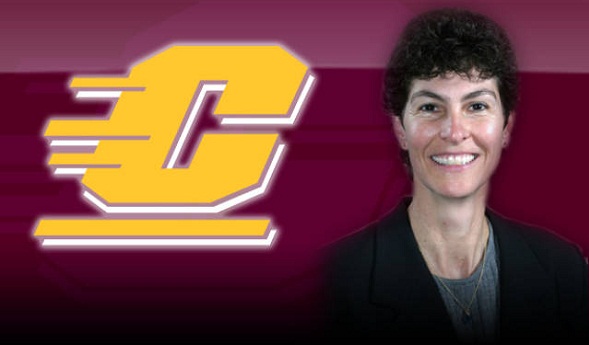
Gina Mazzolini's parents taught her to be a good person first, a good student second, and a good athlete after that. But Mazzolini says her involvement in sports at CMU taught her things that went way beyond the classroom.
"At Central, I learned women are just as good as men -- or better," says Mazzolini, assistant director at the Michigan High School Athletic Association. "I learned that if we put our minds to it, we can do anything."
A star athlete in volleyball and basketball at CMU from 1974 to 1978, Mazzolini says college sports helped her soar after the limitations for girls in high school sports in the early 1970s.
"In high school, women were always taking the back seat to men," says Mazzolini, 57. "I didn't see women in leadership positions in high school. Girls couldn't use the weight room -- we had to sneak in, then we'd get kicked out. They'd look at me and say, 'Why would you want to lift weights?'
"When the guys were done with the gym, then we could use it."
As an athlete at St. Johns High School, Mazzolini was just starting to compete competitively, she says. She won the school's first ever female athlete of the year award.
"Then I went to Central Michigan, and my teammates were all the best kids from their high school teams. Suddenly, everybody was good. And everybody we played against was good."
It was eye opening, she says.
"You learn a lot about yourself," she says. "If you can survive a practice, if you can survive playing Michigan State, you get confidence. I realized I was good. I learned how to be competitive, in a good way."
In basketball, she led the Chippewas in scoring and rebounding three straight seasons - averaging in double figures in both categories. After graduating from CMU, Mazzolini went on to teach and coach at the high school and college levels. She was inducted into the CMU Athletic Hall of Fame in 1992.
A few years later, Mazzolini received the 2009-10 Women In Sports Leadership Award by the Representative Council of the MHSAA.
So much of what she learned on the college volleyball and basketball courts prepared her for later success, Mazzolini says.
"In athletics, you can't worry about what just happened," she says. "You control your emotions, you take a deep breath, you move forward."
Good advice on any day, she says.
"You learn that you don't always win, and you learn to take defeat gracefully," she says. "Later, in your business life, you're not going to win everything, either. Sports teaches you how to deal with setbacks, how to work hard and rearrange your goals so that you do better next time.
"You learn if you work together, you can achieve amazing things."
CMUChippewas.com is running a series of stories to celebrate the 40th anniversary of Title IX legislation. Click to see more of the series.
Applications Available for 2026-27 MHSAA/Farm Bureau Insurance Scholar-Athlete Awards
By
Geoff Kimmerly
MHSAA.com senior editor
October 6, 2026
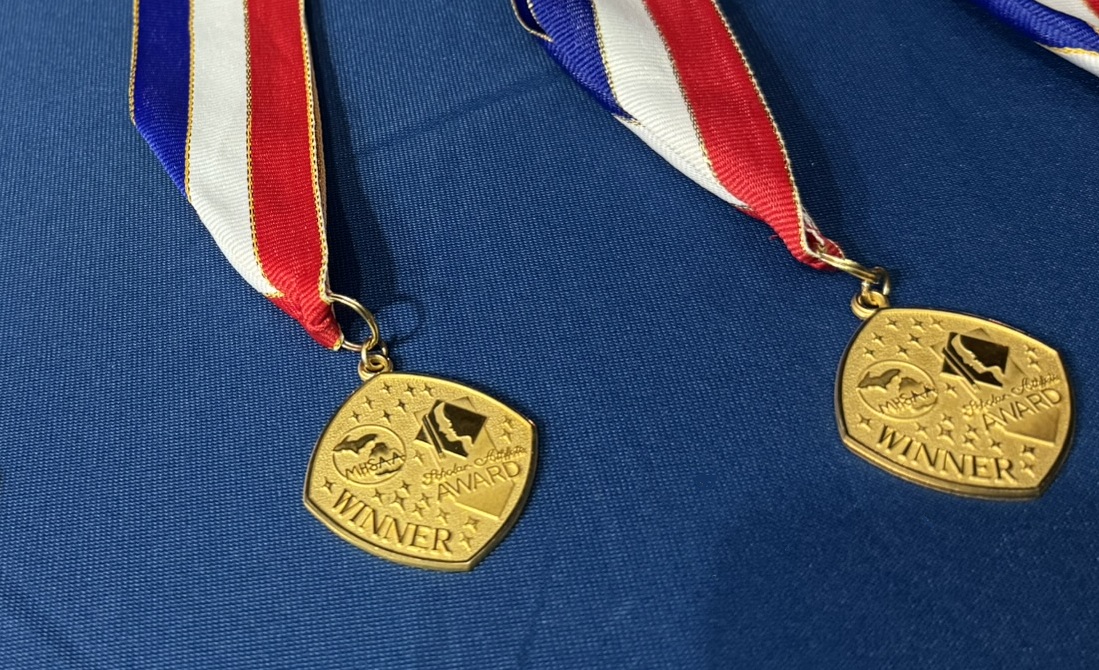
One of the Michigan High School Athletic Association’s most popular programs, the Scholar-Athlete Award, will again with Farm Bureau Insurance present 32 $2,000 scholarships to top student-athletes at member high schools during the 2026-27 school year.

The MHSAA/Farm Bureau Insurance Scholar-Athlete Award highlights the value extracurricular activities play in the total education of high school students, often improving their academic achievements in the process. The Scholar-Athlete Award is in its 38th year. Since the award’s inception in 1988-89, Farm Bureau Insurance has presented more than $1 million in scholarships through this program.
The first 30 scholarships will be presented on a graduated basis across the MHSAA’s traditional class structure. From Class A schools, six boys and six girls will receive scholarships; from Class B schools, four boys and four girls; from Class C schools, three boys and three girls; and from Class D schools, two boys and two girls will be honored. The final two scholarships will be awarded at-large to minority recipients, regardless of school size. The scholarships may be used at the institution of higher learning the recipients attend during the first year at those colleges.
Applications from individual schools will be limited to the number of available scholarships in their enrollment class. Class A schools may submit the names of six boys and six girls, Class B schools may submit four boys and four girls, Class C may submit three boys and three girls and Class D may submit two boys and two girls.
Students applying for Scholar-Athlete Awards must be graduating during the 2026-27 school year, carrying an unrounded 3.5 (on a 4.0 scale) grade-point average and have won a varsity letter in a sport in which the MHSAA sponsors a postseason tournament: baseball, girls and boys basketball, girls and boys bowling, competitive cheer, girls and boys cross country, field hockey, football, girls and boys golf, gymnastics, ice hockey, girls and boys lacrosse, girls and boys skiing, girls and boys soccer, softball, girls and boys swimming & diving, girls and boys tennis, girls and boys track & field, girls and boys volleyball and girls and boys wrestling.
Applicants will be required to show involvement in other school and community activities and submit an essay on the importance of sportsmanship in educational athletics.
Information – including answers to a number of frequently asked questions – and links to the application are available online on the Scholar-Athlete Award page. Applications are available in digital format only and must be submitted online by 4 p.m. Dec. 4.
A committee composed of school administrators from across the state will select finalists and winners in late January, with the winners to be announced throughout February. All applicants, finalists and scholarship recipients will be announced on the MHSAA Website. The 32 scholarship recipients will be recognized during the 2027 MHSAA Boys Basketball Finals at the Breslin Student Events Center in East Lansing.
Farm Bureau Insurance of Michigan was founded in 1949 by Michigan farmers who wanted an insurance company that worked as hard as they did. Those values still guide the company today and are a big reason why it is known as Michigan’s Insurance Company, dedicated to protecting the farms, families, and businesses of this great state. Farm Bureau Insurance agents across Michigan provide a full range of insurance services – life, home, auto, farm, business, retirement, Lake Estate®, and more – protecting more than 660,000 Michigan residents.
The MHSAA is a private, not-for-profit corporation of voluntary membership by more than 1,500 public and private senior high schools and junior high/middle schools which exists to develop common rules for athletic eligibility and competition. No government funds or tax dollars support the MHSAA, which was the first such association nationally to not accept membership dues or tournament entry fees from schools. Member schools which enforce these rules are permitted to participate in MHSAA tournaments, which attract more than 1.4 million spectators each year.