

March Magic Hoopfest Returns to MSU
March 17, 2014
By Geoff Kimmerly
Special to Second Half
March Magic Hoopfest will return to Jenison Field House for this weekend’s Michigan High School Athletic Association Boys Basketball Finals, marking the fifth championship weekend the event has run concurrent with the games being played at Michigan State University’s Breslin Center.
A number of favorite attractions will return including slam dunk (on lowered rims), 3-point shootout and full-court rainbow shot areas where fans can come at any time and participate. Also returning is the Walk of History, showcasing championship games, life-size photos and display boards from throughout the MHSAA Finals’ near century-long run. A large video screen will play a series of “Buzzer Beaters,” “Battle of the Fans” and other MHSAA-produced videos.
Two Hoopfest center courts will host a number of games throughout the event, including the “JumpBall Jamboree” made up of teams of boys and girls in grades 5-8, a wheelchair basketball tournament and a series between four Special Olympics Project UNIFY high school teams.
Admission to the March Magic Hoopfest is $2 per person, and fans attending the MHSAA Boys Basketball Semifinals and Finals will be admitted free with their game tickets. Hours on March 20 and 21 will be 2 p.m. to 7 p.m.; the event is open from 10 a.m. to 7 p.m. on March 22. Jenison Field House, site of Hoopfest, also was the site of the MHSAA Boys Basketball Finals for 31 years. To find out more general information about the event, visit the March Magic Hoopfest Website.
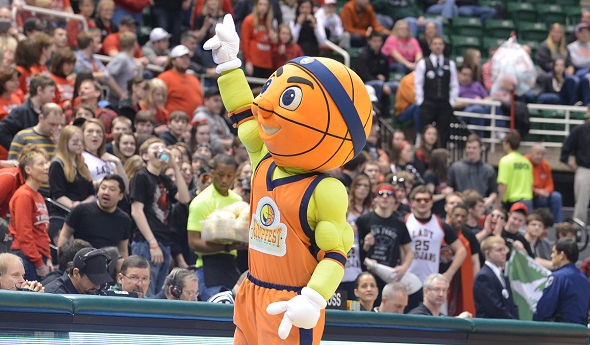
Hoopfest also will be home to Hoopie, the event’s mascot who made his first public appearances during the MHSAA Girls Basketball Finals. Click for video of Hoopfest’s newest volunteer as he helped prepare for this weekend’s event:
The March Magic Hoopfest is being conducted in a partnership between the Greater Lansing Sports Authority (GLSA), a division of the Greater Lansing Convention and Visitors Bureau; and the MHSAA, with vital support coming from the Department of Intercollegiate Athletics at Michigan State University.
“March Magic Hoopfest is a giant playground. There are opportunities for fun all over Jenison – and it’s a great way to spend an hour while waiting for the next round of games to start,” MHSAA Director of Brand Management Andy Frushour said. “All of us can remember reenacting games of our high school heroes. What better place to let kids do so now than across the street from Breslin Center in one of the most storied buildings in this state’s basketball history.”
The Greater Lansing Sports Authority’s mission is to be the leading voice of sports tourism in the Greater Lansing area and to promote economic growth by attracting a diverse range of sporting events to the region. The GLSA strives to enhance the quality of life for area residents through the development of local sports and fitness programs for all ages and supports the continued development and maintenance of safe, high-quality athletic facilities.
Hoopfest was not held at the 2013 Finals due to a Big Ten championship event being hosted by Jenison Field House.
"The GLSA is excited to partner with the MHSAA on the re-launch of March Magic Hoopfest," said Mike Price of the Greater Lansing Sports Authority. "While Hoopfest was absent in 2013, planning and improvement were ongoing. We are excited to showcase an improved Hoopfest that includes new games and activities, as well as the launch of our new mascot, Hoopie!”
PHOTO: Hoopie made his first public appearance during the weekend's MHSAA Girls Basketball Finals at the Breslin Center.

2017 Bush Awards Honor Trio of Leaders
June 26, 2017
By Geoff Kimmerly
Second Half editor
Three athletic directors who have taken leading roles in important areas of educational athletics – Rockford’s Tim Erickson, Bay City Central’s Morley Fraser and Mattawan’s Ken Mohney – have been named recipients of the Michigan High School Athletic Association’s Allen W. Bush Award for 2017.
Al Bush served as executive director of the MHSAA for 10 years. The award honors individuals for past and continuing service to prep athletics as a coach, administrator, official, trainer, doctor or member of the media. The award was developed to bring recognition to men and women who are giving and serving without a lot of attention. This is the 26th year of the award, with selections made by the MHSAA's Representative Council.
Among many contributions, Erickson has built a strong reputation in officiating, while Fraser is a hall of fame coach and Mohney is an accomplished instructor of administrators on the state and national levels.
“These three administrators have contributed to educational athletics in a variety of ways, but are especially well-respected in specific areas of expertise – and the quality that binds them together is leadership,” MHSAA Executive Director John E. “Jack” Roberts said. “This award recognizes work behind the scenes, and Tim Erickson, Morley Fraser and Ken Mohney exemplify it. They are worthy recipients of the Bush Award.”
Erickson recently finished his 34th school year at Rockford, where he started his career in 1982 after earning a bachelor’s degree from Central Michigan University; he later added a master’s degree from CMU. He has served as the Rams’ athletic director for the last decade supervising 34 varsity teams and 140 staff members. Erickson also has served as an assistant principal for five years, two years each as student activities coordinator, middle school athletic director and 6-12 intramural director; and taught for 19 years.
A member of the Michigan Interscholastic Athletic Administrators Association (MIAAA) and National Interscholastic Athletic Administrators Association (NIAAA), Erickson’s vast contributions to educational athletics have stretched far beyond administration. A member of the West Michigan Wrestling Officials Association, he has served as a registered official for 37 years, currently in wrestling but previously as well for basketball, baseball, softball and volleyball. He has officiated an MHSAA Finals in wrestling, and also coached 42 seasons across a variety of sports, including four as the varsity baseball coach and as an assistant on Rockford football teams that won Division 1 championships in 2004 and 2005.
Rockford total has won 32 MHSAA Finals championships across 13 sports during Erickson’s tenure as athletic director. He and his staff also have hosted a variety of MHSAA tournament events at various levels, including 20 Finals. A member of the Rockford High School Athletic Hall of Fame, Erickson also has volunteered locally as a youth sports coach and participates with the Rockford Relay for Life. He’s served as building coordinator for the local United Way and stewardship chairman for his church.
“Tim Erickson continues to provide a wide range of valuable perspectives drawing from his experiences as not only as an administrator, but also as a coach and official,” Roberts said. “Those points of view are especially important as he continues to lead a successful department at one of our state’s largest schools – and as he and his staff continue to provide outstanding leadership as an annual host for a variety of our events, many at the highest levels of our tournaments.”
Fraser this spring completed his 39th year in education and 30th as an athletic director, recently retiring from his administrative duties at Bay City Central although he will continue to coach the football team. Fraser, who earned a bachelor’s degree from Alma College and master’s from CMU, joined the Bay City Central faculty in 1986 and took over as athletic director prior to the start of the 1998-99 school year. He also has served as an assistant principal at Bay City Central.
His Wolves football team returned to the MHSAA Playoffs last fall with a 6-4 record, and Fraser has built a 162-135 record in 31 seasons leading the program. Fraser also coached at Mendon and Bowling Green, Ohio, and was inducted into the Michigan High School Football Coaches Association (MHSFCA) Hall of Fame in 2011. His 1994 Bay City Central team finished Class AA runner-up, and he was named an MHSFCA Regional Coach of the Year that season, 1996 and also in 1978 while at Mendon (and in 1985 earned a similar award at Bowling Green). He was inducted into the Bay County Hall of Fame in 2013.
Also a member of the MIAAA and NIAAA, Fraser has spoken and presented at MIAAA and MHSFCA events and as part of Glazier Coaching Clinics. He’s been a keynote speaker at Rotary Club student leadership summer camps for the last decade and has served in an elementary students and athletes reading program and as part of Habitat for Humanity, assisting with summer projects.
“Morley Fraser has mentored hundreds of his football players over the last four decades, but his mentorship extends beyond the sport he’s coached most,” Roberts said. “Morley Fraser has created a legacy of service, success and stability with his longtime leadership at Bay City Central, and he continues to provide as well a respected voice in the football community across our state.”
Mohney has served as an administrator for 18 years with seven as a teacher and coach after earning bachelor’s and master’s degrees at Western Michigan University and while also serving from 1987-2007 in the U.S. Army. In addition to his work as an assistant principal and athletic director at Mattawan – the school received an MIAAA Exemplary Athletic Program Award in 2005 – Mohney has made significant contributions to his colleagues as a long-serving member of the MIAAA and NIAAA and as an instructor for the MHSAA Coaches Advancement Program.
A contributor to the MIAAA Board of Directors and Executive Board from 2002-14, Mohney served as Executive Board president in 2012-13 and on the NIAAA Board of Directors as Section IV representative (for five states) and as chairperson of the finance sub-committee. He has served on various committees both for the MIAAA and MHSAA, and in addition to his CAP instructor contributions has served on the faculty of the NIAAA Leadership Training Institute providing instruction both in Michigan and nationally. Mohney has earned NIAAA Certified Master Athletic Administrator status and MHSAA CAP Masters Elite certification, and also Certified Interscholastic Coach recognition from the National Federation of State High School Associations (NFHS). He was named a Regional Athletic Director of the Year by the MIAAA in 2008, earned its Denny Kiley Presidential Award in 2013 and its Jack Johnson Distinguished Service Award in 2014 – when he also earned special commendation from the NIAAA for distinguished service on its Board of Directors.
Mohney served as part of an Army helicopter air crew from 1987-91 and then as a flight and leadership instructor for the Michigan Army National Guard from 1991-2007. He received a U.S. Army Air Medal in 1991 for combat missions flown during Operation Desert Shield/Storm, a U.S. Army Achievement Award in 1998 as Michigan National Guard Solider of the Year and a U.S. Army Commendation Award in 2004 as Michigan National Guard Non-Commissioned Officer of the Year.
“Ken Mohney understands the values of education and teaching leadership not only to students at his school, but also those working to provide that education locally and on the statewide and national levels,” Roberts said. “He provides a steady influence among his peers as part of the MIAAA and has been essential in the growth of our Coaches Advancement Program by showing himself to be an exceptional relationship builder in all of his endeavors.”