

MHSAA Schools' National Participation Ranking Rises, Continues to Outpace Population
By
Geoff Kimmerly
MHSAA.com senior editor
September 12, 2024
Michigan’s national ranking for participation in high school athletics improved during the 2023-24 school year, overall and also for girls and boys sports separately, and while continuing to outpace its national ranking for high school-aged population, according to the annual national participation study conducted by the National Federation of State High School Associations (NFHS).
Michigan moved back into eighth for overall participation nationally, based on a total of 289,740 participants, after ranking ninth in 2022-23. The total counts students once for each sport played, meaning students who are multiple-sport athletes are counted more than once.
Michigan improved to seventh nationally for boys (169,533) and eighth for girls (120,207) participation separately, after ranking ninth for both the previous year and despite currently ranking 10th for both high school-aged boys and girls populations according to U.S. Census Bureau estimates.
Michigan’s national rankings in eight sports for which the MHSAA sponsors postseason tournaments improved from 2022-23, with only four sports moving down on their respective lists from the previous year.
Notably, Michigan led the nation in participation in a sport for the first time in at least 14 years – boys bowling with 4,292 athletes – and also moved up to third nationally for girls bowling, girls golf and girls tennis participation. Boys golf (fourth), wrestling (seventh – girls and boys combined), girls competitive cheer (eighth) and boys lacrosse (nine) also moved up on their respective lists.
Keeping with annual trends, participation in several more MHSAA sports also continued to outpace the state’s rankings for high school-aged population.
For girls, participation in volleyball (fifth), cross country (sixth), basketball (seventh), softball (seventh), swimming & diving (eighth), track & field (eighth) and soccer (ninth) all ranked higher than their population listing of 10th nationally. Among boys sports, ice hockey (fourth), tennis (fifth), track & field (sixth), basketball (seventh), cross country (seventh), football (seventh – 11 and 8-player combined), baseball (eighth), swimming & diving (eighth) and soccer (ninth) exceeded the boys ranking of 10th for population.
Only 11 states sponsor alpine skiing, but Michigan again ranked third on both the girls and boys lists for that sport. For wrestling, boys participation moved down one spot to eighth but girls participation moved up one spot to seventh – and their totals combined ranked seventh nationally overall, also up one spot from 2022-23.
Participation nationally exceeded 8,000,000 participants for the first time, with a total of 8,062,302 an increase of 2.7 percent from 2022-23. The total includes 4,638,785 boys and 3,423,517 girls – both record highs – according to figures obtained from the 51 NFHS member state associations, which includes the District of Columbia.
Eleven-player football remained the most popular boys sport and registered an increase for the second consecutive year from 1,028,761 to 1,031,508 athletes. There also was an increase in 8-player football participation from 23,812 to 26,420.
Next on the boys list were outdoor track & field, basketball, baseball, soccer, wrestling, cross country, tennis, golf, and swimming & diving, respectively.
For girls, outdoor track & field, volleyball and soccer all registered increases and remained the top three participatory sports. Track & field increased four percent to 506,015, followed by volleyball at 479,125 and soccer with 383,895 participants. Basketball ranked fourth, followed by softball, tennis, cross country, competitive spirit, swimming & diving and lacrosse, respectively.
Texas (859,301) and California (834,103) remained atop the list of state participation. New York (341,454) remained in third, followed by Pennsylvania (336,946), Ohio (323,117), Illinois (320,603), Florida (299,398), Michigan (289,740), New Jersey (280,798) and Minnesota (224,179).
The NFHS participation survey was started in 1971 and compiled in its current form through the 2018-19 school year, resuming annually with the 2021-22 survey.
The NFHS, based in Indianapolis, is the national leadership organization for high school sports and performing arts activities. Since 1920, the NFHS has led the development of education-based interscholastic sports and performing arts activities that help students succeed in their lives. The NFHS writes playing rules for 17 sports for boys and girls at the high school level. Through its 50 member state associations and the District of Columbia, the NFHS reaches more than 19,800 high schools and 12 million participants in high school activity programs, including more than eight million in high school sports.
The MHSAA is a private, not-for-profit corporation of voluntary membership by more than 1,500 public and private senior high schools and junior high/middle schools which exists to develop common rules for athletic eligibility and competition. No government funds or tax dollars support the MHSAA, which was the first such association nationally to not accept membership dues or tournament entry fees from schools. Member schools which enforce these rules are permitted to participate in MHSAA tournaments, which attract more than 1.4 million spectators each year.
Several 1st-Time Winners Highlight 2025-26 MHSAA Parade of Champions
By
Geoff Kimmerly
MHSAA.com senior editor
June 18, 2026
Three schools celebrated their first Michigan High School Athletic Association Finals championships in any sport during the 2025-26 school year as 39 teams total won first Finals titles in their respective sports.
Holland Calvary, in boys cross country, Durand in boys bowling and Walled Lake Northern in softball won their schools’ first Finals championships in any sport, as 88 schools total won at least one of the 132 MHSAA team titles awarded over the three seasons.
A total of 23 schools won two or more championships this school year, paced again by Marquette with eight earned in girls and boys cross country, boys golf, girls skiing, girls and boys swimming & diving, boys tennis and boys track & field. Detroit Country Day was next with seven Finals championships, followed by Detroit Catholic Central with six and Ann Arbor Pioneer with four.
Bloomfield Hills Cranbrook Kingswood, Negaunee, Northville and Rockford all won three titles in 2025-26. Winning two were Birmingham Seaholm, Charlevoix, Farmington Hills Mercy, Flint Kearsley, Flint Powers Catholic, Grand Rapids West Catholic, Jackson Lumen Christi, Lake Linden-Hubbell, Lowell, Newberry, Orchard Lake St. Mary’s, Pewamo-Westphalia, Ravenna, Rudyard and West Iron County.
A total of 48 champions were repeat winners from 2025-26. A total of 31 teams won championships for at least the third-straight season, while 22 teams extended title streaks to at least four consecutive seasons. The Lowell wrestling program owns the longest title streak at 13 seasons, followed by Dundee wrestling’s nine consecutive titles and runs of seven straight Finals victories by the Detroit Catholic Central ice hockey team and Marquette’s boys cross country and boys swimming & diving programs.
This school year saw the addition of field hockey and boys volleyball to the MHSAA’s postseason tournament offerings. Eighteen of the MHSAA's 30 team championship tournaments are unified, involving teams from the Upper and Lower Peninsulas, while separate competition to determine title winners in both peninsulas is conducted in remaining sports.
For a sport-by-sport listing of MHSAA champions for 2025-26, click here (PDF).
The MHSAA is a private, not-for-profit corporation of voluntary membership by more than 1,500 public and private senior high schools and junior high/middle schools which exists to develop common rules for athletic eligibility and competition. No government funds or tax dollars support the MHSAA, which was the first such association nationally to not accept membership dues or tournament entry fees from schools. Member schools which enforce these rules are permitted to participate in MHSAA tournaments, which attract more than 1.4 million spectators each year.
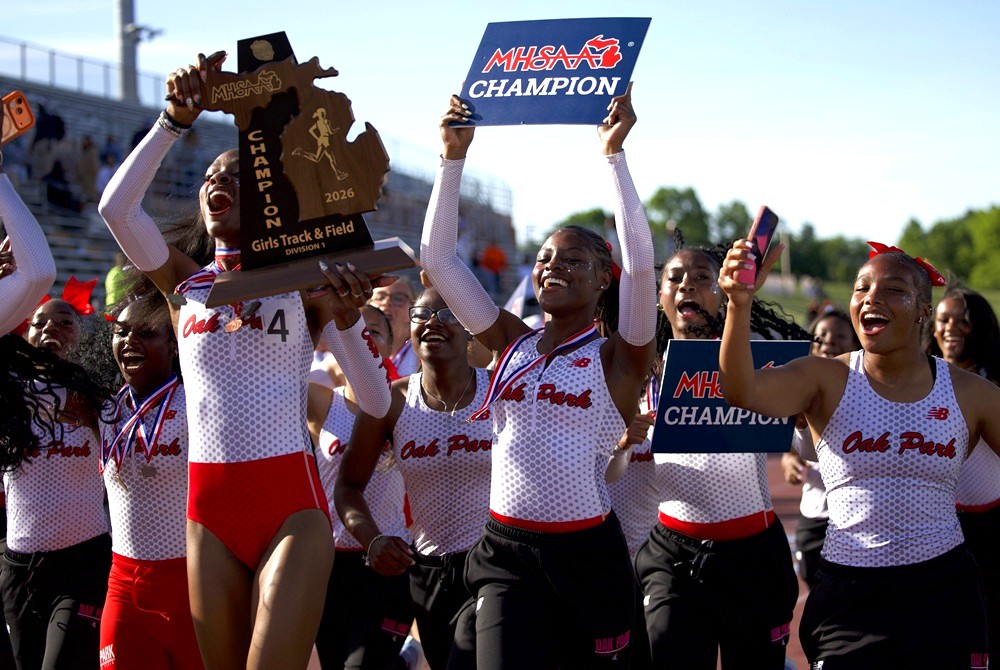
PHOTO The Oak Park girls track & field team hoist their championship trophy and sign May 30 at Rockford High School. (Click for more from RunMichigan.com.)