

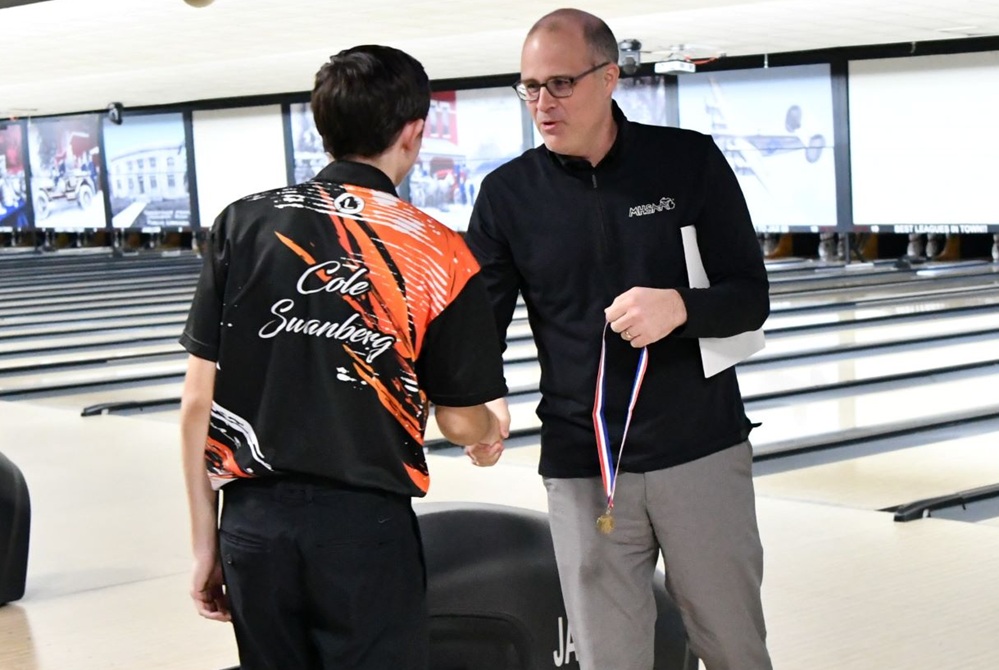
MHSAA Senior Assistant Director Frushour to Receive NFHS Citation
By
Geoff Kimmerly
MHSAA.com senior editor
January 23, 2026
Andy Frushour, a senior assistant director for the Michigan High School Athletic Association, is one of eight high school association leaders who has been selected to receive a Citation from the National Federation of State High School Associations (NFHS) during this summer’s annual meeting.
The Citation is one of the NFHS’ highest honors and recognizes recipients for their contributions to the NFHS, state high school associations, athletic director and coaching professions, the officiating avocation and fine arts/performing arts programs.
Frushour is in his 25th year at the MHSAA and currently directs the association’s efforts in marketing, girls and boys soccer, and student services. His tenure has been most notably defined by his leadership in making the MHSAA a national trendsetter in digital initiatives and communication, and he has spearheaded several pioneering efforts to bring student voices into decisions affecting their activities.
After beginning his tenure in the communications department, Frushour created the MHSAA’s marketing and brand team – which remains unique among state associations and aims to tell the story of school sports. The team tackles everything from media communications, sports information, website content and social media to ticketing, corporate sales and merchandise. As part of his digital branding contributions, Frushour has served as the lead contributor on every website redesign since 1999, created the Michigan Power Rating (MPR) formula now used for seeding in eight MHSAA Tournament sports, and led Michigan’s efforts to exclusively use digital tickets for postseason events.
“Sometimes the most valuable player on a baseball team is the utility player – somebody who plays but also excels at a number of different positions. For the last 25 years, Andy clearly has done that – from student leadership, to running a sport, to branding, to business decisions,” MHSAA Executive Director Mark Uyl said. “He’s someone who is competent, respected and has become a huge part of MHSAA history during his 25 years with us.”
Frushour also has steered the MHSAA to adopt a more prominent focus on students through the creation of several popular programs, including the Student Advisory Council, a series of annual interactive sportsmanship summits and captains clinics, and the Battle of the Fans student section competition. Building off that work, he has developed and created four free NFHS Learn courses geared toward team captains.
Frushour also has served on NFHS committees for soccer, student services, summer meeting and strategic planning, and spoken at several summer meetings and one NFHS winter meeting, and at the National Athletic Directors Conference.
After graduating in 1995 from Mason High School (Mich.) – where he played baseball and golf – Frushour attended Hope College, where he majored in business administration and minored in communications, graduating in 1999. He received an MBA in sports business from Arizona State in 2003.

24th WISL Conference Set for Feb 2-3
By
Geoff Kimmerly
MHSAA.com senior editor
January 6, 2020
The first, largest and longest-running program of its type in the country, the Michigan High School Athletic Association’s Women In Sports Leadership Conference will take place Feb. 2-3 at the Crowne Plaza Lansing West.
The 24th edition of the conference again will feature three keynote speakers and a variety of workshops. The program annually attracts upwards of 500 participants, most of them high school female student-athletes. High school students, coaches and administrators are invited to find registration information on the MHSAA Website.
Cost is $50 for students and $60 for adults, not including lodging for those intending to stay overnight in Lansing. A registration form for lodging also is available on the MHSAA Website.
The theme for this WISL Conference is “The Courage to Lead” – and the opening address will be delivered by two-time Olympic women’s soccer gold medalist Lindsay Tarpley. She led Portage Central to the MHSAA Division 2 championship as a sophomore in 2000, was named college soccer’s National Player of the Year in 2003 after leading University of North Carolina to the NCAA Division I title, and played for the U.S. national team until retiring in 2011. She will speak on setting high standards and challenging one’s self to be a leader throughout life.
Michigan State University women’s volleyball coach Cathy George will challenge participants to embrace a growth mindset and believe in themselves and their potential while speaking at the WISL Banquet during the evening of Feb. 2. George recently completed her 15th season at MSU and 33rd overall as a college head coach. Her 288 wins at MSU are the most in program history, and she has a career record of 653-429 – counting also 11 seasons leading Western Michigan University, five at University of Texas-Arlington and two at North Dakota State. She has taken 15 teams to the NCAA Tournament, including MSU to the Elite Eight in 2017 and Texas-Arlington to the Final Four in 1989. As an athlete, George was a team captain and three-time all-league selection at Illinois State, helping the Redbirds to three NCAA Tournament appearances.
Michigan’s 43rd Secretary of State Jocelyn Benson will speak during the opening session Feb. 3 on expanding opportunities for girls and women as athletes, coaches, sport executives and leaders. She chairs Michigan’s Task Force on Women in Sports, which brings together local and national leaders to develop strategies that support and promote opportunities for girls and women in athletics, and is a founding board member and former CEO of the Ross Initiative in Sports for Equality. Benson is a graduate of Harvard University Law School and expert on civil rights law, education law and election law. As dean of Wayne State University Law School, she was the youngest woman in U.S. history to lead a top-100 accredited law school, and she became in 2015 one of the youngest inductees into the Michigan Women’s Hall of Fame.
Workshops offered during the WISL conference include topics on coaching, teaching and learning leadership; sports nutrition and performance, and injury prevention; empowerment and goal-setting, and building team chemistry and program culture. A complete itinerary is available on the MHSAA Website.
The WISL Banquet will include the presentation of this year’s Women In Sports Leadership Award. The winner will be announced later this month.
Follow the #WISL hashtag on Twitter to learn more about the conference’s activities.