


MI Student Aid to Present MHSAA Media
September 1, 2016
By Geoff Kimmerly
Second Half editor
Just as the Michigan High School Athletic Association hopes students will pursue the many benefits of taking part in educational athletics, MI Student Aid – a division of the Michigan Department of Treasury – encourages students to pursue postsecondary educational opportunities by providing financial assistance toward attaining that goal.
 Sharing in the desire to make Michigan students aware of all possibilities available, MI Student Aid has signed on to work with the MHSAA to present the opportunities provided by both to a statewide audience via the MHSAA’s radio, video, social media and online initiatives.
MI Student Aid – a part of the Student Financial Services Bureau located within the Department of Treasury – encourages students to pursue postsecondary education by providing access to student financial resources and information, including various student financial assistance programs to help make college more affordable for Michigan students. MI Student Aid administers the state’s 529 savings programs (MET/MESP) and eight additional aid programs within its Student Scholarships and Grants division.
Among MHSAA broadcast ventures that will be presented by MI Student Aid during the 2016-17 school year are the five-minute “This Week in High School Sports” program that airs on more than 80 radio stations statewide, and the weekly video highlights from Michigan programming produced for the NFHS Network, dispersed to statewide media and published online on the MHSAA Website.
“We value the life lessons learned on the athletic field, and MI Student Aid promotes continuing education for our student-athletes by providing financial assistance in pursuing those opportunities,” said John E. “Jack” Roberts, Executive Director of the MHSAA. “We are always seeking to make students and their families aware of all that can be gleaned from educational athletics, and we’re glad to provide an avenue for MI Student Aid to promote the options available to help in financing the continuation of their studies.”
In addition to radio and video contributions, MI Student Aid will have an on-site presence at MHSAA championship events throughout this school year and serve as the presenting sponsor of weekly football and boys and girls basketball statewide reports on Second Half.
MI Student Aid also will have an opportunity to connect with students and their families through a presence on the MHSAA’s social media platforms.
“We are extremely excited to be partnered with Michigan High School Athletic Association,” said Anne Wohlfert, Director of the Student Financial Services Bureau. “Students and families oftentimes encounter barriers when paying for college, and MHSAA provides a platform that allows our resources and services to be transparent, directly to the audience we are trying to reach. Our mission and values closely align with that of MHSAA, which made this partnership an easy decision. We are looking forward to a long-lasting, successful partnership with them.”
Click for information on MI Student Aid and connect with MI Student Aid via social media on Facebook and Twitter @mistudentaid.
Huron's Davis Goes 'Beyond' as Leader
March 8, 2017
By Geoff Kimmerly
Second Half editor
On first glance, the word “beyond” seems an imaginative way to describe a favorite colleague.
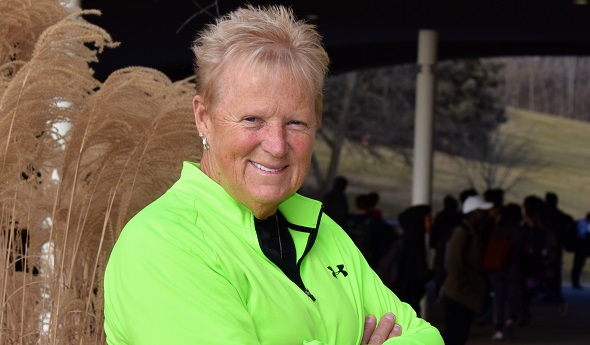
But providing context, Ann Arbor Pioneer assistant principal Jason Skiba may have found the ideal word to describe Ann Arbor Huron assistant principal and athletic director Dottie Davis and her contributions over nearly 40 years in high school athletics.
“Above and beyond the call of duty. Beyond normal work hours. Beyond the scope of her job description. Beyond what most other people would do when it comes to doing what’s right for kids,” he wrote in recommending Davis for the MHSAA’s Women In Sports Leadership Award.
“Dottie models for students what it means to be loyal and have integrity,” Skiba added. “She says what she means and follows up with what she says she’ll do. Dottie’s work with student leadership conferences and her conversations with student athletes about what is involved in being a leader show the value she places on responsibility and follow through, even from students.”
Each year, the Representative Council considers the achievements of women coaches, officials and athletic administrators affiliated with the MHSAA who show exemplary leadership capabilities and positive contributions to athletics. Davis will receive the 30th WISL Award during the Michigan Interscholastic Athletic Administrators Association conference March 19 in Traverse City.
Davis was a three-sport athlete at both Ypsilanti High School and then Eastern Michigan University, before moving into teacher, coach and later administrative roles first at Byron for a year and then Ann Arbor Huron for the last 38, along the way making significant contributions especially in the development of girls sports that didn’t exist as part of the MHSAA tournament offerings during her scholastic career.
“I always wanted the best for our female athletes. They need somebody to be their voice, and I’m all about being positive and what can we do to change and make things better for the women of today,” Davis said. “I think through that, people listen, and we get a chance to make improvements for kids coming up.
“I love being a pioneer and trying to make it better for those that follow. I have such a passion for sports that I want them to be the best for both male and female athletes. I’m glad women are now finally getting recognition they deserve, and it’s kinda cool to hand off the baton to the next person.”
A 1971 graduate of Ypsilanti High, and 1978 grad of Eastern Michigan University – she took off three years from studies after high school to care for her mother, who was recovering from carbon monoxide poisoning at the time – Davis took her first job out of college at Byron High School during the 1978-79 school year, teaching and coaching volleyball, basketball and softball.
She moved closer to home the next fall, joining the staff at Huron as a teacher, and she went on to also coach a variety of sports: varsity volleyball for five seasons from 1979-84, girls varsity basketball from 1980-92 first for eight seasons as head coach and then as an assistant, varsity softball a total of 10 seasons between 1980-2006, and a season each of boys freshman basketball in 2003 and varsity tennis in 1987. She became Huron’s athletic director heading into the 2005-06 school year.
Davis has served on various MHSAA committees and hosted a number of tournaments at the District and Regional levels and also sessions for the MHSAA’s Coaches Advancement Program. In addition, she served as an MHSAA registered official in basketball from the 1992 season through the end of that decade, and also five years each for softball and volleyball.
“Dottie Davis is a fantastic advocate for girls sports and simply an awesome administrator – she’s a great role model for all students and continues to provide a strong voice in support of female athletes,” MHSAA Executive Director John E. “Jack” Roberts said. “We’re delighted to present Dottie with the Women In Sports Leadership Award.”
Davis earned both bachelor’s and master’s degrees from EMU in health and physical education/fitness. She was inducted in 1990 into EMU’s Athletic Hall of Fame for earning a combined 10 letters in volleyball, basketball and track & field, and later inducted as well into Huron’s Athletic Hall of Fame in 2001.
In addition to those accolades, Davis was inducted as a player into both the United States Slow-pitch Softball Association Hall of Fame in 1985 and Michigan Softball Hall of Fame in 1986, and also was named USSSA-deBEER Richard Pollack Memorial “Sportswoman of the Year” in 1986. She has been part of 20 softball world championships.
She’s a member of the Michigan Interscholastic Athletic Administrators Association (MIAAA) and National Interscholastic Athletic Administrators Association (NIAAA), as well as the Michigan Association for Health, Physical Education, Recreation and Dance (MAHPERD), and the Association for Supervision and Curricular Development (ASCD).
“Ask any administrator in our district about Dottie,” Skiba wrote, “and they’ll tell you she is a respected individual who represents the best of what happens in schools.”
Davis will decide soon if this will be her final year at Huron or if she will return for one more in the fall.
Either way, Davis considers herself a “River Rat” for life with plans to remain in the school community more as a fan but still to assist when needed after she does decide to retire.
“The people; it’s all about relationships, and not seeing them face to face every day will be different for me,” Davis said. “I’m a people person. I love people. That’s probably what I’ll miss the most.”
The first Women In Sports Leadership Award was presented in 1990.
Past Women In Sports Leadership Award recipients
1990 – Carol Seavoy, L’Anse
1991 – Diane Laffey, Harper Woods
1992 – Patricia Ashby, Scotts
1993 – Jo Lake, Grosse Pointe
1994 – Brenda Gatlin, Detroit
1995 – Jane Bennett, Ann Arbor
1996 – Cheryl Amos-Helmicki, Huntington Woods
1997 – Delores L. Elswick, Detroit
1998 – Karen S. Leinaar, Delton
1999 – Kathy McGee, Flint
2000 – Pat Richardson, Grass Lake
2001 – Suzanne Martin, East Lansing
2002 – Susan Barthold, Kentwood
2003 – Nancy Clark, Flint
2004 – Kathy Vruggink Westdorp, Grand Rapids
2005 – Barbara Redding, Capac
2006 – Melanie Miller, Lansing
2007 – Jan Sander, Warren Woods
2008 – Jane Bos, Grand Rapids
2009 – Gail Ganakas, Flint; Deb VanKuiken, Holly
2010 – Gina Mazzolini, Lansing
2011 – Ellen Pugh, West Branch; Patti Tibaldi, Traverse City
2012 – Janet Gillette, Comstock Park
2013 – Barbara Beckett, Traverse City
2014 – Teri Reyburn, DeWitt
2015 – Jean LaClair, Bronson
2016 – Betty Wroubel, Pontiac Notre Dame Prep
PHOTO: Ann Arbor Huron athletic director Dottie Davis has spent 38 years in educational athletics, including the last 37 with the River Rats. (Photo by Jo Mathis/AAPS District News.)