

NFHS Introduces Updated Logo
July 17, 2019
Special from NFHS
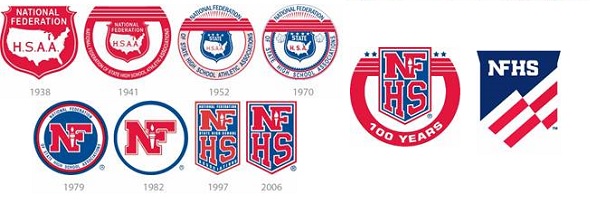
As the National Federation of State High School Associations (NFHS) heads into the next 100 years of leading high school sports and other activity programs nationwide, it will be doing so with a new logo.
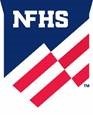 The new logo was unveiled to the membership earlier this month at the close of the NFHS Centennial Celebration. The NFHS and its 51-member state high school associations celebrated the organization’s accomplishments at the 100th Annual Meeting at the JW Marriott in downtown Indianapolis.
The organization will continue to be branded as the NFHS in the new logo, and the N and F are connected as has been the case since 1979. However, the entire acronym is together on one line as opposed to the previous logo with the NF and HS on separate lines. While red and blue will continue to be the predominant colors, the new logo mixes white with red and blue to suggest a flag waving in the wind. The direction of the flag is pointing upward to symbolize forward-thinking and advancement.
The new design maintains a resemblance to the shield that has been a part of the NFHS logo since 1997. However, the logo is flared at the top, and the bottom of the logo does not have definitive borders, which suggests the organization has moved past its first 100 years and is expanding its reach as the national leadership organization for high school sports and performing arts programs in the United States.
While the organization’s logo from 1952 had four stars to signify the four charter members of the NFHS, the four stripes within the new logo represent the four homes of the organization during the first 100 years.
“We wanted to retain NFHS as the central component of the new logo because the organization’s national presence has continued to spiral upward in the 22 years since the NFHS acronym was adopted,” said Dr. Karissa Niehoff, NFHS executive director. “However, as we celebrated our first 100 years, we felt it was important to establish a new look that would signify our ever-increasing role as the national leader in high school sports and performing arts programs.”
Counting the Centennial logo that was used during the 2018-19 school year, the new logo will be 10th used by the organization since the first one was adopted in the 1930s. The new logo was created by Section 127, an Indianapolis-based design company.
The NFHS was started in 1920 and had offices in Chicago until 1971, when it moved to Elgin, Illinois. The organization moved to Kansas City, Missouri, in 1979, and then in 2000 to Indianapolis, where it remains today.
The Michigan High School Athletic Association is a member of the NFHS, and Michigan is one of the four founding states of the national association.

MHSAA.tv Broadcast Schedule Includes Nearly 200 Week 1 Varsity Football Games
By
Geoff Kimmerly
MHSAA.com senior editor
August 22, 2022
Nearly 200 varsity football games scheduled for this opening weekend of the Michigan high school season will be broadcast on MHSAA.tv and the NFHS Network or by Michigan High School Athletic Association partner Bally Sports Detroit – including all 16 games being played at the Xenith Prep Kickoff Classic, Battle at the Big House and Vehicle City Gridiron Classic.
Varsity football teams may kick off the season Thursday (Aug. 25), and BSD and NFHS Network will have broadcasts that first day from all three showcase events. Below are the schedules for all three:
Xenith Prep Kickoff Classic – Wayne State University – Tom Adams Field
Aug. 25, 4 p.m.: Bloomfield Hills Brother Rice vs. Macomb Dakota – Bally Sports Detroit
Aug. 25, 7 p.m.: Sterling Heights Stevenson vs. West Bloomfield – Bally Sports Detroit
Aug. 26, 4 p.m.: Allen Park vs. Wyandotte – NFHS Network
Aug. 26, 7 p.m.: Belleville vs. Novi – NFHS Network
Aug. 27, 1 p.m.: Dexter vs. Grosse Pointe South – NFHS Network
Aug. 27, 4 p.m.: Cedar Springs vs. River Rouge – NFHS Network
Battle at the Big House – University of Michigan – Michigan Stadium
Aug. 25, Noon: Brighton vs. Dearborn Fordson – NFHS Network
Aug. 25, 3:30 p.m.: DeWitt vs. Haslett – NFHS Network
Aug. 25, 7 p.m.: Clarkston vs. Davison – NFHS Network
Aug. 26, Noon: Livonia Churchill vs. Plymouth – NFHS Network
Aug. 26, 3:30 p.m.: Port Huron vs. Grand Rapids Catholic Central – NFHS Network
Aug. 26, 7 p.m.: Lapeer vs. Ann Arbor Huron – NFHS Network
Vehicle City Gridiron Classic – Kettering University – Atwood Stadium
Aug. 25, 4 p.m.: Grand Blanc vs. Grandville – NFHS Network
Aug. 25, 7:30 p.m.: Flint Kearsley vs. Flint Carman-Ainsworth – NFHS Network
Aug. 26, 4 p.m.: Flint Southwestern vs. Swartz Creek – NFHS Network
Aug. 26, 7:30 p.m.: Flint Beecher vs. Saginaw Nouvel – NFHS Network
The other nearly-200 varsity football games will be viewable on the NFHS Network via the MHSAA’s School Broadcast Program. Several girls volleyball and boys soccer matches also are on this week’s schedule; see the link’s below for each sport:
Football | Girls Volleyball | Boys Soccer
NFHS Network subscriptions begin at $11.99 per month (or $79.99 annually). Subscribers have access to all live video across the country. School Broadcast Program participants benefit as a portion of every subscription sold by a school goes to benefit its program.
More than 550 MHSAA member schools are participants in the School Broadcast Program, now in its 14th year, producing games using traditional hands-on student crews or via Pixellot cameras installed at stadiums and gymnasiums across the state. A complete list of participating schools can be found on the School Broadcast Program page of the MHSAA Website.
Additionally this season, Bally Sports Detroit will be broadcasting a game every week of the regular season followed on Friday nights by the hour-long highlight show “Football Fridays Overtimes powered by State Champs” – see the schedule below, with games for Weeks 6-9 to be released at a later date.
Aug. 25, 4 p.m.: Bloomfield Hills Brother Rice vs. Macomb Dakota at Wayne State
Aug. 25, 7 p.m.: Sterling Heights Stevenson vs. West Bloomfield at Wayne State
Sept. 2, 7 p.m.: Birmingham Groves at Oxford
Sept. 9, 7:30 p.m.: Clarkston at Rochester Adams
Sept. 16, 7:30 p.m.: Detroit Martin Luther King at Detroit Cass Tech
Sept. 23, 7:30 p.m.: Detroit Catholic Central at Bloomfield Hills Brother Rice