

Photos: Top Shooters & Award Winners
March 26, 2019
By Geoff Kimmerly
Second Half editor
The MHSAA Girls & Boys Basketball Finals the last two weekends showed off many of the best teams and players who took the courts across Michigan this winter.
The championships also provided an opportunity to celebrate a few more accomplishments with the Basketball Coaches Association of Michigan “Top Shooters Challenge” contests and MHSAA recognition for leaders past, present and future.
Below are photos from a number of events that took place during quarter breaks and halftimes at Van Noord Arena this past weekend and the Breslin Center two weeks ago.
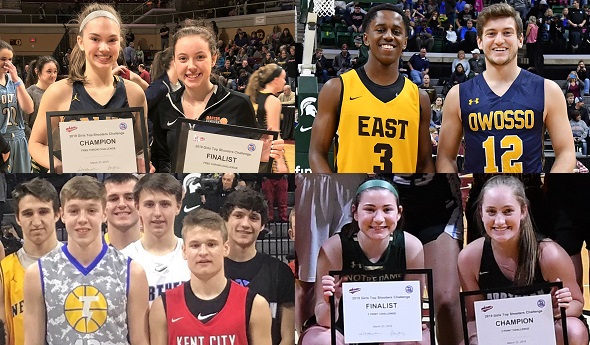
Top Shooters: This season’s BCAM top shooters contests again recognized the sharpest from the free-throw line and 3-point arc. This past weekend at Calvin College, Grand Rapids Forest Hills Northern’s Madi Stevenson won the 3-point contest with Pontiac Notre Dame Prep’s Sarah Stuart runner-up, while Saline’s Ella Stemmer won the free throw contest and Manton’s Abby Brown was second.
At Breslin, Mio’s Drew Hess won the 3-point challenge with Kent City’s Eli Carlson second. Zeeland East’s Clayton Dykhouse and Owosso’s Carson Bornefeld tied for the free throw championship.
(See photo above, clockwise from left: Girls free throw finalists, boys free throw finalists, girls 3-point finalists and boys 3-point finalists.)
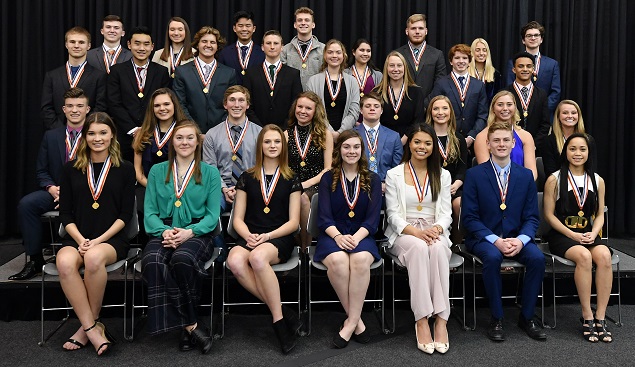
30th Scholar-Athlete Awards: Farm Bureau and the MHSAA presented 31 honorees with Scholar-Athlete Awards during Boys Finals weekend (one honoree was unable to attend). This year’s selections were honored at a banquet and then on the floor during halftime of the Division 3 Final.


Miss Basketball & Mr. Basketball: Detroit Edison’s Rickea Jackson was recognized on-court as the Miss Basketball Award winner during Saturday’s Division 3 game before leading the Pioneers that evening to their third straight MHSAA title. Mr. Basketball Award honoree Romeo Weems accepted the trophy at Breslin as this year’s top senior on the boys side.
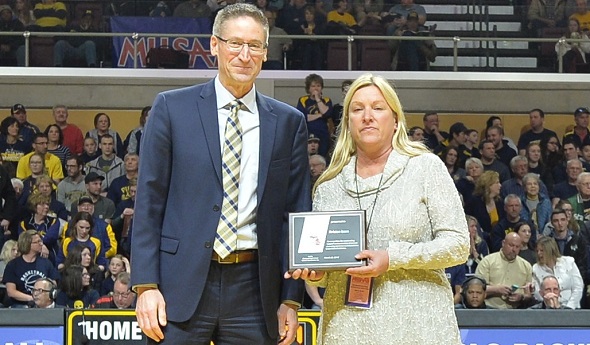
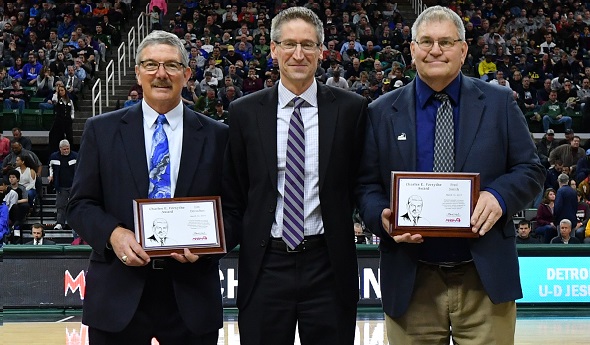
WISL & Forsythe Awards: Adrian Madison athletic director Kris Isom was honored Saturday as this year’s recipient of the MHSAA Women In Sports Leadership Award. The week prior, retired Negaunee and Brimley superintendent Jim Derocher and retired Buchanan, Benton Harbor, Comstock and St. Joseph Lake Michigan Catholic athletic director Fred Smith accepted Charles E. Forsythe Awards. All three were presented by Grand Haven Area Public Schools assistant superintendent Scott Grimes, who serves as president of the MHSAA’s Representative Council.
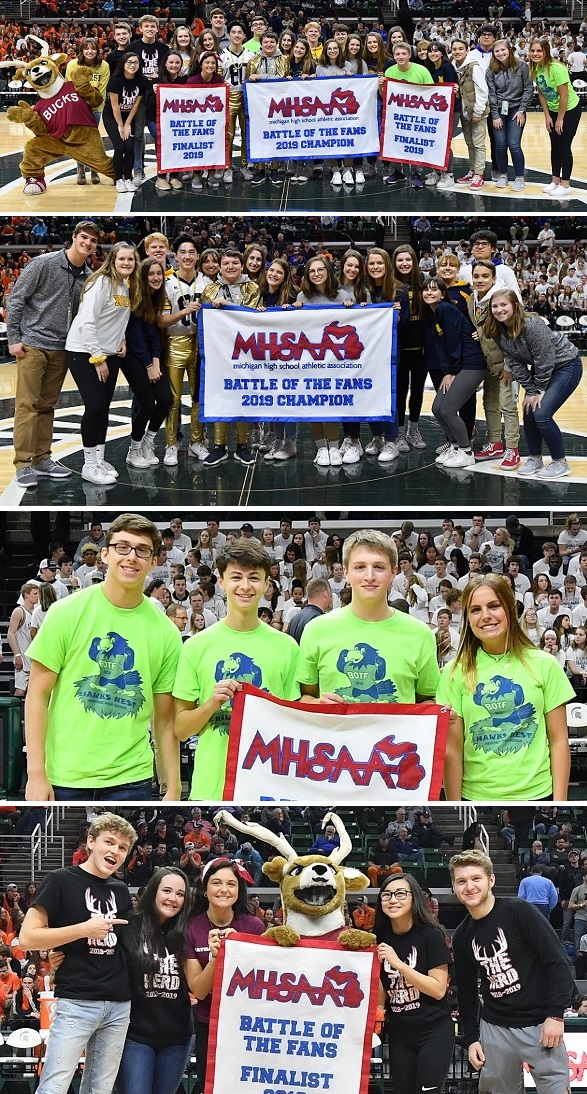
Battle of the Fans: Representatives from all three finalists from this year’s BOTF VIII – champion North Muskegon with Saginaw Heritage and Buchanan – took to the Breslin floor during the Division 2 Semifinals to receive their banners.

Update: Attendance, Broadcast Information
March 12, 2020
By Geoff Kimmerly
Second Half editor
Postseason events sponsored by the Michigan High School Athletic Association and scheduled for March 12-14 will be conducted as scheduled. However, attendance will be restricted at all events through this weekend, with updates to be announced Monday, March 16, for the remainder of the girls and boys basketball tournaments.
The MHSAA Ice Hockey Semifinals and Finals will be played March 12-14 at USA Hockey Arena, with Lower Peninsula Boys Swimming & Diving Finals beginning Friday, March 13 and concluding March 14 at Oakland University and Holland Aquatic Center. Girls Gymnastics at Rockford High School also will be competed Friday and Saturday this weekend. Girls Basketball Regionals Finals are scheduled for tonight, March 12, across the state, as are Boys District Finals on Friday, March 13.
Based on recommendations from Gov. Gretchen Whitmer suggesting attendance limitations, no spectators will be allowed for the three Swimming & Diving Finals, both days, or Saturday’s Girls Gymnastics Individual Finals. These events have the highest number of participants of this weekend’s events.
However, for Hockey Semifinals and Finals and Gymnastics Team Finals – events with far fewer participants – a limited number of spectators will be allowed, as determined by participating schools, to include only parents, legal guardians and essential administrators. Basketball games during the next two days also will allow only limited spectators, as determined by participating schools and following these same restrictions. Each competing school will provide the entry list of parents, legal guardians and essential administrators to the host site prior to each contest.
To recap, here is a breakdown of sport-by-sport attendance stipulations and broadcast information.
Boys Swimming & Diving Finals
Rounds: Preliminaries on March 13, Finals on March 14
Attendance: No on-site spectators allowed.
Broadcast: Live streaming of prelims and Finals on MHSAA.tv.
Girls Gymnastics Finals
Rounds: Team Finals on March 13, Individual Finals on March 14
Attendance: Limited to parents, legal guardians and essential administrators on March 13. No on-site spectators allowed March 14.
Broadcast: Live streaming of Team and Individual Finals on MHSAA.tv.
Boys Ice Hockey Semifinals and Finals
Rounds: Semifinals on March 12-13, Finals on March 14
Attendance: Limited to parents, legal guardians and essential administrators.
Broadcast: Live streaming of all nine games on MHSAA.tv. Live audio on MHSAA Network.
Girls Basketball Regional Finals
Rounds: All scheduled for March 12.
Attendance: Limited to parents, legal guardians and essential administrators.
Broadcast: Live streaming of some games, with subscription, on MHSAA.tv.
Boys Basketball District Finals
Rounds: All scheduled for March 13.
Attendance: Limited to parents, legal guardians and essential administrators.
Broadcast: Live streaming of some games, with subscription, on MHSAA.tv.
Bands, cheerleaders and gatherings in parking lots or elsewhere on-site will not be allowed. Restrictions on noisemakers, etc., will continue to be upheld for those fans who will attend.
For those allowed to be present, there will be no admission charged at any of these five events. Online ticket sales have been stopped, and all tickets that have been purchased are voided and will be fully refunded.
Fans not allowed to attend will have the opportunity to watch coverage of all three of this weekend’s Finals live on MHSAA.tv. Complete streaming of all nine Hockey Semifinals and Finals is scheduled, as is streaming of both the Team and Individual Gymnastics Finals and both preliminaries and Finals for swimming & diving. MHSAA.tv also will carry a number of girls and boys basketball games this weekend as part of its usual subscription coverage by members of the School Broadcast Program.
The streaming of all three divisions of the MHSAA Swimming & Diving Finals and both Team and Individual Gymnastics Finals will be provided FREE OF CHARGE. More details about access to these free feeds will be provided in the next update this afternoon. Also, free live audio of the Hockey Semifinals and Finals will be available on the MHSAA Network.
This remains a fluid situation, and another update will be released today, March 12, at 2 p.m. Updates will be posted to the MHSAA Website.
The MHSAA is a private, not-for-profit corporation of voluntary membership by more than 1,500 public and private senior high schools and junior high/middle schools which exists to develop common rules for athletic eligibility and competition. No government funds or tax dollars support the MHSAA, which was the first such association nationally to not accept membership dues or tournament entry fees from schools. Member schools which enforce these rules are permitted to participate in MHSAA tournaments, which attract more than 1.4 million spectators each year.